
Most "one-click" security tests are little more than surface-level marketing tools that fail to identify the deep-seated vulnerabilities hackers actually exploit. It's natural to feel anxious about the safety of your domain, especially when complex security reports leave you more confused than protected. You want to ensure your site is secure without accidentally crossing legal boundaries or using tools that lack professional rigor. How can you verify your defenses without the high cost of a manual audit? We believe digital safety requires a disciplined, transparent approach to risk management rather than a simple "scan" button.
This guide shows you how to perform a professional-grade, fully authorized free website security scan using the exact same technology stack employed by industry experts. By leveraging a comprehensive six-scanner engine that includes Nmap and OpenVAS, you can identify critical gaps aligned with the OWASP Top 10 2025 and PCI DSS 4.0 standards. You'll learn how to move beyond basic checklists to generate a prioritized risk audit, secure formal proof of authorization for compliance, and follow clear steps to remediate vulnerabilities. This process ensures you gain technical depth and ethical clarity while focusing on your long-term security posture.
Key Takeaways
- Learn how a professional free website security scan utilizes a stack of six industry-standard engines like Nmap and OpenVAS to find hidden network vulnerabilities.
- Understand the critical legal distinction between authorized audits and unauthorized scanning to ensure your domain remains compliant through signed records.
- Gain the ability to interpret complex security reports by mastering the CVE scoring system to prioritize critical risks over informational findings.
- Discover how to turn raw technical data into actionable remediation steps that actually harden your website against modern exploits.
- Transition from one-time checks to a disciplined security routine by implementing automated scanning schedules for long-term protection.
What is a Vulnerability Scan and Why Does Your Website Need One?
A vulnerability scanner is an automated software tool that systematically inspects your website's infrastructure for known security flaws. It functions as a technical health check, probing your servers, ports, and applications for misconfigurations or outdated software versions. It's vital to distinguish between a "scan" and a "hack." A professional scan is an authorized, transparent process conducted with the owner's permission to improve safety. A hack is an unauthorized intrusion intended to cause harm or steal data. By choosing to scan, you're taking a disciplined step toward protecting your digital assets rather than leaving their safety to chance.
Why is this necessary now? The 2026 threat landscape has made "security through obscurity" a dangerous myth. Every internet-facing asset is a target for automated scripts that never sleep. These bots perform constant port and service discovery, looking for any entry point that hasn't been secured. By performing a free website security scan, you gain a prioritized list of risks. This allows you to meet modern compliance requirements, such as those outlined in PCI DSS 4.0, while providing your developers with clear, actionable guidance on what to fix first. It transforms security from a vague concern into a manageable, documented process.
The Consequences of Unpatched Vulnerabilities
Unpatched vulnerabilities are the primary cause of most successful digital intrusions. The cost of a breach extends beyond the immediate loss of funds to include long-term reputational damage and legal liability. Automated bots are the main drivers of this risk; they crawl the web to find targets that haven't updated their defenses or secured their configurations. The window of exposure is the critical time between a CVE release and the successful application of a patch. Minimizing this window is essential for maintaining a secure environment and preventing opportunistic attackers from gaining a foothold in your network.
Why a Free Website Security Scan is the First Step
A free website security scan is the most logical starting point for any organization. It establishes a baseline security posture, allowing you to see your domain as an attacker would. This data is invaluable for justifying security investments to stakeholders, as it replaces vague fears with documented facts. In a modern DevSecOps workflow, scanning is integrated early to catch flaws before they reach production. Using a professional audit ensures your security strategy is grounded in technical rigor rather than guesswork. It provides a clear entry point for serious owners who want to move beyond superficial checks and implement a robust defense strategy.
Inside the ReadySECURE Stack: 6 Engines Protecting Your Domain
Our security philosophy centers on technical transparency and the use of industry-standard tools. We don't rely on proprietary "black box" scanners that hide their methodology. Instead, we utilize a stack of six proven, open-source engines that are trusted by professional penetration testers and security researchers worldwide. This approach ensures that every free website security scan we perform is grounded in verifiable data and rigorous testing protocols. By combining multiple specialized engines, we provide a depth of coverage that single-tool solutions simply cannot match.
This multi-layered strategy mirrors the methodology used by the federal Site Scanning Program, which employs automated tools to maintain the health and security of public-facing digital infrastructure. By using a similar framework, we help you identify vulnerabilities across your network, application, and encryption layers simultaneously. This disciplined process replaces guesswork with factual confidence, allowing you to prioritize remediation based on actual risk rather than superficial checklists.
Network Discovery with Nmap and OpenVAS
Every professional audit begins with a reconnaissance phase. We use Nmap to perform detailed port scanning and service discovery on your host. This tool doesn't just check if a port is open; it fingerprints the services running behind those ports to identify specific software versions. This is a critical step for organizations managing hybrid cloud environments, where forgotten or misconfigured internet-facing assets often serve as the primary entry point for attackers. Once the attack surface is mapped, we deploy OpenVAS to perform comprehensive network vulnerability detection. OpenVAS scans against a massive database of known security flaws, identifying weaknesses in your server configuration and outdated components before they can be exploited.
Web Application Testing with ZAP and Nuclei
Securing the application layer requires a more nuanced approach than network scanning alone. We integrate OWASP ZAP to perform both passive and active scanning. Passive scanning allows us to observe headers and traffic patterns without disrupting your service, while active scanning probes for logic flaws like SQL injection and cross-site scripting. To ensure high-speed, targeted detection, we supplement this with Nuclei. Nuclei uses a template-based system to scan for specific, high-impact vulnerabilities with extreme precision. These tools work in tandem to automatically identify risks aligned with the OWASP Top 10 2025, providing your team with the data they need to harden your web applications. If you're ready to see how these engines analyze your domain, you can initiate your authorized audit here.
Finally, we utilize TestSSL for automated certificate and encryption inspection. This engine checks your SSL/TLS configurations to ensure you aren't using deprecated ciphers or weak protocols that could lead to data interception. By examining your encryption layer with the same rigor as your network and applications, we provide a complete picture of your domain's security posture.
The Professional Difference: Authorized vs. Unauthorized Scanning
Professional security is built on a foundation of explicit consent. Running security tools against a domain you don't own isn't just unethical; it's often illegal under various computer misuse laws. Many tools available online allow users to point and click at any target, but this "unauthorized scanning" is a prohibited category in the professional cybersecurity industry. We believe that every free website security scan should be conducted with the same legal rigor as a paid engagement. This is why we attach a signed authorization record to every report we generate. It provides technical proof that the audit was legitimate and requested by the rightful owner, protecting all parties involved in the process.
Why is this distinction so critical? Without formal authorization, security activity can be indistinguishable from a malicious attempt to breach a system. This can trigger automated defense mechanisms, lead to IP blacklisting, or result in legal inquiries from hosting providers. By establishing a clear, documented mandate before the scan begins, we ensure that the discovery process remains a disciplined exercise in risk management rather than a legal liability. It's a commitment to transparency that defines our role as a trusted security partner.
The Authorization Process Explained
How do we ensure every scan is legitimate? Before any engine in our stack begins its work, we require written authorization for the domain or API being tested. This step serves as a digital contract. It protects the scanner by providing a legal defense against claims of malicious intent and protects you by ensuring that network activity is recognized and approved by your internal teams. We maintain a strict ethical compass regarding digital boundaries. Our process ensures that our tools are used exclusively to harden defenses and improve your security posture.
Comparing Authorized Audits to Passive Ratings
You may have encountered platforms that offer a security "rating" or "score" based on public data scraping. While these provide a high-level view, they are often less accurate than a deep authorized scan. Passive ratings rely on unauthenticated, outside-in views that can easily miss critical internal misconfigurations or logic flaws. In contrast, an authorized audit allows for a more thorough investigation of your infrastructure. Consider these key differences:
- Authorized scans access technical areas that passive scrapers cannot reach.
- Authenticated tests provide significantly fewer false positives than unauthenticated views.
- Signed records fulfill strict compliance requirements for standards like PCI DSS 4.0.
While a passive rating simply gives you a score, ReadySECURE provides a prioritized list of actionable remediation steps based on the actual vulnerabilities found during the audit. Choosing a free website security scan that includes formal authorization is a disciplined choice. It demonstrates to stakeholders and regulators that you take your security obligations seriously and value technical depth over superficial metrics.
How to Interpret Your External Vulnerability Scan Report
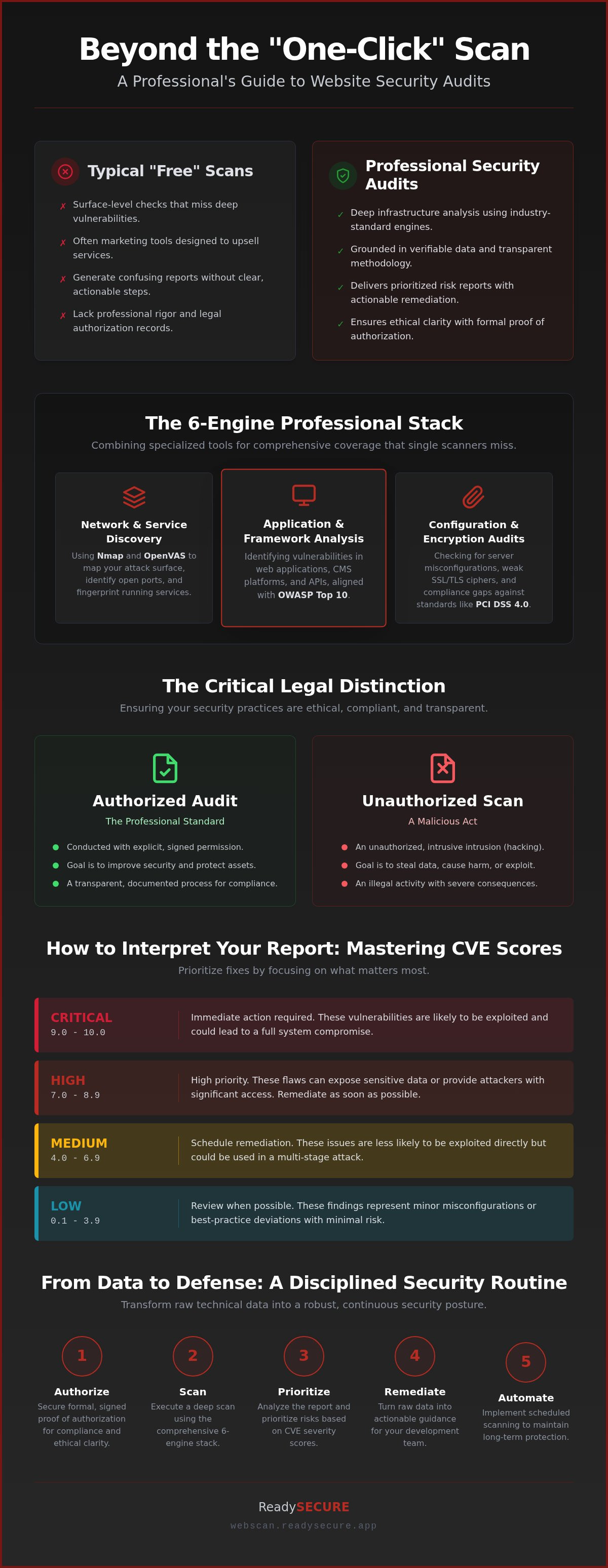
Receiving the results of a free website security scan can feel overwhelming if the report isn't structured for technical clarity. Many tools in the industry gatekeep these findings or hide them behind complex credit card trials. We prioritize immediate transparency. A professional report is more than a list of flaws; it's a structured audit designed to guide your technical decision-making. By utilizing the CVE (Common Vulnerabilities and Exposures) system, we provide a standardized way to understand each risk. This ensures your security team and developers speak the same language as the global cybersecurity community.
The CVSS (Common Vulnerability Scoring System) provides a numerical score reflecting the risk level of each finding. It's essential to distinguish between "Critical" risks and "Informational" findings. Informational items often highlight server headers or minor configuration details that don't represent an immediate threat but reflect best practices. In contrast, Critical findings indicate vulnerabilities that are actively being exploited or are easily reachable by automated scripts. ReadySECURE filters and ranks findings based on actual exploitability to ensure your team focuses on critical threats without being overwhelmed by low-impact noise.
Decoding CVE Severity and Impact
A "High" severity rating doesn't always mandate an immediate emergency response. The actual risk depends heavily on the context of the vulnerability, such as whether it exists on a public-facing API or an isolated internal service. We provide the technical depth needed to understand these nuances. ReadySECURE prioritizes issues to prevent alert fatigue by focusing on the vulnerabilities that present the highest potential impact to your specific environment. You can access your comprehensive security report immediately after your audit is complete to begin this analysis.
From Report to Remediation
Once you have your data, the focus shifts to implementation. Sharing these reports with development teams should be a collaborative process rather than a source of friction. Clear remediation guidance helps developers understand the logic behind a fix, which reduces the time spent on manual research. After a patch is applied, re-scanning is mandatory to verify that the security gap is closed. These reports also serve as tangible proof of your security posture when you need to prove compliance to partners or customers who require evidence of your commitment to digital safety.
Historical data and trend analysis are vital for long-term security. By comparing reports over time, you can identify recurring configuration errors or systemic weaknesses in your deployment pipeline. This longitudinal view transforms a one-off audit into a strategic security program that evolves with your infrastructure.
Establishing Continuous Security with ReadySECURE
A single audit provides a technical snapshot of your defenses at a specific moment in time. While a free website security scan is an essential starting point, it doesn't account for the new vulnerabilities discovered every day. Security is a continuous process rather than a one-time event. How can you maintain this level of technical rigor as your infrastructure grows? The solution lies in transitioning from manual, periodic checks to a disciplined, scheduled security routine that monitors your assets consistently. This proactive approach ensures that your defenses evolve at the same pace as the threats targeting them.
Maintaining consistency across distributed hosts and APIs is one of the greatest challenges in modern cybersecurity. It's common for subdomains or staging environments to fall out of sync with your primary security policies. Continuous monitoring identifies these gaps automatically. It provides a reliable safety net, ensuring that every internet-facing asset remains within your authorized security boundary. By establishing a regular cadence for your audits, you replace reactive firefighting with a structured, predictable risk management strategy.
The Value of Scheduled Network Security Scans
Why is frequency such a critical factor in digital safety? New exploits are documented daily, and scanning templates for engines like Nuclei are updated constantly to reflect these emerging threats. If you only scan once a quarter, you might remain exposed to a critical vulnerability for months without knowing it. Automated scheduling ensures that your domain is tested as soon as new detection logic becomes available. For small IT teams, this automation is a force multiplier. It removes the burden of manual testing while providing constant visibility into your security posture. By implementing Automated Vulnerability Scanning, you ensure that your network discovery and application testing remain current without requiring constant manual intervention.
Scaling Your Security Posture
As your organization expands, your attack surface grows to include complex APIs and hybrid cloud environments. How do you manage this complexity without losing technical depth? Scaling your security involves moving from monitoring a single target to enterprise-wide oversight. This is where vulnerability trend analysis becomes indispensable. By tracking your findings over time, you can measure the effectiveness of your remediation efforts and identify systemic issues in your development lifecycle. This data-driven approach allows you to prove to stakeholders that your security posture is improving through tangible evidence. Are you ready to take the first step toward comprehensive protection? Get started with your first free authorized scan on ReadySECURE today and begin building a more resilient digital environment.
Strengthening Your Domain with Professional Security Audits
Your website's safety shouldn't be left to chance or superficial tools that offer little more than a generic score. By choosing a professional approach, you ensure your domain is protected by a stack of six industry-standard engines like Nmap, OpenVAS, and ZAP. This methodology provides the technical depth needed to identify real risks while maintaining strict ethical boundaries through signed authorization records. Transitioning to a disciplined security routine allows you to stay ahead of automated threats and emerging vulnerabilities. It's about building a resilient environment that grows alongside your organization.
You can start this process today without any financial commitment. Our free website security scan requires no credit card and provides the same technical rigor used by industry experts. Every report includes a signed record to prove authorization for compliance and transparency. Run Your First Authorized Free Scan Now to receive a prioritized audit of your domain's vulnerabilities. Taking this first step is the most effective way to replace uncertainty with factual confidence. Your long-term digital safety depends on the proactive measures you implement today.
Frequently Asked Questions
Is a free website security scan safe for my live site?
A professional scan is safe because it utilizes non-invasive protocols to identify vulnerabilities without interrupting your services. Our engines, such as ZAP and Nmap, perform a mix of passive and active probing that mimics attacker behavior without executing destructive payloads. This ensures your site remains operational while we map its attack surface. It's best practice to perform audits during low-traffic periods to maintain peak performance for your users.
Can I scan a domain that I do not own?
You cannot scan a domain that you don't own or have explicit permission to audit. Running security tools against unauthorized targets is a violation of digital boundaries and can carry legal consequences. ReadySECURE maintains a strict ethical compass and requires written authorization before any scan begins. This commitment to legitimacy protects both the platform and the user, ensuring that all security activity is documented and legal.
What is the difference between a vulnerability scan and a penetration test?
A vulnerability scan is an automated process that identifies known flaws using specialized software engines. It is designed for speed, scale, and consistency across many targets. In contrast, a penetration test is a manual engagement where a human expert attempts to exploit those flaws to understand their impact. While we provide a comprehensive free website security scan using six industry-standard engines, we don't offer manual penetration testing.
How often should I scan my website for vulnerabilities?
You should scan your website at least once a month or whenever you deploy significant code changes. The threat landscape evolves rapidly, with new CVEs released daily and scanning templates updated constantly. Organizations with high-traffic sites or sensitive data often move toward continuous monitoring to catch risks in real time. Regular audits help you identify configuration drift and ensure your security posture remains resilient against the latest scripts.
Does ReadySECURE provide a report after the free scan?
Yes, every scan concludes with a detailed, prioritized report that you can access immediately. This report breaks down discovered vulnerabilities by severity, providing your team with clear remediation guidance and technical evidence. Unlike some tools that gatekeep findings, we provide a transparent view of your security posture. Each result also includes a signed authorization record, which serves as formal documentation that the audit was requested by the owner.
What scanning engines does ReadySECURE use?
ReadySECURE utilizes a stack of six industry-standard engines to provide a multi-layered audit of your domain. Our stack includes Nmap for port discovery, OpenVAS for network vulnerabilities, and OWASP ZAP for web application flaws. We also integrate TestSSL for encryption inspection and Nuclei for high-speed, template-based detection. This combination ensures that your free website security scan covers the network, application, and encryption layers with professional-grade technical rigor.
How do I prove to my customers that I have scanned my website?
You can prove your commitment to security by sharing the summary of your audit report and the attached authorization record. These documents provide technical evidence that you're proactively monitoring your attack surface using recognized tools like OpenVAS and ZAP. Providing customers with proof of a recent, authorized scan demonstrates transparency and builds trust. It shows that you treat digital safety as a disciplined priority rather than a vague concern.
What happens if the scan finds a critical vulnerability?
If a critical vulnerability is identified, your report will immediately flag it and provide specific remediation guidance. These findings should be addressed by your development or IT team as a high priority to prevent potential exploitation. While we provide the technical data and steps required to close the gap, we don't offer managed remediation services. Re-scanning your site after applying a patch is essential to verify that the vulnerability is resolved.