
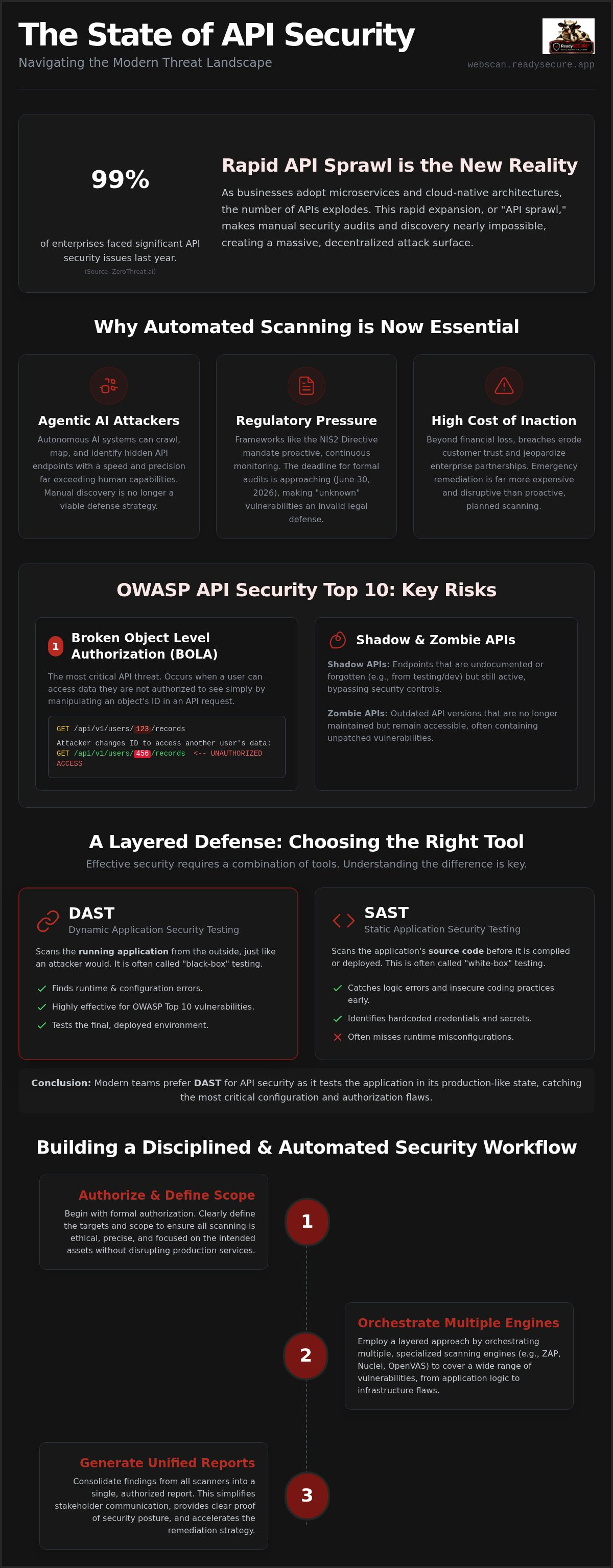
Did you know that 99% of enterprises encountered significant API security issues in the last year? This data from ZeroThreat.ai reflects a reality where rapid API sprawl makes manual audits nearly impossible. You're likely dealing with high false-positive rates that waste engineering time and make it difficult to provide clear reports to stakeholders. Finding the right api security tools is no longer optional; it's a requirement for maintaining a professional security posture in an increasingly complex threat environment.
How can you move from reactive patching to a disciplined, automated defense? This article provides a curated list of reliable tools designed to identify vulnerabilities and ensure compliance with the 2023 OWASP API Security Top 10. We will compare industry-standard engines, including ZAP, Nuclei, and OpenVAS, to help you understand the functional differences between various scanner types. You'll gain a clear path to integrating automated scanning into your pipeline. This approach allows you to prove your security posture to stakeholders with factual confidence and technical rigor.
Key Takeaways
- Understand how the rise of Agentic AI and rapid API sprawl has shifted the threat landscape, making automated discovery a necessity for modern SaaS organizations.
- Learn the functional differences between DAST and SAST to select the most effective api security tools for your specific development pipeline and compliance requirements.
- Compare industry-standard engines like OWASP ZAP and Nuclei to determine which scanners provide the technical rigor and speed required for your environment.
- Discover how to build a disciplined security workflow that prioritizes ethical scanning through formal authorization and precise scope definition.
- Explore how orchestrating multiple scanning engines into a single, authorized report can simplify stakeholder reporting and accelerate your remediation strategy.
The Rising Stakes of API Security in 2026
Why have APIs become the primary attack surface for modern SaaS organizations? The shift toward microservices and cloud-native architectures means that almost every business function is now exposed through an endpoint. This connectivity is essential for innovation, but it creates a massive, decentralized target. Attackers no longer need to find a way through a hardened perimeter; they only need to find one poorly secured API call.
The emergence of Agentic AI has accelerated this trend. These autonomous systems can crawl and map your entire infrastructure with technical precision, identifying hidden endpoints much faster than a human operator could. Relying on manual discovery is no longer a viable strategy. Using automated api security tools is the only way to match the speed and scale of these modern threats. It's a disciplined necessity for any organization that values digital safety.
Regulatory pressure has also reached a tipping point. With the full implementation of the NIS2 Directive, many organizations face their first formal compliance audits by June 30, 2026. Legal frameworks now emphasize proactive monitoring rather than reactive patching. Claiming that a vulnerability was unknown is no longer a valid legal defense. A professional security posture requires a move away from annual "snapshot" audits toward continuous, automated scanning.
Common API Vulnerabilities in the Modern Landscape
Broken Object Level Authorization (BOLA) remains the most critical threat according to the 2023 OWASP API Security Top 10. This flaw allows unauthorized users to access sensitive data by simply manipulating resource IDs in a request. Modern environments are also plagued by shadow APIs. Shadow APIs are undocumented endpoints that bypass security controls, often left behind after testing or rapid feature deployments. Without proper Web API security protocols, these endpoints remain invisible to defenders but highly visible to attackers.
The Cost of Inaction: Beyond the Data Breach
The fallout from an API breach extends far beyond immediate financial loss. It erodes customer trust and can permanently damage your ability to secure enterprise partnerships. Large-scale clients now demand proof of technical rigor before entering into service agreements. There's also the hidden cost of emergency remediation. Fixing a flaw during an active incident is significantly more expensive and disruptive than addressing it through planned, automated api security tools. To evaluate your current readiness, you can review The Essential REST API Security Audit Checklist for 2026.
Essential Categories of API Security Tools
Effective protection requires a layered approach. You can't rely on a single utility to find every flaw. Instead, professional teams categorize their api security tools based on when and how they inspect the target. These categories include static analysis for code, dynamic analysis for running services, network scanning for infrastructure, and encryption audits for data in transit.
DAST vs. SAST: Which Does Your API Need?
How do you decide between scanning your code or your running application? Static Application Security Testing (SAST) checks your source code before it's deployed. It's excellent for catching logic errors and hardcoded credentials. However, it often fails to identify issues that only appear during execution, such as misconfigured servers or broken authentication.
Dynamic Application Security Testing (DAST) scans the running API. It's the preferred choice for modern teams because it interacts with endpoints just as an attacker would. DAST is particularly effective at identifying risks listed in the OWASP API Security Top 10, such as improper authorization or injection flaws. Testing APIs in a production-like environment ensures you catch configuration risks that a simple code review would miss.
The Role of Specialized Scanners
Standard scanners sometimes miss the nuances of modern protocols. Do you use GraphQL or gRPC? Specialized api security tools provide protocol-specific testing to handle these complex structures. These tools often utilize template-based scanning to detect a specific CVE. A CVE is a publicly disclosed cybersecurity vulnerability with a specific identification number.
Beyond application logic, infrastructure security is paramount. Network scanners like Nmap identify exposed endpoints and misconfigured ports that shouldn't be public. SSL/TLS inspectors, such as TestSSL, ensure that your encrypted data remains private by checking for weak ciphers or expired certificates. If you're ready to see how these categories work together, you can start a free vulnerability scan to audit your external endpoints. This disciplined approach ensures that no layer of your API architecture is left exposed.
Top Industry-Standard API Security Tools for 2026
Choosing the right api security tools isn't about finding the most expensive platform. It's about selecting the right engines for the job. While many vendors hide their logic behind proprietary shields, the security community largely relies on a core set of open-source engines. These tools are the foundation of professional vulnerability management because they prioritize depth and technical accuracy over marketing claims. They provide the technical rigor required to identify vulnerabilities before they are exploited by malicious actors.
Why Open-Source Engines Dominate the Market
What gives open-source engines their edge? Transparency is the primary factor. When you use an engine like ZAP or Nuclei, you can inspect the exact logic used to detect a flaw. This clarity is essential for verifying results and reducing the false-positive rates that often plague generic scanners. Also, these engines receive rapid updates from a global network of researchers. As soon as the OWASP API Security Project identifies a new threat vector, the community develops a corresponding detection template. This collective speed allows you to customize your scanning logic to match the unique architecture of your APIs.
Comparing the Top 4 Scanners
How do these engines differ in practice? You must understand their specific strengths to build a comprehensive defense. Each tool addresses a different layer of the attack surface. A disciplined approach uses a combination of these scanners to ensure no vulnerability goes unnoticed.
- OWASP ZAP: This is the gold standard for application-level security. It performs deep crawling and fuzzing to identify complex flaws like broken authorization or injection. It's versatile enough for both active and passive scanning of REST and GraphQL endpoints.
- Nuclei: If your priority is speed and specific CVE detection, Nuclei is the choice. It uses YAML-based templates to identify known misconfigurations across modern stacks. It's designed to catch the latest vulnerabilities as soon as they're disclosed.
- OpenVAS: Security doesn't stop at the application layer. OpenVAS provides comprehensive network-level scanning. It identifies vulnerabilities in the underlying server operating system and supporting services that host your APIs.
- TestSSL: Every API depends on secure transport. TestSSL audits your endpoint encryption and certificates. It verifies cipher strength and ensures that your SSL/TLS configuration hasn't drifted into an insecure state.
By orchestrating these specific engines, you create a disciplined security posture. You aren't just checking a compliance box; you're conducting a rigorous technical assessment of your entire infrastructure. This methodical approach is the most reliable way to maintain a secure and compliant digital environment.
Building an Automated API Security Workflow
How do you transform a collection of scanners into a functional defense system? Simply having access to api security tools isn't enough. You need a disciplined, repeatable process that ensures coverage without creating legal risk or developer fatigue. A professional workflow follows a logical sequence from ethical preparation to actionable remediation. This methodology ensures that your security efforts are both effective and sustainable.
The Legal Requirement: Why Authorization Matters
Is your scanning activity authorized? This is the most critical question in any security program. The distinction between authorized scanning and unauthorized "hacking" rests entirely on written consent. Professional api security tools require domain ownership verification to ensure you aren't targeting infrastructure you don't own. You should maintain a signed record of authorization for every scan. This document serves as a vital artifact for compliance audits and establishes an ethical boundary for your security operations. Without this record, your security testing lacks the legitimacy required for enterprise-grade protection.
Once legal requirements are met, you must define your scanning scope. This involves identifying specific endpoints, hosts, and ports to avoid scanning irrelevant or fragile legacy systems. You should then schedule these scans to run on a recurring basis. Monthly tests are insufficient for modern development cycles; weekly or daily scans are the industry standard for maintaining a secure posture. This regularity ensures that new deployments don't introduce unmonitored risks into your environment.
From Detection to Remediation
What happens when the scan finishes? A 500-page "data dump" of every possible finding is useless for a busy engineering team. It leads to alert fatigue and ignored vulnerabilities. Instead, you must prioritize results by severity: Critical, High, Medium, and Low. Use CVSS scores to decide what to fix first. This data-driven approach ensures that your team focuses on the risks that pose the greatest threat to your business rather than chasing minor configuration quirks.
The final step is integration. You should feed prioritized remediation guidance directly into developer ticket queues. This turns security findings into standard tasks rather than emergency interruptions. For a deeper look at this process, read Continuous Security Scanning: A Comprehensive Strategy. To simplify this entire process, you can configure an automated scanning workflow that handles the orchestration, authorization records, and reporting for you.
Simplifying API Security with ReadySECURE
How do you manage multiple scanning engines without increasing operational complexity? Manually running individual api security tools like ZAP, Nuclei, and OpenVAS is time-consuming and often results in fragmented data. ReadySECURE solves this by orchestrating these industry-standard engines into a single, comprehensive report. This consolidation allows you to see your entire security posture in one place, removing the need to reconcile different data formats or severity scales.
A key component of this service is the signed authorization record. As discussed previously, ethical scanning requires clear consent. ReadySECURE provides a formal record for every scan result, ensuring that your security testing is always legitimate and documented. This transparency is vital for meeting compliance requirements and proving your technical rigor to external stakeholders. It transforms a technical task into a verifiable business asset.
Continuous monitoring is the only way to keep pace with rapid development cycles. ReadySECURE allows you to move away from ad-hoc, manual tests by implementing automated scheduling. You can set scans to run on a recurring basis, ensuring that new vulnerabilities are identified as soon as they appear. The resulting report is prioritized by severity, guiding your team to the most critical fixes first. This structure prevents alert fatigue and ensures that your remediation efforts are always focused on the highest risks.
A Principled Approach to Vulnerability Scanning
Why does ReadySECURE rely on open-source engines rather than proprietary "black box" technology? We believe in technical transparency and ethical clarity. By using industry-standard api security tools, we ensure that you understand exactly how vulnerabilities are detected. There are no hidden algorithms or opaque processes. You can interpret the prioritized vulnerability report with factual confidence, knowing that every finding is backed by established security research. This disciplined approach prioritizes your long-term security over superficial marketing claims.
Next Steps for Your Security Posture
Are you ready to establish a clear path to automated API security? The most effective way to begin is by identifying the current vulnerabilities in your most critical endpoints. You can start with a ReadySECURE Free Scan to audit your public-facing hosts. As your infrastructure grows, you can scale to continuous monitoring with ReadySECURE Paid Plans. This progression ensures that your security strategy evolves alongside your business requirements. Secure your APIs with a ReadySECURE Free Scan today and take the first step toward a disciplined, automated defense.
Securing Your API Infrastructure for the Future
Maintaining a professional security posture requires a shift from reactive patching to a disciplined, automated workflow. We have explored how the right combination of api security tools, such as ZAP for deep application analysis and Nuclei for rapid vulnerability detection, creates a comprehensive defense against modern threats. By prioritizing technical rigor and ethical transparency, you ensure that your security strategy remains reliable and compliant with evolving directives.
ReadySECURE simplifies this process by orchestrating industry-standard engines into a single, prioritized report. Every assessment includes a signed authorization record to verify the legitimacy of your testing. This approach allows your engineering team to focus on remediation rather than managing complex scanning infrastructure. Are you ready to validate your current defense strategy? You can Run a Professional API Security Scan for Free to identify critical vulnerabilities today. Taking this step demonstrates a commitment to digital safety and long-term operational integrity.
Frequently Asked Questions
What are the most common vulnerabilities found by API security tools?
The most common vulnerabilities identified by api security tools include Broken Object Level Authorization (BOLA), broken user authentication, and improper asset management. These issues often allow unauthorized access to sensitive data or administrative functions. Modern scanners also frequently detect injection flaws and security misconfigurations within the underlying server infrastructure. Identifying these risks early is essential for maintaining a secure and professional digital environment.
Can API security tools be integrated into a CI/CD pipeline?
Yes, you can integrate api security tools into your CI/CD pipeline to automate testing during the development lifecycle. This integration allows you to run scans automatically whenever new code is committed or deployed to a staging environment. By identifying vulnerabilities before they reach production, your team can maintain a "shift-left" security posture. This process ensures that security remains a continuous priority rather than an occasional audit.
Is a free API security scan as effective as a paid version?
A ReadySECURE Free Scan utilizes the same industry-standard engines as our paid versions, including ZAP, Nuclei, and OpenVAS. The technical accuracy of the detection logic remains consistent across all tiers. However, paid plans provide essential operational features for enterprise environments. These include automated scheduling, historical reporting, and trend analysis. These features allow you to move from ad-hoc testing to a disciplined, continuous monitoring strategy.
What is the difference between an API scanner and a web application scanner?
An API scanner focuses on endpoints, data structures, and protocols like REST, GraphQL, or gRPC. It inspects how data is exchanged between systems rather than how it's displayed to a user. A web application scanner primarily targets the user interface and HTML elements. While some platforms offer both, specialized API scanning is necessary to identify logic flaws that exist beneath the surface of the visual interface.
Do API security tools require access to my source code?
The dynamic scanners used by ReadySECURE do not require access to your source code. These tools perform black-box testing by interacting with your running API endpoints just as an external user or attacker would. This approach is highly effective for identifying vulnerabilities that only manifest in a production environment. These include server misconfigurations, weak SSL/TLS ciphers, and authorization flaws that static code analysis might miss.
How often should I run an automated API security scan?
You should run an automated scan at least once a week or whenever you deploy code changes to your environment. In high-velocity development settings, daily scans are the industry standard for maintaining a secure posture. Regular testing ensures that new features or infrastructure updates don't introduce unmonitored risks. Consistent scanning also provides the historical data required to prove your security posture to stakeholders and auditors.
What happens if a security tool finds a critical vulnerability?
If a critical vulnerability is identified, your first step is to validate the finding using the technical details provided in the report. ReadySECURE delivers prioritized remediation guidance to help your team address the most severe risks first. You should assign the fix to your development queue immediately to minimize the window of exploitation. Professional reporting ensures that your engineers have the factual information needed to resolve the issue efficiently.
Is it legal to scan an API for vulnerabilities without authorization?
No, it's generally illegal and unethical to scan an API without the owner's explicit permission. Unauthorized scanning can be interpreted as an attempted breach or a violation of service terms. ReadySECURE requires a signed authorization record for every target domain to ensure that all security testing is legitimate. This disciplined approach protects both the security researcher and the organization by establishing clear, ethical boundaries for the assessment.


