

Did you know that more than 48,000 CVEs were published in 2025? This represents a 20% increase from the previous year, and the volume of new threats isn't slowing down as we move through 2026. It's understandable if your security team feels overwhelmed by this constant stream of disclosures. You're likely tired of sorting through low-quality false positives or struggling to provide auditors with signed proof that your perimeter scans actually occurred.
An automated cve scanning service should simplify your workflow, not add more noise to your dashboard. You deserve a strategy that moves beyond basic detection to provide actionable intelligence. This article will show you how to implement a professional, authorized vulnerability scanning strategy. You'll discover how to identify critical vulnerabilities before they can be exploited by using a disciplined, multi-tool framework. We'll explore how to transition to a "set-and-forget" monitoring system that delivers prioritized, remediable results. We'll also cover how to maintain the signed authorization records required for compliance with 2026 SEC and CISA standards.
Key Takeaways
- Understand why a multi-scanner architecture is necessary to identify both network-level and application-level vulnerabilities across your entire external perimeter.
- Learn how an automated cve scanning service delivers a prioritized list of remediable threats, reducing the time your team spends on low-quality false positives.
- Discover the distinction between the broad, continuous coverage of automated scanning and the deep, targeted nature of manual penetration testing for your 2026 security budget.
- Identify the critical requirement for signed authorization records to maintain legal compliance and satisfy rigorous cybersecurity audits.
- Follow a structured approach to inventorying your hosts and APIs to ensure no internet-facing asset remains unmonitored.
The Growing Necessity of an Automated CVE Scanning Service
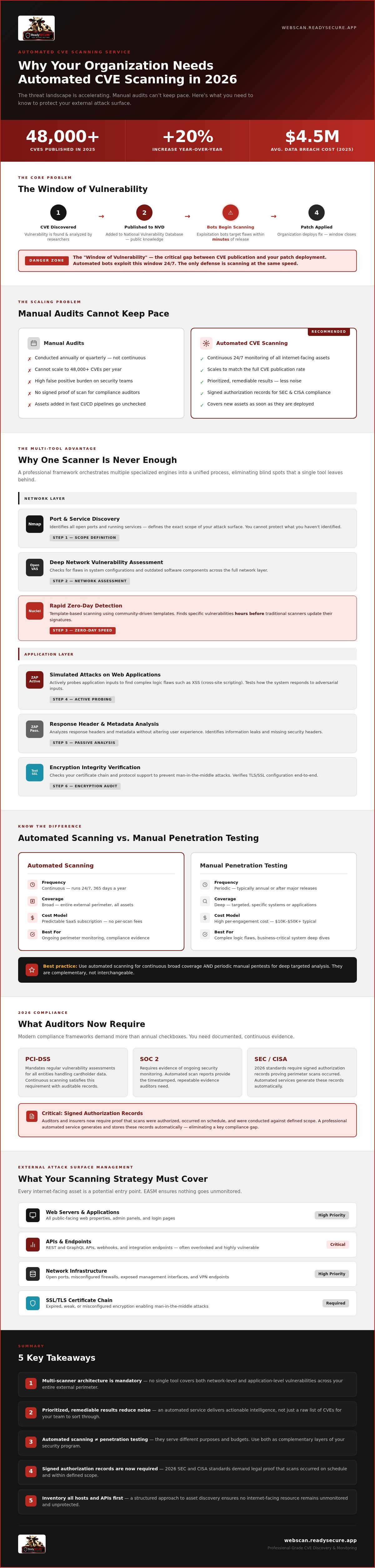
The cybersecurity landscape is shifting rapidly. To protect your organization, you must understand the Common Vulnerabilities and Exposures (CVE) system. This list provides a standardized way to identify publicly known security flaws. in 2025 alone, over 48,000 CVEs were published. This represents a 20% increase from the previous year. Relying on manual audits is no longer a viable strategy because software development cycles now move in hours rather than months. Manual testing simply cannot scale to meet the speed of modern deployment pipelines.
How can a human team keep pace with this volume? They can't. In 2026, the primary threat comes from automated exploitation bots. These programs scan the internet for specific vulnerabilities within minutes of a CVE being released. This reality has led to the rise of External Attack Surface Management (EASM). EASM is the continuous discovery and monitoring of all internet-facing assets, from APIs to web servers. An automated cve scanning service is the foundational component of this management strategy, ensuring that every public asset is accounted for and checked for known flaws.
Understanding the CVE Lifecycle
Vulnerabilities follow a specific path. They're discovered, analyzed, and then added to the National Vulnerability Database (NVD). The "Window of Vulnerability" is the critical period between the public release of a CVE and the moment you apply a patch. Hackers thrive in this gap. Because bots scan for weaknesses 24/7, your defense must operate at the same speed. Continuous monitoring is the only method to ensure you find these flaws before an attacker does. It's about closing the window before someone climbs through it.
The Cost of Reactive Security
Waiting for a breach to happen is expensive. The average cost of a data breach in 2025 reached $4.5 million. Beyond the immediate financial loss, unpatched vulnerabilities damage your reputation with partners and customers. Compliance standards like PCI-DSS and SOC2 also mandate regular vulnerability assessments. Moving from annual audits to continuous visibility isn't just a best practice; it's a requirement for modern digital trust. An automated cve scanning service provides the objective proof that your organization maintains a disciplined security posture, which is essential for satisfying auditors and insurance providers.
How Modern Automated Scanning Services Function
Why is one tool never enough? A single scanner often specializes in either network layers or web applications, leaving significant blind spots in your defense. A professional Modern Automated Scanning Services framework relies on orchestration to combine multiple specialized engines into a unified process. This multi-layered approach is what defines a high-quality automated cve scanning service. By leveraging a SaaS model, you eliminate the operational overhead of managing local scanning servers and database updates. The infrastructure is maintained for you, so your results are always based on the most current threat intelligence. It allows your security team to focus on remediation rather than software maintenance.
The Multi-Tool Advantage
Effective discovery starts with Nmap. It identifies open ports and running services to define the exact scope of your attack surface. This is a critical first step because you cannot protect what you haven't identified. Following this, OpenVAS performs a deep network-level vulnerability assessment, checking for flaws in system configurations and outdated software components. For the speed required in 2026, Nuclei provides template-based scanning. This tool is specifically designed for rapid zero-day detection. It uses community-driven templates to find specific vulnerabilities as soon as they are disclosed, often hours before traditional scanners update their signatures.
Active vs. Passive Scanning
Securing web applications requires a more nuanced touch. ZAP Active scanning performs simulated attacks against your application to find complex logic flaws such as cross-site scripting (XSS). It actively probes the application's inputs to see how the system responds. ZAP Passive scanning takes a different route, analyzing response headers and metadata without altering the user experience. This identifies information leaks or missing security headers that might expose your users. Finally, TestSSL is used to verify encryption integrity. It checks your certificate chain and protocol support to prevent man-in-the-middle attacks. You can run a free perimeter scan to see how these scanners identify risks on your own domain.
Automated Scanning vs. Manual Penetration Testing
How does automated scanning differ from manual penetration testing? While both are essential components of a security strategy, they serve different purposes. Manual penetration testing provides depth. It involves a human expert attempting to chain vulnerabilities together to breach a specific target. This process is time-consuming and expensive. In contrast, an automated cve scanning service provides breadth. It checks every host and API for known vulnerabilities on a continuous basis. For mid-market businesses, the return on investment for automation is high. It provides 365 days of visibility for a fraction of the cost of a single manual engagement.
Frequency is the deciding factor. A yearly penetration test is a point-in-time assessment. It becomes obsolete the moment you deploy new code or a new CVE is discovered. By scanning daily or weekly, you catch threats in real-time. This discipline ensures that when you eventually hire manual testers, they don't spend their expensive hours finding basic flaws that an automated tool could have caught. Instead, they can focus on complex business logic errors. Automated reports prepare your team for a more efficient manual audit by clearing out the low-hanging fruit first.
When to Rely on Automation
Automation is your first line of defense for several reasons. First, it identifies regressions. If a developer accidentally reintroduces an old bug during a code deploy, a scan will flag it immediately. Second, it monitors for the explosion of new threats. Because the volume of new disclosures is constantly increasing, manual tracking is impossible. Finally, it maintains your baseline security posture. This continuous evidence is often required for SOC2 or PCI-DSS compliance audits, where proving a "set-and-forget" monitoring system is in place can satisfy rigorous oversight requirements.
Interpreting Severity Scores
Professional reporting relies on the Common Vulnerability Scoring System (CVSS). However, a score of 9.0 doesn't always mean you should fix it first. You must consider asset criticality. A "High" severity vulnerability on a public-facing marketing site might be less urgent than a "Medium" severity flaw on a database containing customer records. Context is everything. A high-quality automated cve scanning service provides the remediation guidance needed to prioritize these fixes. It tells your team exactly what to patch and why, based on the actual risk to your business operations rather than just a raw number.
Implementing a Compliant and Authorized Scanning Schedule
Implementing a scanning strategy requires more than just picking a tool. You must follow a disciplined process to ensure your security posture is both effective and legally defensible. The first step is inventorying every internet-facing host and API. You can't protect what you haven't documented. This inventory should include subdomains, staging environments, and third-party integrations. Once your assets are identified, you must establish a scanning cadence. Whether you choose daily, weekly, or monthly intervals depends on your asset criticality and risk tolerance. Integrating an automated cve scanning service into your existing development workflow, such as Jira or Slack, ensures that vulnerabilities are addressed by the right team members immediately. This prevents security reports from becoming stagnant documents. Finally, you must verify every fix. A professional platform allows for re-scanning functionality to confirm that a vulnerability is truly closed before you mark a ticket as resolved. Using a professional automated cve scanning service ensures that these schedules are maintained without manual intervention.
The Importance of Authorization Records
Why is written authorization so critical? Scanning a domain without explicit permission can be legally interpreted as an attempted breach, even if you own the asset. This creates significant risk for internal security teams and external contractors who might be flagged by automated defense systems. To mitigate this, you need a verifiable paper trail. Every scan should be backed by a signed authorization record that includes the scan date, scope, and the identity of the authorized party. ReadySECURE addresses this by attaching a signed authorization record to every scan result. This feature provides a layer of professional transparency that protects you from legal scrutiny during internal audits or external compliance reviews.
Strategic Scanning Frequency
How often should you scan? The goal for high-traffic web apps and critical APIs is continuous monitoring. However, you must balance scan depth with server performance. Intensive scans can consume significant bandwidth and compute resources. For this range of assets, you should prioritize light daily checks for critical CVEs and perform deep assessments weekly. Many organizations schedule these intensive network assessments during low-traffic periods to minimize impact on user experience. For less critical assets, a weekly schedule is usually sufficient to maintain a baseline of security. You can start an authorized perimeter scan today to see how a scheduled approach works for your organization.
ReadySECURE: Professional-Grade CVE Discovery
ReadySECURE is built to solve the problems of fragmented security tooling and the legal ambiguity of unauthorized scanning. It's a professional SaaS platform designed to streamline your security operations through a disciplined, multi-scanner approach. By running six industry-standard scanners simultaneously, including Nmap, OpenVAS, ZAP, TestSSL, and Nuclei, it provides a level of coverage that single-tool solutions can't match. This architecture ensures that you identify everything from network-level misconfigurations to complex web application flaws. While raw data is plentiful in the security industry, ReadySECURE bridges the gap by turning that data into actionable business intelligence. It's not just an automated cve scanning service; it's a comprehensive risk management framework that prioritizes transparency and ethical clarity.
Actionable Reporting and Remediation
How do you decide what to fix first? ReadySECURE prioritizes issues based on severity and potential impact so your team doesn't waste time on low-risk findings. Every report includes clear remediation guidance. This means your developers don't have to spend hours researching how to patch a specific vulnerability. They get the functional instructions they need to resolve the issue immediately. Over time, you can use the platform's trend analysis to prove security improvements to stakeholders and auditors. This historical data is vital for showing that your security posture is strengthening rather than stagnating. It transforms security from a reactive cost center into a disciplined, measurable process that supports long-term digital safety.
Getting Started with Your First Scan
Starting your security journey doesn't require a complex setup or long-term commitment. The ReadySECURE: Professional Free Website Security Scan & Vulnerability Audit provides a low-friction entry point for any risk assessment. You can provide authorization and start your first scan in under five minutes. This process is designed for speed and legitimacy, ensuring that every scan is backed by a signed record. Once you've seen the value of the initial results, you can transition to ReadySECURE Paid Plans for scheduled monitoring and deeper historical reporting. This ensures your external perimeter remains secure against the evolving threats of 2026 without requiring constant manual oversight. Ready to see what's on your perimeter? Provide your domain and start your authorized scan now.
Future-Proofing Your Perimeter Defense
Securing your organization against the evolving threats of 2026 requires a transition from periodic audits to continuous, disciplined monitoring. You've learned that a multi-scanner approach is the only way to eliminate blind spots across both network and application layers. By prioritizing authorized discovery and actionable reporting, you can close the window of vulnerability before exploitation occurs. Implementing an automated cve scanning service is no longer just a best practice; it's a fundamental requirement for maintaining digital trust and compliance.
You don't need to navigate this complex landscape alone. A professional risk assessment is the first step toward a more resilient external perimeter. Start your ReadySECURE Free Scan today to receive a prioritized remediation report delivered directly to your inbox. This initial assessment includes results from six industry-standard scanners and requires no credit card to begin. It's a straightforward way to gain immediate visibility into your security posture without any upfront commitment. Take the first step toward a more secure and transparent future for your digital assets.
Frequently Asked Questions
What is the difference between a CVE scan and a penetration test?
A CVE scan is an automated, high-breadth discovery process, while a penetration test is a manual, high-depth exploitation exercise. CVE scans identify known vulnerabilities across all assets continuously. Penetration tests simulate specific attack scenarios by chaining vulnerabilities together. ReadySECURE focuses on the former to provide continuous visibility. This approach ensures that your perimeter is always monitored. It allows your team to find low-hanging fruit before a manual auditor ever starts their work.
Is automated vulnerability scanning safe for my live production website?
Yes, professional automated scanning is designed to be non-disruptive to live environments. We use standard protocols to probe for weaknesses without attempting to crash services. For example, ZAP Passive Scanning observes traffic without interaction. This ensures your production uptime remains stable while still identifying critical security gaps. It's a disciplined way to maintain safety. You get the security insights you need without risking the availability of your customer-facing applications or business tools.
How often should I run an automated CVE scan on my APIs?
High-traffic APIs should ideally be scanned daily to keep up with the 20% annual increase in new vulnerability disclosures. Continuous or daily scanning is the industry standard for 2026 compliance. This frequency ensures that any regression introduced during a code deploy is caught immediately. Using an automated cve scanning service daily helps you close the window of vulnerability. It provides a consistent baseline that periodic or manual audits simply cannot match.
Do I need written authorization to scan my own company domain?
Yes, written authorization is a legal necessity to prove the scan was intentional and authorized. This record protects security teams from internal legal scrutiny and external service provider flags. Without it, a scan can be misinterpreted as an attack. ReadySECURE includes a signed authorization record with every result to maintain this trail of legitimacy. It's a critical step for ethical IT professionals who need to prove they followed proper digital boundaries.
Can automated scanners find OWASP Top 10 vulnerabilities?
Yes, an automated cve scanning service can identify many OWASP Top 10 risks, such as Cross-Site Scripting (XSS) and Broken Access Control. By using tools like ZAP Active Scanning, the platform probes for these specific logic flaws. However, some complex business logic errors still require manual review. The service provides broad coverage for the most common attack vectors. This allows your security team to automate the discovery of widespread issues across your entire external perimeter.
What happens if a scan discovers a critical "zero-day" vulnerability?
The system flags the vulnerability immediately and provides a prioritized remediation report. While "zero-day" usually refers to unknown flaws, template-based tools like Nuclei allow us to scan for newly disclosed threats within hours. This rapid detection helps your team patch the window of vulnerability before automated bots find the weakness. It's a proactive way to handle fast-moving threats. You receive the actionable data needed to secure your systems before a widespread exploit occurs.
How do I interpret the severity levels in a vulnerability report?
Severity levels are based on the Common Vulnerability Scoring System (CVSS) and the criticality of the specific asset. A "Critical" score on a database is a higher priority than a "High" score on a static marketing page. Context is everything. Our reports provide remediation guidance to help your team focus on the most impactful fixes first. This ensures you spend your limited time on vulnerabilities that represent the highest actual risk to your business.
Does ReadySECURE scan internal network hosts or only internet-facing ones?
ReadySECURE is designed to monitor external, internet-facing hosts and APIs. This focus helps you manage your External Attack Surface Management (EASM) strategy. It ensures that any asset visible to the public internet is continuously checked for known CVEs and misconfigurations. By focusing on the external perimeter, the service identifies the same weaknesses that an attacker would see first. This targeted approach provides a clear view of your organization's most vulnerable digital boundaries.


