

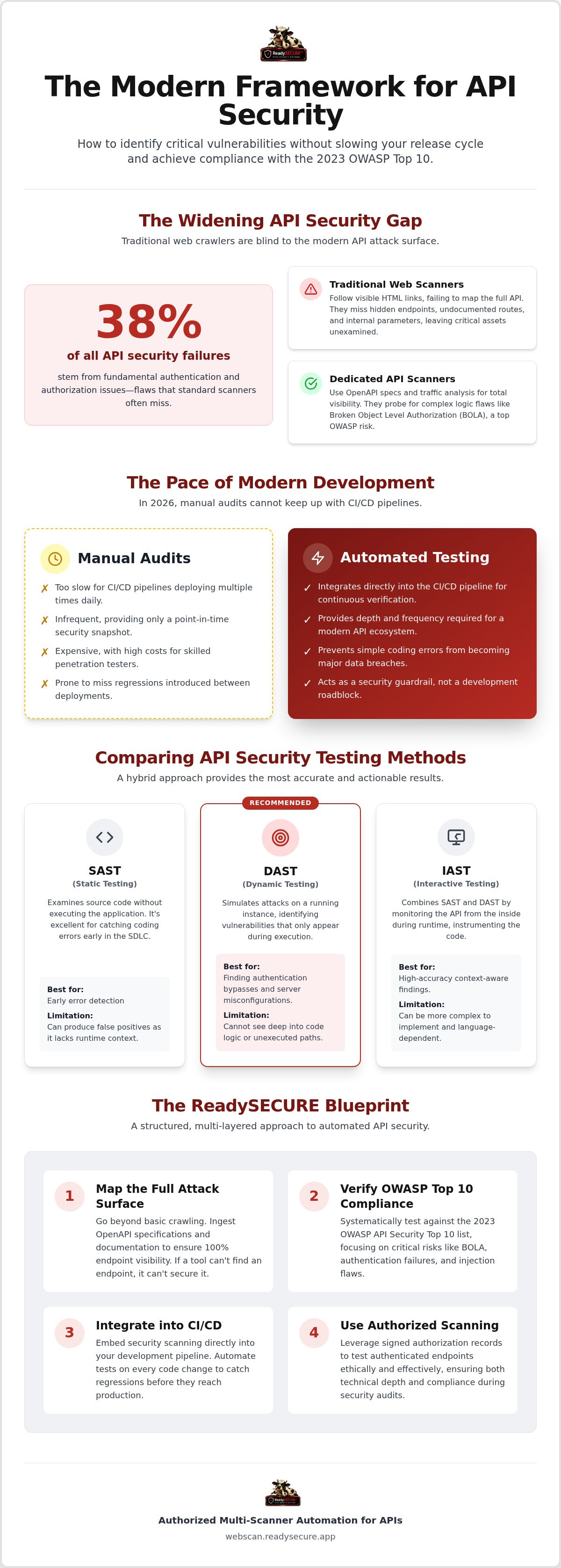
Your API security strategy is only as effective as its slowest scan. If your current tools force a choice between comprehensive coverage and deployment speed, the process is already broken. You likely deal with the daily noise of alert fatigue and the technical hurdle of scanning authenticated endpoints. Research shows that 38% of all API security failures stem from authentication and authorization issues, yet many teams still struggle with inconsistent reporting across different environments. We agree that security should be a guardrail, not a roadblock. Implementing effective automated api security testing requires a balance of technical rigor and operational efficiency.
This guide explains how to evaluate a framework that identifies vulnerabilities without stalling your release cycle. How do you secure your endpoints without compromising your development timeline? You'll discover how to move beyond fragmented tools toward a unified approach that ensures compliance with the 2023 OWASP API Security Top 10. We examine essential features for 2026, such as CI/CD integration and the necessity of signed authorization records. By comparing the leading options, including the transition from standalone scanners to ReadySECURE Paid Plans, you will learn how to generate a prioritized list of risks that your team can actually act upon.
Key Takeaways
- Understand why traditional web crawlers fail to detect hidden API endpoints and how dedicated scanners address this specific visibility gap.
- Identify the practical differences between DAST, SAST, and IAST to determine which testing method provides the most accurate results for your architecture.
- Evaluate the operational trade-offs between open-source tools and commercial platforms when scaling automated api security testing for production environments.
- Follow a structured two-step process to map your API attack surface and verify compliance with the 2023 OWASP API Security Top 10.
- Learn how a multi-scanner approach combined with signed authorization records ensures both technical depth and ethical compliance during security audits.
Why Your REST API Needs a Dedicated Vulnerability Scanner
The transition to API-first architecture has fundamentally changed the digital attack surface. While traditional web applications rely on a browser to render HTML, modern services communicate through thousands of interconnected endpoints. This shift means that a standard web crawler, designed to follow visible links on a page, cannot effectively map your API. It will miss hidden methods, undocumented routes, and internal parameters. Without total visibility, you cannot identify critical flaws like Broken Object Level Authorization (BOLA), which remains a top risk in the 2023 OWASP API Security Top 10. An api security scanner is required to probe these interfaces for authorization failures and logic flaws. As release cycles accelerate, continuous api security scanning is the only viable method to maintain protection across complex environments.
API Security vs. Traditional Web Security
How does API testing differ from testing a standard website? Standard scanners look for vulnerabilities within HTML tags and form fields. APIs deal with structured JSON or XML data. These scanners must understand the logic of the request body and the specific requirements of API key security to authenticate properly. Testing is often stateless; the scanner must handle each request as an independent event while still understanding the underlying business logic. Discovery is the most critical phase. If a tool cannot find an endpoint, it cannot secure it. Dedicated scanners use OpenAPI specifications and documentation to ensure no part of the architecture is left unexamined.
The Risks of Manual API Audits in 2026
Is manual testing still feasible? In 2026, the answer is usually no. Modern CI/CD pipelines deploy code multiple times per day. A manual audit is too slow to keep pace. Traditional penetration testing is too infrequent to catch regressions between deployments. These manual methods are also expensive and provide only a point-in-time snapshot of your security posture. Implementing automated api security testing ensures that every change is verified against known vulnerabilities before it reaches production. This disciplined approach prevents simple coding errors from becoming major data breaches. Automation provides the depth and frequency required to defend a modern API ecosystem without slowing down the development team.
Comparing API Security Testing Methods: DAST, SAST, and IAST
Choosing the right methodology depends on where you are in the development cycle. Static Application Security Testing (SAST) examines the source code without executing it. It's excellent for catching coding errors early, though it often produces false positives because it doesn't see the API in a live state. Dynamic Application Security Testing (DAST) takes the opposite approach by simulating attacks on a running instance. This identifies vulnerabilities that only appear during execution, such as server misconfigurations. Interactive Application Security Testing (IAST) combines these by monitoring the API from the inside during runtime. Implementing a hybrid model for automated api security testing provides the technical rigor needed for modern defense. By using multiple engines, you ensure that logic flaws found by SAST are verified by DAST, which reduces noise and increases reporting accuracy.
When to Choose DAST for API Security
DAST excels at identifying vulnerabilities that involve the interaction between the API and its environment. It's particularly effective for finding authentication bypasses and improper encryption settings. For the best results, you should scan your rest api for vulnerabilities within a staging environment that mirrors production. This allows the scanner to test real-world scenarios without risking live data. However, DAST has limits. It cannot see deep into the code logic or identify vulnerabilities in unexecuted code paths. It's a "black box" method that requires a complementary strategy to be truly comprehensive. If you're looking for a way to start this process, a vulnerability scan can provide an immediate baseline of your external risks.
The Role of Posture Management and Inventory
You cannot secure what you don't know exists. Shadow APIs, which are endpoints not documented in your Swagger or OpenAPI files, represent a significant security gap. Posture management tools help discover these undocumented routes by analyzing traffic patterns. This inventory process also involves classifying sensitive data, such as Personally Identifiable Information (PII), that specific methods handle. By mapping these flows, you can prevent data leaks before they reach production. Aligning your inventory with the OWASP API Security Top 10 ensures that your automated api security testing targets the most critical risks first. This disciplined approach moves beyond simple scanning toward a comprehensive governance model that protects your digital boundaries.
Open-Source vs. Commercial API Vulnerability Scanners
Choosing between open-source and commercial solutions is a critical decision for any security team. Open-source tools like ZAP and Nuclei offer high levels of customization and are free to download. However, they require significant engineering time to configure, update, and maintain. Commercial platforms provide immediate value through prioritized reporting and historical trend analysis. This data is essential for tracking your security posture over time. Many teams underestimate the "hidden cost" of open-source stacks, which often includes the salary of specialists required to manage the complex infrastructure. A managed scanner platform offers a logical middle ground. It provides the technical depth of open-source engines without the operational burden of manual maintenance.
The Power of the Multi-Scanner Stack
Why settle for a single scanning engine? A comprehensive automated api security testing strategy involves more than just probing endpoints. By integrating network-level tools like Nmap and OpenVAS alongside API-specific scanners, you gain depth across the entire infrastructure stack. Nmap identifies open ports and services, while OpenVAS checks for underlying server vulnerabilities. Nuclei templates are particularly valuable because they allow for the rapid detection of newly discovered CVEs. When these diverse tools are combined into a single, unified report, stakeholders get a clear picture of the entire attack surface. This prevents the fragmented reporting and tool fatigue often found in DIY security environments.
The Authorization Gap in Open-Source Tools
Does your tool have permission to scan? Most open-source tools don't generate a formal record of authorization. This is a significant gap for businesses that must prove compliance to auditors or cyber insurance providers. A "proof of scan" ensures that all automated api security testing was conducted ethically and with the owner's consent. Commercial platforms, such as ReadySECURE Paid Plans, solve this by attaching a signed authorization record to every result. This documentation protects the organization from legal liability and simplifies the audit process. Aligning these practices with the OWASP API Security Top 10 establishes a baseline of professional accountability that manual open-source setups can't easily replicate. It's a matter of technical rigor meeting ethical clarity.
How to Automate API Security Testing for the OWASP Top 10
Automating your security strategy requires a disciplined, five-step workflow. This structured approach ensures that you move from reactive patching to a proactive security posture. The process follows a logical sequence:
- Step 1: Map your API attack surface and identify all endpoints using OpenAPI or Swagger files.
- Step 2: Scan api for owasp top 10 vulnerabilities using an automated DAST tool.
- Step 3: Authenticate your scanner to test protected resources and hidden business logic.
- Step 4: Prioritize findings based on business impact and severity scores.
- Step 5: Integrate results into your ticketing system for rapid remediation.
By following these steps, automated api security testing becomes a functional part of your development lifecycle. It prevents security from becoming a bottleneck during release cycles.
Automating Authentication and Authorization Checks
Authenticating an automated session is often the most significant technical challenge for security teams. Scanners must handle complex tokens such as JWT, OAuth2, and static API keys without manual intervention. This capability is essential for testing for "Insecure Direct Object Reference" (IDOR) flaws, which are common in RESTful architectures. Through automated api security testing using fuzzing techniques, the scanner attempts to access resources belonging to other users by manipulating object IDs. If the API returns sensitive data to an unauthorized request, the scanner flags a critical authorization failure. It's a matter of testing the full depth of your logic rather than just the public-facing surface.
Interpreting Results and Avoiding Alert Fatigue
How do you handle a high volume of findings without overwhelming your developers? Use CVSS scores to differentiate between critical risks and informational warnings. A critical finding might indicate a cryptographic failure. Informational findings might simply note missing security headers. Effective reports must include specific remediation guidance. It doesn't just state a flaw exists; it explains exactly how to fix it. Establishing a scheduled scanning cadence allows you to measure progress over time and verify that previous vulnerabilities haven't regressed. If you're ready to implement this structured approach, you can start a free API scan to establish your initial security baseline.
ReadySECURE: Authorized Multi-Scanner Automation for APIs
ReadySECURE represents the logical evolution for teams that have outgrown individual open-source tools. Managing multiple standalone scanners often leads to fragmented data and operational friction. Our platform addresses this by consolidating six industry-standard scanners, including Nmap, OpenVAS, ZAP, TestSSL, and Nuclei, into a single, automated platform. This multi-engine stack provides a comprehensive view of your attack surface by combining network-level discovery with API-specific vulnerability detection. The platform doesn't just provide raw data. It delivers a prioritized report with severity levels and remediation guidance. This allows your development team to focus on critical vulnerabilities like BOLA or IDOR before addressing lower-risk configuration issues.
Legitimacy and Professional Compliance
Ethical security testing requires more than just technical capability. It requires documented consent. Many tools used for automated api security testing overlook the legal and ethical necessity of authorization. ReadySECURE is built on a foundation of professional compliance and transparency. Every scan includes a signed authorization record that serves as a permanent log of your security activities. This document is essential for organizations that must prove their security posture to stakeholders, auditors, or cyber insurance providers. The platform also includes strict safeguards to prevent the unauthorized scanning of third-party domains. It ensures that your testing remains within ethical and legal boundaries at all times.
Getting Started with Your First API Scan
Launching your first audit is a straightforward and efficient process. You start by submitting your domain and completing the authorization step, which typically takes under five minutes. Once the multi-scanner engine completes its analysis, you receive a comprehensive report that translates technical findings into actionable remediation steps. Transitioning from a ReadySECURE Free Scan to ReadySECURE Paid Plans allows you to implement a scheduled security strategy. This ensures that your APIs are monitored continuously as your codebase evolves. Regular scanning helps you track progress and verify that previous vulnerabilities haven't regressed. You can Start your ReadySECURE Free Scan today to identify your most immediate risks and establish a baseline for your security journey.
Establishing a Resilient API Security Posture
Securing a modern API ecosystem requires more than just reactive patching. It demands a disciplined framework that balances technical depth with operational speed. We've explored how the shift to API-first architecture necessitates dedicated scanning tools that handle structured data and hidden endpoints. By moving beyond fragmented open-source setups toward a unified multi-scanner stack, you ensure that no vulnerability is left unexamined. Implementing automated api security testing is the most efficient way to maintain this standard without slowing down your development cycle.
A professional security strategy must also prioritize ethical legitimacy. ReadySECURE provides this clarity by combining 6 industry-standard scanners into a single report, supported by signed authorization records for full compliance. You receive prioritized remediation guidance that allows your team to focus on the most critical risks first. Are you ready to verify your current security baseline? You can Secure your API with a ReadySECURE Free Scan today. Taking this first step ensures your digital boundaries remain protected as your architecture continues to evolve.
Frequently Asked Questions
What is the difference between an API vulnerability scanner and a web scanner?
API scanners focus on structured data formats like JSON and XML rather than HTML. While a web scanner crawls a site by following links, an API scanner probes specific endpoints and methods. It must understand the underlying logic of REST or SOAP calls. This includes handling various HTTP methods like PUT and DELETE. It's a technical approach that requires knowledge of the API structure, often through documentation like OpenAPI.
Can an automated scanner detect all OWASP Top 10 API vulnerabilities?
Automated tools detect the majority of these risks, especially those involving injection or misconfiguration. However, they can't catch 100% of logic-based flaws. While automated api security testing provides essential coverage for the 2023 OWASP API Security Top 10, it works best when combined with a clear understanding of your business logic. It excels at finding technical vulnerabilities that a human auditor might miss during a manual review.
Is it safe to run an automated API security test against a production environment?
It is generally safer to test in a staging environment. Active scanning involves sending various payloads to your endpoints, which can trigger rate limits or create junk data in your database. If you must test in production, use passive scanning or schedule tests during low-traffic periods. This prevents service disruptions for your customers. Always ensure you have a backup of your data before running intensive security probes against live systems.
How often should I run automated security scans on my APIs?
You should ideally scan your APIs every time you deploy new code. This approach catches regressions before they reach your users. If your release cycle is less frequent, a weekly scan is a professional baseline. This helps identify new vulnerabilities in your dependencies or server configurations. Regular automated api security testing ensures that your security posture remains strong as new threats emerge in the cybersecurity landscape.
Do I need to be a security expert to use an API vulnerability scanner?
You don't need to be a specialist to get value from these tools. Professional platforms provide clear, prioritized reports that explain what the issue is and how to fix it. This remediation guidance is written for developers and IT managers rather than just security researchers. While a specialist can help with advanced configurations, the automated nature of the software handles the complex technical probing on your behalf.
What is an 'authorized' vulnerability scan, and why does it matter?
An authorized scan includes a formal record of consent from the system owner. This is critical for legal protection and ethical compliance. Without it, scanning can be mistaken for a malicious attack. ReadySECURE attaches a signed authorization record to every scan result. This document is essential for proving your security diligence to insurance companies, regulatory bodies, and internal stakeholders who require evidence of legitimate testing.
How do I scan an API that requires authentication?
You scan authenticated APIs by providing the tool with valid tokens or credentials. Most modern scanners support JWT, OAuth2, and static API keys. Once authenticated, the scanner can probe protected resources to find flaws like Broken Object Level Authorization. This provides a much deeper level of security than an unauthenticated scan. It allows the tool to see the API exactly as a legitimate user or a potential attacker would.
What should be included in a professional API security report?
A professional report must include a prioritized list of vulnerabilities with clear severity levels. It should provide specific remediation steps so your team can fix the issues quickly. Every report should also feature a signed authorization record to prove the scan was permitted. Including a summary of the scanners used, such as ZAP or Nuclei, adds technical credibility. This ensures the document is useful for both developers and auditors.


