

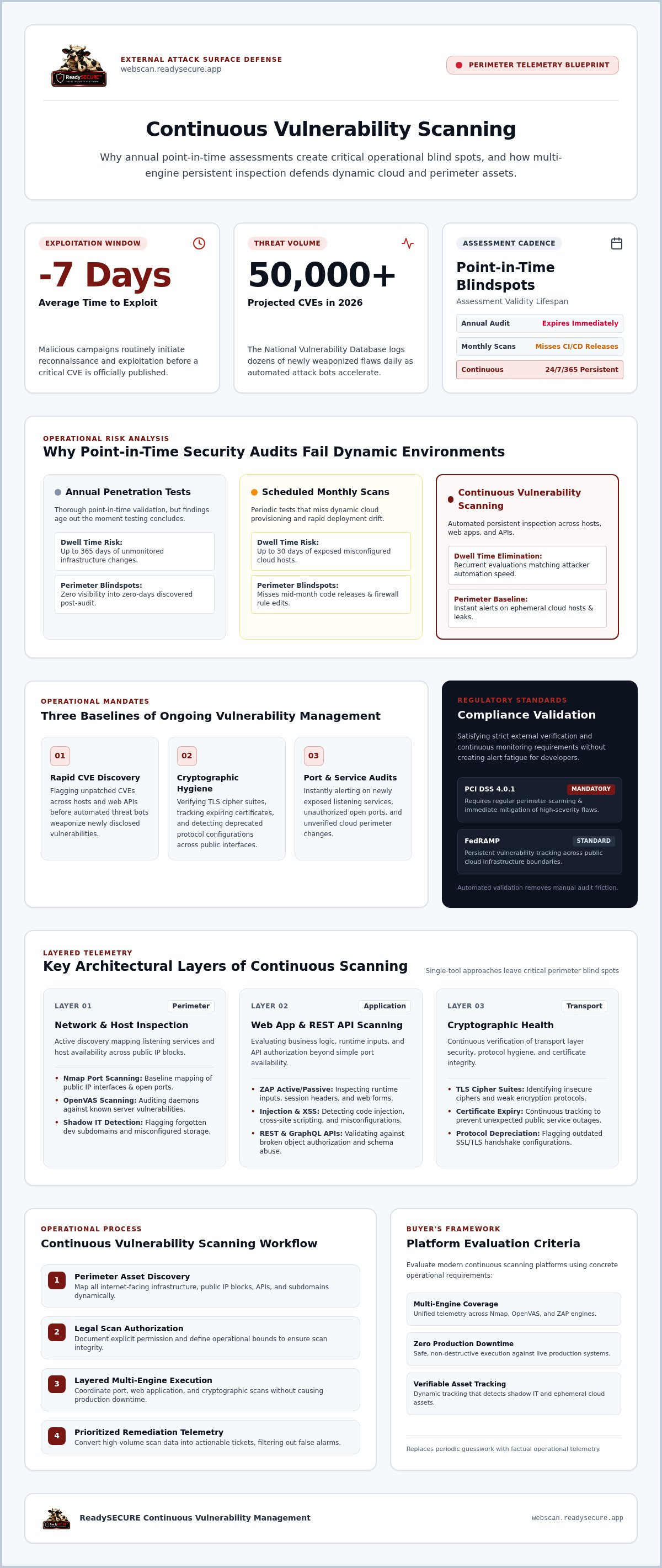
The average time to exploit a critical software vulnerability has shifted to negative seven days, which means malicious campaigns routinely begin before a CVE is even publicly published. Relying on an annual audit to defend internet-facing assets leaves critical blind spots open for months at a time. You already know that point-in-time assessments give a false sense of security, and managing disconnected scanning tools only creates alert fatigue for your engineering team. That is why continuous vulnerability scanning has become an operational necessity for modern web applications, APIs, and public infrastructure.
In this guide, you'll learn how continuous vulnerability scanning works across dynamic perimeter assets, why periodic tests fail, and how to maintain automated monitoring without causing operational downtime. We'll break down multi-engine scanning mechanics, review strict validation requirements like PCI DSS 4.0.1, and outline practical steps to turn high-volume telemetry into actionable, prioritized remediation reports.
Key Takeaways
- Learn how continuous vulnerability scanning bridges critical visibility gaps between scheduled penetration tests by maintaining automated, perimeter-wide oversight.
- Discover why defending modern attack surfaces requires layered telemetry across network ports, web applications, APIs, and TLS configurations rather than a single scanning tool.
- Understand how continuous monitoring satisfies evolving compliance requirements, including PCI DSS 4.0.1 and FedRAMP, without overwhelming developers with false alarms.
- Master a structured implementation workflow to discover internet-facing infrastructure, document legal scan authorization, and prioritize high-severity flaws for remediation.
- Evaluate modern platforms using concrete operational criteria, focusing on multi-engine coverage, zero production downtime, and verifiable asset tracking.
Continuous Vulnerability Scanning: Why It's Critical
Continuous vulnerability scanning is the automated, persistent inspection of digital assets to identify security exposures, configuration weaknesses, and unpatched flaws across public-facing infrastructure. Instead of relying on static assessments conducted at arbitrary intervals, this approach executes recurrent evaluations against live systems. A modern vulnerability scanner probes network interfaces, web applications, and host ports to establish an accurate, dynamic operational baseline. Attackers automate their reconnaissance. Defending dynamic cloud perimeters requires matching that velocity.
The National Vulnerability Database logs dozens of newly weaponized CVEs daily, with forecasts projecting over 50,000 published entries in 2026. Point-in-time assessments leave engineering teams completely blind to zero-day exposures and configuration drift that occur between audit cycles. Rapid continuous integration and delivery pipelines deploy code daily, provisioning ephemeral cloud hosts and modifying firewalls in minutes. Without persistent verification, a single misconfigured storage bucket or leaked administrative interface can remain exposed for weeks before detection.
The Limits of Point-in-Time Security Audits
Annual penetration tests provide thorough validation of target defenses, but their findings age out almost immediately. A clean report validates an environment only at the exact second testing concludes. Scheduled monthly scans present similar operational blind spots; they miss critical vulnerabilities introduced during mid-month production code releases or routine maintenance. Continuous vulnerability scanning acts as an essential proactive layer between annual audits, ensuring newly deployed code does not silently break defensive configurations.
Core Objectives of Ongoing Vulnerability Management
Why replace periodic testing with persistent oversight? The primary goal centers on eliminating dwell time through structured, automated surveillance. An operational continuous program targets three essential baselines:
- Rapid CVE Discovery: Flagging unpatched Common Vulnerabilities and Exposures across hosts and web APIs before automated threat bots weaponize them.
- Cryptographic Hygiene: Verifying TLS cipher suites, tracking expiring certificates, and detecting deprecated protocol configurations across public interfaces.
- Port and Service Auditing: Instantly alerting on newly exposed listening services, unauthorized open ports, and cloud perimeter changes.
Securing modern attack surfaces demands systematic vigilance. Automated inspection eliminates reliance on assumptions, replacing periodic guesswork with factual operational telemetry.
Key Architectural Layers of an External Continuous Scanning Program
Most exposure discussions focus strictly on internal code repositories, leaving internet-facing infrastructure vulnerable to external reconnaissance. A resilient program requires inspecting multiple architectural boundaries simultaneously. Relying on a single tool creates severe blind spots, because an engine tailored for network ports cannot properly analyze complex web sessions or cipher handshakes. External continuous vulnerability scanning coordinates distinct engines to deliver cohesive coverage across hosts, web applications, and encryption layers.
Network and Host Perimeter Inspection
Active discovery maps listening services and host availability across public IP blocks. Nmap Port Scanning establishes this perimeter baseline, flagging unexpected open services. Building on those results, OpenVAS Network Scanning audits listening daemons against known server vulnerabilities and outdated service banners. This network layer quickly exposes forgotten development subdomains, misconfigured cloud storage, and shadow IT assets before external attackers map them.
Web Application and REST API Scanning
Confirming that port 443 is open doesn't reveal whether the application running on it contains exploitable business logic flaws. ZAP Active/Passive Scanning inspects runtime inputs, session headers, and web forms to detect injection flaws, cross-site scripting, and security misconfigurations. For REST and GraphQL services, targeted scanning validates endpoints against broken object level authorization and schema abuse, securing the interfaces that modern client applications rely on.
Cryptographic Health and Rapid Template Detection
Transport layer security demands rigorous, specialized auditing. TestSSL Inspection analyzes cipher suites, handshake protocols, and key lengths across public interfaces. Automated certificate tracking alerts teams weeks before production certificates expire, preventing costly service outages. Fast, template-based engines like Nuclei Template-Based Scanning rapidly identify zero-day exposures and high-risk entries logged in the CISA Known Exploited Vulnerabilities (KEV) catalog. You can assess your public endpoints across these critical layers by running a baseline evaluation through ReadySECURE Free Scan.
Continuous Scanning vs. Periodic Scans vs. Penetration Testing
Security teams often struggle to balance automated tooling with manual security evaluations. Understanding where each methodology fits is critical for maintaining an effective defense-in-depth architecture. Recognizing this operational balance is why industry benchmarks establish continuous monitoring as a core CIS Critical Security Control. Each approach addresses distinct operational risks, costs, and detection mechanisms across your attack surface.
| Assessment Model | Typical Cadence | Primary Scope | Key Limitation |
|---|---|---|---|
| Continuous Scanning | Daily or recurrent automated runs | Perimeter ports, known CVEs, SSL/TLS, web misconfigurations | Cannot uncover complex multi-step business logic flaws |
| Periodic Scans | Quarterly or monthly | Regulatory baseline compliance checks | Leaves wide windows of exposure between execution cycles |
| Manual Penetration Testing | Annual or bi-annual | Chained exploits, authentication bypass, business logic | High resource cost; findings age out rapidly after completion |
Evaluating Cadence, Depth, and Resource Overhead
How do operational demands differ between these cadences? Continuous vulnerability scanning operates autonomously in the background, providing uninterrupted telemetry without demanding daily engineering oversight. In contrast, quarterly scheduled scans reduce data volume but leave infrastructure unprotected against ephemeral cloud errors and mid-cycle deployments. To determine the right scanning frequency across your specific environments, explore strategic scheduling options in our guide to scheduled network security scans.
Addressing the Business Logic Assessment Gap
Automated scanners excel at discovering known vulnerabilities, exposed ports, and invalid cipher configurations. They can't, however, fully emulate an adversarial researcher trying to manipulate multi-step checkout workflows or exploit role-based access logic. Manual penetration testing fills this specific gap by probing creative attack chains that algorithms miss. Implementing continuous vulnerability scanning doesn't replace manual testing. Instead, it complements human assessments by verifying that resolved vulnerabilities stay patched and guarding the perimeter between formal audit engagements.
How to Implement a Continuous Vulnerability Scanning Routine
Deploying an automated monitoring routine requires a structured operational process rather than simply turning on an automated tool. Without clear boundaries, uncalibrated engines can overwhelm databases, trigger noisy alerts, or scan unauthorized hosts. A disciplined implementation follows four sequential stages: discover exposed assets, verify legal authority, calibrate execution pacing, and integrate verified telemetry into engineering workflows.
Asset Discovery, Scoping, and Legal Authorization
First, enumerate all public endpoints to eliminate blind spots. Modern perimeters shift constantly as development teams spin up staging environments, cloud storage containers, and test APIs. Catalog every domain, IP range, and API route before firing a probe. Crucially, establish explicit authorization for every target. Running security tools without cryptographically signed permission records creates legal exposure and confuses hosting providers. For a deeper breakdown on scoping target inventories, review our comprehensive buyer's resource on automated vulnerability scanning.
Calibrating Scanning Frequency and Eliminating Production Friction
How do you scan live production environments without causing service disruption? Successful programs separate non-invasive checks from heavier structural evaluations across different schedules:
- Daily Lightweight Probing: Run non-destructive port scans, TLS handshake checks, and template-based vulnerability tests to catch immediate configuration drift.
- Weekly Deep Application Crawls: Schedule resource-intensive web crawlers during off-peak hours to map complex form inputs and authentication states.
- Traffic Throttling: Set strict request-per-second thresholds on target APIs and web applications to prevent database connection spikes and latency degradation.
Triage, Prioritization, and Remediation Workflows
Continuous vulnerability scanning delivers real value only when its telemetry leads to rapid remediation. High scan frequencies generate substantial data, making intelligent triage essential. Score raw findings by combining CVSS base ratings with active weaponization status to separate theoretical risks from immediate perimeter threats. Once prioritized, route findings directly into engineering issue trackers like Jira or GitHub Issues. Establish rigid remediation SLAs, enforcing shorter turnaround times for critical network exposures compared to informational findings. To automate this entire lifecycle across your perimeter hosts, explore ReadySECURE Paid Plans for structured multi-engine monitoring.
Evaluating Continuous Vulnerability Scanning Solutions: A Buyer's Framework
Selecting an external monitoring platform shouldn't depend on proprietary marketing claims or vague promises of total automation. A dependable evaluation centers on concrete operational capabilities: detection accuracy, engine diversity, and clear reporting. Single-engine scanners inherently miss critical exposure types because every detection tool relies on specific signatures and scanning methodologies. A network-focused tool won't uncover deep web session flaws, while a web crawler can't assess host daemon banners or lower-level transport layer weaknesses. Effective continuous vulnerability scanning depends on transparent, verifiable assessment mechanics.
Multi-Engine Orchestration vs. Single-Tool Scanners
Why orchestrate multiple security engines under one framework? Combining industry-standard tools provides genuine defense-in-depth across the entire external perimeter. Integrating proven engines like Nmap for port identification, OpenVAS for network vulnerabilities, ZAP for runtime web application analysis, TestSSL for cryptographic health, and Nuclei for rapid exploit detection ensures broad visibility. Multi-engine orchestration aggregates these discrete telemetry streams into a single, unified view. Historical trend tracking then lets engineering leads measure remediation velocity across recurring assessment cycles, verifying that security posture improves over time.
Actionable Reporting and Audit-Ready Verification
Raw scan outputs waste developer time. Development teams need clear remediation steps and verified CVE references rather than hundreds of unprioritized, noisy log lines. Platforms must deliver structured reports that make patch validation straightforward. When planning your evaluation, look for these key reporting and governance capabilities:
- Clear Remediation Guidance: Step-by-step instructions that allow engineers to replicate and fix underlying misconfigurations without guesswork.
- Cryptographic Authorization Records: Signed verification documenting that all target probing occurred with explicit administrative permission, protecting your team during formal compliance audits.
- Longitudinal Trend Tracking: Historical dashboards tracking resolved versus unresolved exposures across scheduled scan intervals.
Audit readiness and perimeter defense require dependable data rather than complex vendor lock-in. You can start auditing your perimeter today with a ReadySECURE Free Scan.
Build a Defensible Perimeter Security Posture
Defending public infrastructure requires moving past the false comfort of static, annual assessments. Modern software release cycles and dynamic cloud environments create exposure windows that attackers exploit within days. Adopting continuous vulnerability scanning eliminates these visibility gaps, giving engineering teams reliable telemetry across host configurations, web applications, and cryptographic layers before external threats take advantage.
A resilient defense doesn't require complex tool sprawl or unmanageable alert fatigue. Orchestrating proven engines, including Nmap, OpenVAS, ZAP, TestSSL, and Nuclei, provides comprehensive coverage with prioritized remediation guidance and cryptographically signed authorization records for formal compliance. Take the first step toward continuous perimeter hygiene: Run a verified vulnerability assessment with ReadySECURE Free Scan and establish an accurate operational baseline today.
Frequently Asked Questions
What is the difference between continuous vulnerability scanning and a penetration test?
Continuous scanning is an automated, ongoing perimeter verification routine, whereas a penetration test is an intensive, periodic manual assessment conducted by human security professionals. Continuous tools uncover known CVEs, exposed ports, and configuration drift on a recurring schedule. Penetration tests simulate human adversary tactics to chain exploits and probe complex business logic. Both methodologies complement each other within a mature defense-in-depth security program.
Will continuous vulnerability scanning slow down or crash our production website?
Properly calibrated external scans do not degrade production performance or cause service downtime. Safe platforms employ non-destructive testing profiles and strict request rate throttling to protect backend databases and web servers. Deep crawler passes can run during off-peak traffic windows. When configured correctly, continuous vulnerability scanning monitors live perimeter endpoints without creating latency spikes for legitimate application users.
How often should continuous vulnerability scans run against external assets?
Most engineering teams run lightweight perimeter evaluations daily, complemented by deep application crawls weekly or monthly. Regulatory frameworks mandate baseline frequencies; for example, PCI DSS 4.0.1 requires quarterly external scans, and FedRAMP ConMon standards enforce at least monthly assessments. Implementing continuous vulnerability scanning on a daily cadence ensures newly deployed code and cloud configuration changes are audited immediately.
Can continuous scanning tools detect zero-day vulnerabilities?
Scanning tools identify zero-day exposures as soon as community proof-of-concept templates and vulnerability signatures become available. While automated scanners cannot discover entirely unknown zero-day flaws through intuition, template-driven engines like Nuclei rapidly operationalize new signatures within hours of disclosure. This rapid cadence allows security teams to identify newly published CVEs across their exposed domains before automated adversary bots weaponize them.
Why is legal authorization necessary before scanning an internet-facing host?
Legal authorization ensures security testing is distinguishable from hostile cyberattacks and complies with computer fraud regulations. Port probing and input fuzzing generate alerts across hosting providers, firewalls, and upstream ISPs. Attaching a cryptographically signed authorization record proves administrative consent and target ownership. This documentation protects organizations from liability, prevents cloud hosting account suspensions, and satisfies formal compliance audits.
What are the essential scanning engines required for full perimeter coverage?
Full perimeter coverage requires distinct, specialized engines covering network, application, host, and cryptographic layers. A comprehensive architecture pairs Nmap for network port identification with OpenVAS for host daemons and operating system flaws. At the application layer, OWASP ZAP evaluates dynamic web inputs and API endpoints, while TestSSL inspects cryptographic suites. Template scanners like Nuclei complete the stack by tracking rapidly evolving public exploit definitions.
How do continuous vulnerability scanners handle false positive results?
Advanced scanning frameworks reduce false positives by cross-referencing multiple engine outputs and verifying active response payloads. Rather than flagging a vulnerability based purely on a banner version string, reliable tools test active response headers and runtime behavior. Corroborating findings across engines before alerting developers ensures engineering teams spend time patching verified threats instead of chasing phantom warnings.


