

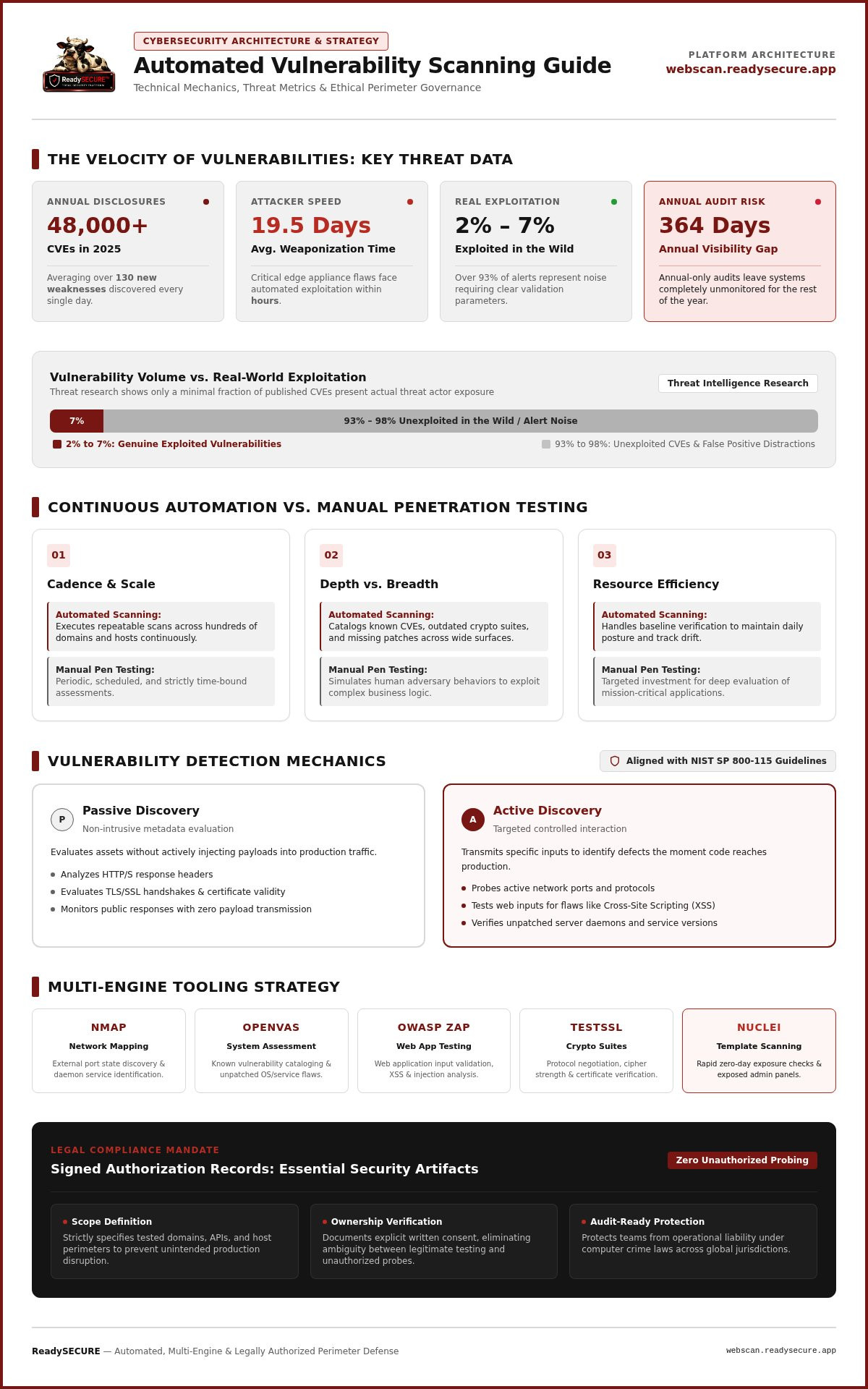
Research across threat intelligence groups confirms that only 2% to 7% of all published vulnerabilities are ever exploited in the wild, yet security teams routinely find themselves buried beneath hundreds of false positives. When you deploy automated vulnerability scanning without clear validation parameters, separating genuine exposure from harmless noise can feel impossible. At the same time, scanning production infrastructure without verifiable written permission introduces serious legal and operational risks. You already understand that managing perimeter risk shouldn't mean drowning in unprioritized alerts or struggling to prove compliance to executive stakeholders.
This 2026 buying guide outlines how to master the technical and ethical requirements of automated vulnerability scanning so you can protect your digital assets with confidence. You'll learn how to establish a repeatable security routine, evaluate multi-engine architectures, and implement prioritized remediation that highlights actionable threats. We also break down how signed authorization records ensure your security routine remains legally sound, disciplined, and audit-ready from day one.
Key Takeaways
- Discover why traditional annual audits fail against modern release cycles, and how automated vulnerability scanning acts as an essential force multiplier.
- Understand the distinct roles of network, web application, and configuration scanners when evaluating websites, APIs, and host perimeters.
- Learn why legal scanning mandates written consent, and how signed authorization records protect your team from severe operational liability.
- Master multi-engine assessment strategies using proven tools like Nmap, OpenVAS, ZAP, TestSSL, and Nuclei to eliminate blind spots.
- Implement a structured vulnerability lifecycle that translates raw scanner outputs into prioritized remediation roadmaps for technical teams and leadership.
Why is Automated Vulnerability Scanning Essential in 2026?
Annual security reviews belong to a different operational era. In 2025 alone, researchers registered more than 48,000 Common Vulnerabilities and Exposures (CVEs), averaging over 130 new weaknesses discovered every single day. If your team only audits infrastructure once a year, you are operating blind for the other 364 days. Automated vulnerability scanning bridges this gap. Unlike passive log monitoring, which merely flags anomalous traffic after a potential breach has begun, active detection systematically interrogates your perimeter to uncover exposures before adversaries find them.
Modern engineering teams release updates daily. Cloud instances spin up, APIs evolve, and network configurations drift. Understanding the fundamental mechanics of vulnerability scanners clarifies why continuous discovery is essential: these engines probe network ports, examine protocol negotiations, and test web inputs to catch defects the moment code touches production. By integrating automation into regular deployment cycles, security shifts from an external roadblock to an integrated operational safeguard.
Addressing the 2026 Threat Landscape
Threat actors rely heavily on automated reconnaissance. Attackers weaponize publicly disclosed vulnerabilities in an average of 19.5 days, and critical flaws in edge appliances often face automated exploitation within hours. For any internet-facing host or SaaS environment, continuous monitoring is no longer optional; it is baseline hygiene. The financial and operational cost of reactive incident response far outweighs the disciplined investment in routine automated vulnerability scanning that catches perimeter misconfigurations early.
Automation vs. Manual Penetration Testing
How should organizations distinguish between automated discovery and manual testing? The answer comes down to cadence, coverage, and purpose:
- Cadence and scale: Automated tools execute repeatable scans across hundreds of domains and hosts continuously, while manual testing is periodic and time-bound.
- Depth vs. breadth: Automation rapidly catalogs known CVEs, outdated cryptographic suites, and missing patches across a broad surface. Manual penetration tests simulate human adversary behaviors to exploit complex business logic.
- Resource efficiency: Relying exclusively on manual testing leaves vast visibility gaps between audit cycles. Automated scanning handles the baseline verification needed to maintain daily posture.
Automation does not replace deep, periodic manual penetration testing where required for complex applications. Instead, it provides the continuous verification layer that ensures routine drift never goes unnoticed.
The Mechanics of Professional Vulnerability Detection
How does a vulnerability scanner evaluate an asset without disrupting production traffic? Automated scanners interact with external targets through coordinated network probes and application requests. Passive discovery techniques monitor headers, TLS handshakes, and public responses without actively injecting payloads. In contrast, active discovery transmits targeted inputs to uncover flaws such as cross-site scripting or unpatched server daemons. Aligning these assessments with established NIST SP 800-115 security testing guidelines ensures testing remains methodical, controlled, and safe for live services.
Modern platforms combine network mapping with template-based testing engines to rapidly query specific misconfigurations. Rather than relying on closed, proprietary payloads that obscure what traffic was sent, standard engines execute transparent checks. Nuclei templates, for instance, detect newly disclosed zero-day exposures and exposed admin panels within hours of release. If you want to benchmark your external perimeter against standard detection protocols, you can run a free security scan to review your baseline posture.
The Legal Necessity of Authorization
Scanning digital systems without documented permission violates computer crime laws in almost every jurisdiction. An automated probe looks identical to malicious reconnaissance in firewall logs. This is why a signed authorization record is your most vital security artifact. It defines the testing scope, confirms ownership, and establishes an audit trail. ReadySECURE embeds this protection directly into its operational architecture, requiring documented authorization before initiating any scanning activity. This verification guarantees your compliance records withstand external scrutiny.
Scanning APIs and Internet-Facing Hosts
Perimeter defenses frequently break down at undocumented endpoints. Modern microservices expose REST interfaces and dynamic routes that standard port scans easily miss. Implementing continuous api security scanning allows teams to evaluate authentication headers, input validation boundaries, and rate limits alongside host-level assessments. Simultaneously, dedicated host scanning inspects internet-facing servers for outdated OpenSSH packages, exposed databases, and deprecated TLS ciphers.
Automated vulnerability scanning delivers maximum value when it evaluates both application interfaces and underlying infrastructure concurrently, preventing dangerous blind spots from persisting across your digital border.
Evaluating Your Security Stack: Key Features and Frameworks
Can a single scanning engine deliver comprehensive perimeter visibility? In practice, no single scanner excels across network mapping, web application logic, and cryptographic verification simultaneously. Relying on an isolated scanner creates systemic blind spots that attackers readily exploit. A multi-engine automated vulnerability scanning stack combines specialized tools into a unified assessment pipeline. By cross-referencing results across purpose-built scanners, teams capture nuanced misconfigurations while filtering out engine-specific anomalies.
This coordinated model reflects modern operational benchmarks, including CISA Cyber Hygiene vulnerability scanning guidance, which advocates continuous external evaluation across all publicly accessible infrastructure. Evaluating network boundaries, application endpoints, and encryption protocols through distinct engines produces verifiable results that engineering teams can trust.
The Multi-Engine Advantage
Deploying specialized scanners in concert provides complementary layers of perimeter insight:
- Host and network discovery: Nmap maps open ports and identifies active services, while OpenVAS evaluates underlying host services for known system-level flaws.
- Web application auditing: OWASP ZAP handles active and passive testing of dynamic application layers, auditing session handling, headers, and injection points.
- Cryptographic validation: TestSSL checks transport layer configurations, verifying cipher suites and flagging deprecated protocol handshakes.
- Targeted zero-day checks: Utilizing nuclei template scanning enables fast, community-driven detection of emerging CVEs and configuration exposures across complex environments.
Reporting and Remediation Guidance
A scanner that only produces a raw list of CVE numbers wastes valuable engineering time. Effective platforms categorize vulnerabilities by verified impact, separating critical exposures from low-priority noise. Clear remediation advice must accompany each finding, providing precise technical guidance that explains how to resolve the underlying misconfiguration rather than just pointing out its existence.
Tracking historical trends is equally critical. Comparing scan outputs over time allows organizations to measure patch velocity, prove security posture improvements to auditors, and ensure resolved flaws don't quietly reappear after deployment cycles. If you need an objective starting point to evaluate your current setup, running a free website security scan provides an actionable report with clear severity levels and remediation guidance.
Implementing a Sustainable Scanning Lifecycle
Scanning without an operational framework produces raw data rather than security improvement. To transform automated vulnerability scanning into a reliable discipline, organizations need a closed-loop lifecycle. Vulnerability management succeeds only when discovery directly informs engineering priorities and verification confirms that fixes actually work.
A mature scanning routine follows five practical stages:
- Define the attack surface: Catalog all active web applications, public APIs, subdomains, and network endpoints before running scans.
- Establish legal authorization: Secure explicit, written authorization records for every target domain and IP to maintain a complete audit trail.
- Calibrate scan frequency: Align scanning schedules with your release cadences and overall risk profiles.
- Integrate into sprint workflows: Convert prioritized scanner findings directly into engineering backlog tickets with concrete remediation guidance.
- Verify remediation: Trigger targeted follow-up scans immediately after patches deploy to confirm the flaw has been resolved.
Setting Your Scan Frequency
How often should your organization run automated vulnerability scanning? The answer depends on deployment speed and asset criticality. Core production APIs and customer-facing portals benefit from weekly scheduled runs, alongside automated event triggers after major infrastructure changes. Lower-risk staging environments may require bi-weekly checks. Scheduled scanning ensures that compliance requirements under frameworks like NIST CSF 2.0 remain satisfied through documented, continuous perimeter oversight.
Managing the Remediation Workflow
Closing the loop on vulnerabilities requires translating technical findings for two distinct audiences. Engineers need actionable diagnostics: affected endpoints, parameter names, and remediation code examples. In contrast, boards and executive stakeholders require risk context. When presenting to non-technical leadership, avoid listing hundreds of low-severity notices. Focus instead on high-risk exposures, mean time to remediate (MTTR), and historical trend trajectories that prove security posture is actively improving.
Effective vulnerability management relies on consistent verification. Once your engineering team deploys a fix, execute an immediate rescan rather than waiting for the next monthly audit. To establish a structured, audit-ready testing cadence across your perimeter, you can start your authorized vulnerability assessment today.
ReadySECURE: Ethical, Authorized Scanning for Modern Enterprises
How do you maintain continuous perimeter defense without drowning in operational complexity? ReadySECURE delivers an authorized SaaS platform designed specifically to evaluate websites, APIs, and internet-facing hosts. Rather than relying on isolated utilities or opaque scanning tools, the platform coordinates an industry-standard engine stack featuring Nmap, OpenVAS, ZAP, TestSSL, and Nuclei. Every scan is anchored by a signed authorization record, providing your organization with verifiable proof of authorized testing that eliminates legal ambiguity during audits.
By bringing these tools together into a unified workflow, automated vulnerability scanning becomes structured, consistent, and legally sound. You receive verified perimeter intelligence without having to maintain disparate scanning servers or wrestle with complex command-line configurations.
Professional Grade Tools for Every Team
Configuring and updating standalone security engines requires substantial engineering time. ReadySECURE unifies these systems into a seamless interface. TestSSL inspection audits cryptographic configurations and certificate validity, while ZAP active and passive scanning inspects web application endpoints for modern security flaws. OpenVAS and Nmap handle comprehensive port discovery and network service evaluation. The platform translates this multi-engine output into prioritized reports structured by clear severity levels. Instead of sorting through uncurated logs, your developers receive practical remediation guidance that explains exactly how to resolve each confirmed issue.
Start Your Security Journey Today
Moving from intermittent checks to a sustainable vulnerability management program starts with an accurate baseline. The ReadySECURE Free Scan offers a straightforward, low-friction way to audit your perimeter and evaluate your attack surface against our multi-scanner engine. When your organization requires continuous monitoring, ReadySECURE Paid Plans unlock automated scan scheduling, historical trend analysis, and comprehensive target management to track remediation progress over time.
Proactive security starts with verifiable, authorized insight. Get started with a ReadySECURE Free Vulnerability Scan today to identify perimeter risks, streamline remediation, and establish a disciplined security posture.
Securing Your External Perimeter with Confidence
Modern perimeter defense demands continuous discipline rather than occasional panic. By establishing a repeatable testing routine, your team eliminates dangerous operational blind spots, handles configuration drift promptly, and translates complex findings into structured engineering fixes. Effective security isn't about collecting endless vulnerability alerts. It's about maintaining verified visibility across your internet-facing assets and proving that your defensive posture withstands rigorous scrutiny.
ReadySECURE simplifies this workflow by coordinating an industry-standard engine stack featuring Nmap, OpenVAS, ZAP, TestSSL, and Nuclei. Authorized by you and scanned by us, every assessment delivers prioritized findings alongside a signed record of authorization attached directly to your report. You get the technical depth required to protect production environments without legal ambiguity or operational friction. Take the first step toward disciplined, defensible automated vulnerability scanning today: Run your first authorized vulnerability scan for free and secure your perimeter with complete clarity.
Frequently Asked Questions
What is the difference between automated vulnerability scanning and a penetration test?
Automated vulnerability scanning uses software to systematically identify known security flaws, outdated packages, and network misconfigurations on a repeatable schedule. A manual penetration test, by contrast, involves human security professionals actively attempting to exploit business logic flaws and chain vulnerabilities together. Automated tools deliver scalable, continuous baseline visibility across wide perimeters, whereas penetration tests offer deep, point-in-time assessments of specific high-risk targets.
Is automated vulnerability scanning legal for any website?
No, scanning is only legal against digital infrastructure you own or have explicit written permission to assess. Running automated discovery probes against third-party systems without consent violates computer crime laws and triggers intrusion alarms. Professional platforms require verified target authorization before initiating any checks. This legal boundary protects both the assessment platform and your organization from civil or criminal liability.
How often should I run an automated vulnerability scan on my API?
You should run automated vulnerability scanning against production APIs at least weekly, as well as immediately following any major deployment or routing update. Modern APIs evolve rapidly as developers deploy new microservices and endpoints. Frequent development changes introduce configuration risks such as broken authorization headers or unvalidated inputs. Scheduled scanning ensures that perimeter drift gets caught immediately rather than remaining exposed until an annual review.
What scanners does ReadySECURE use in its multi-tool stack?
ReadySECURE orchestrates five core open-source engines: Nmap for network port mapping, OpenVAS for host-level vulnerability detection, OWASP ZAP for web application analysis, TestSSL for cryptographic inspection, and Nuclei for targeted template checks. Combining these tools creates a comprehensive assessment workflow. This multi-layered architecture discovers network, transport, and application flaws simultaneously without requiring your team to configure separate standalone scanners.
How do I prioritize which vulnerabilities to fix first?
Prioritize vulnerabilities by cross-referencing their CVSS severity rating with verified exploitability and asset criticality. High or critical severity flaws affecting public, internet-facing endpoints or listed on known exploited vulnerability catalogs demand immediate attention. Lower-risk items, such as missing non-critical HTTP headers, can be safely routed to regular sprint backlogs. Prioritized reporting isolates genuine operational risks so developers can focus on urgent fixes.
Can automated scanning cause downtime for my website or application?
Professional scanners are calibrated to minimize disruption, but aggressive active scanning can occasionally stress fragile endpoints or flood server logs. Reputable platforms employ rate-limiting controls, non-destructive test payloads, and safe testing logic to protect production availability. However, you should always coordinate scan schedules with engineering teams if you plan to audit legacy systems with strict resource limits or sensitive backend databases.
What is a signed authorization record and why do I need one?
A signed authorization record is a timestamped document proving that an authorized asset owner permitted the vulnerability scan. You need this documentation to protect against legal disputes, comply with enterprise governance standards, and validate testing legality during external audits. ReadySECURE attaches a verified authorization record directly to every completed report. This ensures that internal leaders and auditors have clear evidence that testing was lawful.
Does ReadySECURE provide remediation services to fix the found vulnerabilities?
No, ReadySECURE provides detailed remediation guidance rather than hands-on managed remediation services. Every report outlines practical technical steps, configuration recommendations, and contextual details to help your in-house developers resolve discovered issues. Because your internal engineering team best understands your production codebase and architectural dependencies, you retain complete authority over code updates, patch rollouts, and server configurations.


