

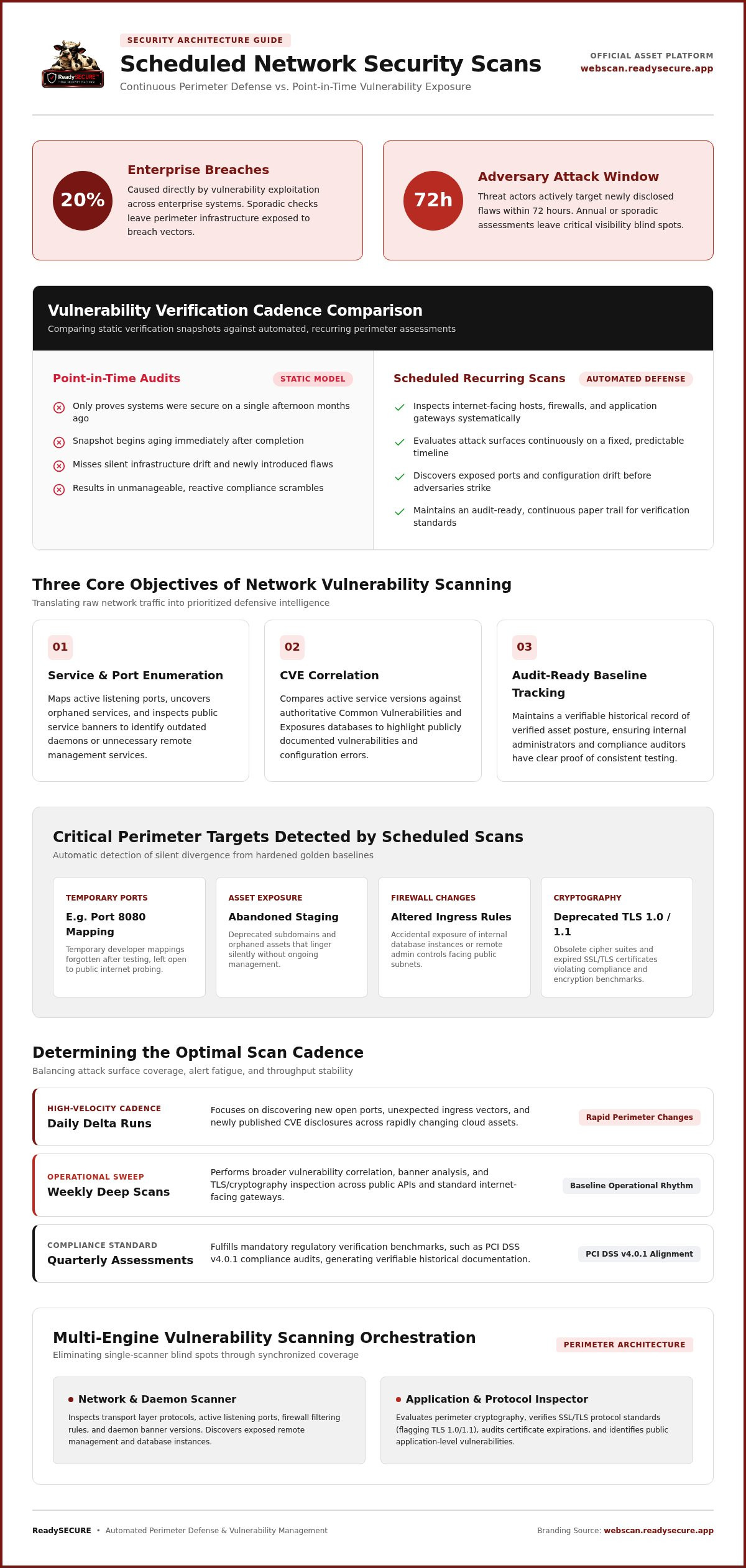
An annual security audit only proves your systems were secure on a single afternoon months ago. With vulnerability exploitation causing 20% of enterprise breaches and attackers targeting newly disclosed flaws within 72 hours, sporadic checks leave critical systems exposed. Implementing reliable scheduled network security scans bridges this gap, transforming static compliance exercises into continuous perimeter defense.
It is easy to agree that public IPs and APIs demand regular testing. However, figuring out how frequently to scan without degrading network throughput or drowning in alert fatigue isn't simple, especially when your team needs verifiable documentation for rigorous compliance audits.
This guide shows you how automated network scan cadences detect exposed vulnerabilities and protect internet-facing infrastructure before adversaries strike. We will walk through establishing cadences aligned with standards like PCI DSS v4.0.1, preventing blind spots from configuration drift, and maintaining an audit-ready paper trail across every environment.
Key Takeaways
- Understand why scheduled network security scans are essential for discovering exposed ports, weak configurations, and vulnerable services across public infrastructure.
- Detect silent infrastructure drift and newly published CVEs before threat actors can target recently altered cloud assets or network firewalls.
- Select the ideal scan cadence by comparing daily delta runs, weekly operational sweeps, and quarterly compliance assessments based on asset risk.
- Build an end-to-end scanning workflow that clearly scopes targets, handles alerts without notification fatigue, and produces continuous, audit-ready authorization records.
- Deploy multi-engine vulnerability scanning orchestration across your external perimeter to generate prioritized, actionable remediation data.
What Are Scheduled Network Security Scans and Why Do They Matter?
A scheduled network security scan is an automated, recurring assessment designed to systematically inspect internet-facing hosts, firewalls, and application gateways for discoverable flaws. Rather than reacting after an incident occurs, these automated routines evaluate your attack surface on a fixed, predictable timeline. Malicious actors use automated discovery tools around the clock to probe public subnets for weak configurations. Running disciplined scheduled network security scans ensures your team uncovers internet-facing exposures before external parties can target them.
Point-in-Time Audits vs. Recurring Automated Scans
Point-in-time assessments deliver a static snapshot of your perimeter, but that snapshot begins aging the moment testing finishes. Modern infrastructure changes quickly. Routine software updates, firewall policy adjustments, and DNS reconfigurations happen weekly, and any single change can open an unintended ingress vector.
Relying solely on an annual audit leaves massive visibility blind spots across your public assets. Deploying modern automated vulnerability scanners on an active schedule bridges this critical operational gap. Recurring cadences identify configuration drift as it occurs, preventing newly introduced flaws from lingering silently across months of unmonitored production changes.
The Core Objectives of Network Vulnerability Scanning
How does automated scanning translate network traffic into defensive intelligence? Systematic scanning provides clear visibility into external risk, shifting security teams from subjective guesswork to measurable evidence. A structured scan executes three core tasks:
- Service and Port Enumeration: Maps active listening ports, uncovers orphaned services, and inspects public service banners to identify outdated daemons or unnecessary remote services.
- CVE Correlation: Compares active service versions against authoritative Common Vulnerabilities and Exposures databases to highlight publicly documented vulnerabilities and configuration errors.
- Audit-Ready Baseline Tracking: Maintains a verifiable historical record of verified asset posture, ensuring internal administrators and compliance auditors have clear proof of consistent testing.
Executing regular scheduled network security scans turns perimeter hygiene into an organized, repeatable process rather than an unmanageable compliance scramble.
How Scheduled Scanning Detects Infrastructure Drift and New CVEs
Modern cloud environments evolve constantly. Rapid continuous integration cycles, ephemeral microservices, and routine firewall updates keep engineering teams agile, but they frequently introduce unintended exposures. A developer might temporarily map port 8080 to the public internet for testing and forget to tear it down. Without continuous verification, these orphaned services sit unprotected for weeks. Running automated scheduled network security scans catches these misconfigurations before external scanners find them.
Tracking Configuration Drift Across Internet-Facing Hosts
Configuration drift occurs when production assets quietly diverge from their hardened golden baselines. Abandoned staging subdomains, deprecated API endpoints, and altered ingress rules steadily erode your security posture. Regular port discovery tracks these perimeter changes automatically. By comparing current listening ports and active banners against known baseline states, scanning engines immediately flag newly exposed remote management ports or database instances that should never face the public internet.
Evaluating Perimeter Cryptography and SSL/TLS Standards
Transport layer encryption requires disciplined maintenance. Deprecated protocol versions like TLS 1.0 or 1.1 and obsolete cipher suites create significant compliance liabilities and expose data in transit to interception. Automated protocol inspection verifies certificate expiration dates, checks key exchange parameters, and ensures all exposed endpoints enforce modern cryptographic standards, keeping public services aligned with recognized technical benchmarks.
Multi-Engine Orchestration for Deep Vulnerability Coverage
Single-tool assessments leave blind spots. Relying on an isolated port scanner will not reveal web application vulnerabilities, while a standalone web scanner completely overlooks exposed network daemons. Effective posture monitoring requires multi-engine orchestration across your entire target range. Following standard NIST SP 800-115 security testing guidelines, a structured assessment synthesizes several specialized scanning layers:
- Port Discovery: Identifies reachable IP addresses, open TCP/UDP ports, and active operating system signatures.
- Comprehensive Network Vulnerability Assessment: Analyzes network service daemons against known CVE databases to spot outdated, exploitable packages.
- Cryptographic & Web Protocol Inspection: Audits SSL/TLS certificates, cipher suites, and HTTP security headers across public endpoints.
- Targeted Template Checks: Probes public web applications and APIs for zero-day signatures, exposed administrative panels, and misconfigured middleware.
Combining these specialized tools eliminates blind spots and dramatically reduces false negatives. If you want to check your public perimeter against these vectors without manual setup, running a ReadySECURE Free Scan establishes an immediate baseline across your exposed hosts.
Implementing regular scheduled network security scans that correlate multi-engine findings gives your engineers actionable remediation data instead of fragmented, unverified alert logs.
Determining Optimal Scan Frequency: Daily, Weekly, or Monthly Cadence?
How often should your organization run automated perimeter assessments? Setting an effective cadence requires balancing exposure risk against system resources. Scanning too rarely leaves dangerous visibility gaps, but scanning without structure can overwhelm engineering teams with alert noise. Establishing deliberate scheduled network security scans allows you to target critical assets aggressively while keeping production systems running smoothly.
Cadence Comparison: Daily vs. Weekly vs. Monthly
Different network tiers require distinct assessment intervals. Matching frequency to asset volatility ensures efficient protection across your environment:
- Daily Scans (High Exposure): Best for public-facing web applications, critical ingress APIs, and edge firewalls. Because automated exploits can materialize within days of CVE disclosure, rapid delta scans on external perimeters detect new listening services immediately.
- Weekly Scans (Standard Baseline): Recommended for corporate web servers, hosted databases, and auxiliary staging environments. Weekly intervals reflect established operational best practices, matching the cadence outlined in official CISA vulnerability scanning guidance.
- Monthly Scans (Low Volatility): Suitable for isolated internal subnets, static legacy appliances, and offline storage tiers where system changes occur infrequently.
Managing Bandwidth Consumption and Network Impact
Can automated scans disrupt active business operations? While intrusive penetration tests can cause downtime, non-destructive vulnerability assessments safely evaluate service banners and network handshakes. To prevent bandwidth strain on production services, schedule extensive port sweeps during off-peak maintenance windows. Applying connection rate-limiting prevents stateful firewalls from dropping legitimate user sessions and keeps application gateways responsive throughout the discovery run.
Meeting Regulatory and Compliance Mandates
Major security frameworks mandate strict adherence to regular testing cadences. Under PCI DSS v4.0.1, organizations must run external vulnerability scans at least quarterly using an Approved Scanning Vendor, alongside mandatory scans after every significant network update. Similarly, frameworks like SOC 2 and ISO 27001 require auditable evidence of continuous technical surveillance.
Maintaining a disciplined schedule turns compliance reporting into a straightforward exercise. Detailed historical logs generated by recurring scheduled network security scans provide external auditors with undeniable, timestamped proof of your proactive testing regimen.
How to Implement an Automated Network Security Scanning Workflow
Setting up recurring assessments requires more than pointing a scanner at a web server and hitting run. A haphazard deployment creates inaccurate findings, disrupts production services, and creates serious legal exposure. Establishing reliable scheduled network security scans demands a repeatable operational framework that balances thorough technical discovery with responsible asset governance.
Scoping Assets and Verifying Ownership Authorization
Every scanning initiative begins with an accurate boundary definition. Teams must catalog all internet-facing domains, static IP ranges, and cloud gateway subnets before launching automated assessments. Uncontrolled scanning can easily strike shared hosting tenants or upstream third-party APIs, triggering automated abuse complaints from hosting providers.
Security testing requires verified, documented authorization from the asset owner. Probing infrastructure without written consent crosses legal boundaries and risks violating computer crime laws. Legitimate vulnerability scanning platforms enforce signed authorization records to verify testing ownership, differentiating professional security operations from unauthorized scanning tools.
Configuring Scan Profiles and Alert Thresholds
How do engineering teams prevent notification fatigue from burying critical findings? The answer lies in disciplined profile configuration. Raw scan reports often overwhelm teams with informational flags like missing banners or common TLS ciphers. To prevent alert fatigue, structure your profiles to separate informational noise from genuine risk:
- Targeted Execution Profiles: Focus automated runs on high-impact exposures, including unpatched daemons, exposed administration interfaces, and critical remote code execution vectors.
- Prioritized Routing: Route critical and high-severity findings directly into operational communication channels like Slack or incident ticketing systems.
- Noise Reduction: Group low-severity informational observations into weekly summary digests rather than triggering immediate engineering alerts.
Establishing Structured Remediation and Verification Loops
Discovery holds zero value without structured follow-through. Once a scan identifies an active vulnerability, log the ticket directly into your development backlog. Track your team's mean time to remediate (MTTR) across deployment cycles to measure posture improvements objectively.
After your team applies a configuration update or security patch, automated verification ensures the fix worked. Consistent scheduled network security scans automatically re-test the updated endpoint on the next cycle, closing the remediation loop without manual intervention.
Ready to validate your current external perimeter? Run a ReadySECURE Free Scan today to audit your public endpoints and establish your initial security baseline.
Strengthen Your Infrastructure with ReadySECURE Scheduled Scans
Managing individual scanning utilities manually quickly turns into an administrative drain. Stitching together custom scripts for port mapping, network probing, and TLS audits leaves gaps in your perimeter coverage and creates disorganized data. ReadySECURE Paid Plans solve this operational challenge by providing a turnkey platform that orchestrates multiple trusted engines into coordinated, recurring assessments.
Orchestrated Multi-Engine Intelligence
Why depend on a single utility when network threats span multiple operational layers? ReadySECURE consolidates industry-standard engines into a single automated execution flow, giving your team deep visibility across hosts, applications, and network services:
- Nmap Port Scanning: Maps active host availability and enumerates open TCP and UDP ports across public IP blocks.
- OpenVAS Network Scanning: Analyzes operating systems and active services to identify unpatched daemons and cataloged CVEs.
- Nuclei Template-Based Scanning: Evaluates public web assets and endpoints against community-verified templates for rapid vulnerability detection.
- TestSSL Inspection: Audits transport layer security to flag weak ciphers, expired certificates, and obsolete TLS protocols.
- ZAP Active and Passive Scanning: Discovers security weaknesses and misconfigurations across exposed web application interfaces.
Teams seeking an immediate baseline before committing to a full recurring schedule can run a zero-friction ReadySECURE Free Scan to inspect primary perimeter endpoints.
Historical Tracking and Verifiable Audit Trails
Running isolated scans on an ad-hoc basis makes long-term risk assessment difficult. ReadySECURE Paid Plans track vulnerability lifecycles across consecutive evaluation cycles, charting regressions, remediated flaws, and configuration changes over time. Instead of handing engineers unformatted output, the platform delivers prioritized remediation reports with clear CVSS severity scoring. This prioritization eliminates alert fatigue, enabling your technical staff to patch critical exposures first.
Compliance readiness requires transparency. Every assessment includes a signed authorization record confirming that testing was conducted with verified asset ownership. These signed records give external auditors and compliance officers indisputable evidence of legitimate, authorized testing across your environments.
Take control of your attack surface with automated, multi-engine verification. You can set up scheduled network scans with ReadySECURE to protect your perimeter against configuration drift and emerging CVEs.
Build a Resilient Perimeter Through Continuous Verification
Relying on occasional assessments leaves your attack surface blind to rapid configuration drift and newly disclosed CVEs. Moving to a predictable cadence ensures that open ports, unpatched software daemons, and weak cryptographic protocols are flagged immediately. Consistent testing also generates the verifiable historical records required to satisfy rigorous compliance frameworks.
Effective perimeter hygiene doesn't require juggling disconnected tools or sorting through mountains of notification noise. ReadySECURE orchestrates industry-standard engines, including Nmap, OpenVAS, and Nuclei, into a single automated workflow. Every report delivers prioritized remediation guidance to eliminate alert fatigue, backed by signed authorization records that prove scan legitimacy to your auditors.
Establishing reliable scheduled network security scans ensures your team stays ahead of exposures without draining engineering resources. Schedule your automated network security scans with ReadySECURE today to maintain verified visibility across your entire external infrastructure.
Frequently Asked Questions
How often should an organization run scheduled network security scans?
Organizations should run scheduled network security scans weekly for standard corporate infrastructure, while critical, internet-facing APIs and edge gateways benefit from daily delta runs. Regulatory standards like PCI DSS v4.0.1 require external scans at least quarterly and after major network changes. Aligning your scan frequency with asset volatility ensures you catch newly introduced configuration drift and emerging CVEs before external parties identify exposed public endpoints.
Will automated network security scans disrupt production server traffic?
Non-intrusive automated scans generally do not disrupt production server traffic because they focus on querying service banners, network handshakes, and protocol configurations. Unlike aggressive exploit attempts, vulnerability scanners inspect open services without attempting service-denial attacks. Configuring sensible rate limits and running intensive port discovery during off-peak maintenance hours further minimizes bandwidth utilization and keeps application gateways performing normally.
What is the difference between a vulnerability scan and a penetration test?
A vulnerability scan is an automated assessment that discovers, catalogues, and prioritizes known security flaws and misconfigurations across your assets. In contrast, a penetration test is an authorized simulated attack designed to actively exploit vulnerabilities and chain flaws together to gain unauthorized system access. Automated scanning provides continuous, recurring posture tracking, whereas penetration testing offers a periodic, deep evaluation of defensive controls.
Why is written authorization mandatory before scanning an IP or domain?
Written authorization is mandatory because scanning external systems without explicit consent violates computer abuse laws and cloud provider acceptable use policies. Ethical security providers require verified proof of ownership to prevent bad actors from weaponizing automated tools. Attaching signed authorization records to completed scan reports also protects your organization legally and verifies testing legitimacy for compliance officers and external audit teams.
How do scheduled network scans detect zero-day vulnerabilities?
Automated scheduled network security scans detect zero-day and emerging threats by rapidly adopting updated signature sets and template-based detection tools like Nuclei as soon as security researchers document exploit patterns. While scanners cannot predict unpublished, uncataloged zero-day mechanisms, running continuous schedules ensures that newly released proof-of-concept signatures and CISA Known Exploited Vulnerabilities catalog entries flag exposures within hours of public disclosure.
Can automated network scans satisfy SOC 2 and ISO 27001 requirements?
Yes, automated scans satisfy continuous monitoring and vulnerability management controls mandated by SOC 2, ISO 27001, and NIST frameworks. Auditors require verifiable, timestamped evidence showing that your organization regularly tests perimeter systems, documents remediation activities, and tracks vulnerability history over time. Maintaining recurring schedules alongside signed authorization logs provides third-party auditors with clear, tamper-resistant documentation of operational security diligence.
What happens if a scheduled scan detects an active, critical vulnerability?
When a scan detects an active critical vulnerability, the platform flags the exposure with prioritized severity scoring and provides direct technical remediation details. Alerts route immediately to your engineering team so they can isolate the affected host or deploy an urgent patch. Once the team applies the necessary configuration fix, the next automated schedule re-scans the target, verifying that the issue is fully resolved without manual triage.


