

How many internet-facing assets does your organization actually own, and are you certain none of them were forgotten during the last cloud migration? Identifying every host is a critical first step. However, the real challenge lies in the volume of data produced by security tools. Most teams feel overwhelmed by the daily release of new CVEs and the constant fear of "shadow IT" lurking in their infrastructure. You likely agree that having more data isn't the same as having better security. This is why automated vulnerability detection is shifting from simple tool-running toward orchestrated multi-engine intelligence.
This shift focuses on clarity and legal integrity rather than just generating long lists of potential issues. You'll understand how automated vulnerability detection is evolving in 2026 and how to implement a professional, authorized scanning strategy for your digital assets. We'll explore the current trends in scanning technology, provide a framework for prioritizing your most critical security issues, and outline a reliable way to begin scanning your environment with confidence. By the end of this guide, you'll have a clear path to move from technical noise to actionable security intelligence.
Key Takeaways
- Understand how security is shifting from static annual audits to continuous monitoring to catch weaknesses as they appear.
- Learn why modern automated vulnerability detection now relies on orchestrated stacks rather than individual, siloed tools.
- Identify the core engines, including Nmap and OpenVAS, that provide the technical depth needed for a thorough network assessment.
- Navigate the legal complexities of security scanning by ensuring every audit is backed by a signed authorization record.
- Discover how to consolidate findings from six different scanners into one prioritized report to focus your remediation efforts effectively.
What is Automated Vulnerability Detection in 2026?
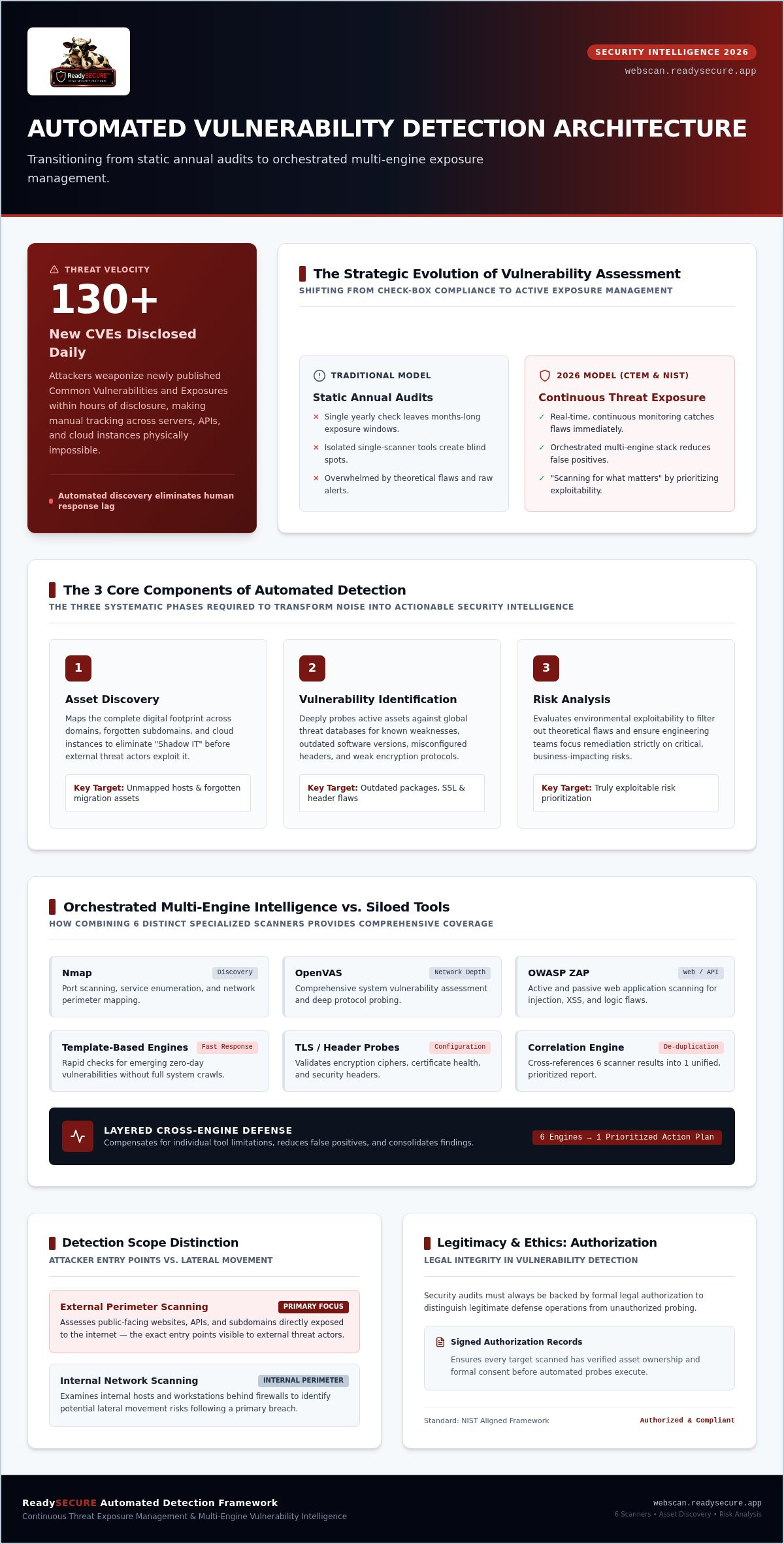
In the current security environment, automated vulnerability detection is defined as the systematic use of specialized software to continuously discover, analyze, and report security weaknesses within digital assets. This process has moved far beyond the traditional model of static, annual audits. In the past, companies might have felt secure after a single yearly check. Today, that approach is dangerously insufficient. Modern organizations now rely on automated vulnerability scanners to provide a real-time view of their security posture. This transition toward continuous monitoring ensures that new flaws are identified as soon as they emerge, rather than months after a breach has occurred.
The scale of the challenge makes this shift mandatory. Industry reports indicate that over 130 new Common Vulnerabilities and Exposures (CVEs) are disclosed daily. For a standard security team, tracking these updates manually across every server, API, and cloud instance is physically impossible. Automation bridges this gap by instantly matching your specific infrastructure against global threat databases. It's also important to distinguish between internal network scanning and external, internet-facing host scanning. While internal scans look for lateral movement risks inside a perimeter, external automated vulnerability detection focuses on the assets most visible to attackers: your public websites and APIs.
The Core Components of Detection
- Asset Discovery: You cannot protect what you don't know exists. This phase involves mapping your entire digital footprint to find forgotten subdomains or "shadow IT" hosts before an external threat actor does.
- Vulnerability Identification: Once assets are mapped, the system probes them for known weaknesses, such as outdated software versions, misconfigured headers, or weak encryption protocols.
- Risk Analysis: Not every flaw is a crisis. Modern tools help determine which vulnerabilities are actually exploitable in your specific environment, allowing you to prioritize your limited remediation time.
Why Automation is Non-Negotiable
The speed of modern exploits has outpaced human response times. Attackers often weaponize a new CVE within hours of its public disclosure. Automated systems work without fatigue, ensuring that repetitive security checks are performed with consistent precision. This reliability reduces the risk of human error, which remains a leading cause of misconfigurations. Additionally, as your business grows, automated vulnerability detection scales with you. It allows a single security professional to maintain oversight across hundreds of domains and complex API structures without a proportional increase in manual workload.
Key Trends Shaping Security Assessment in 2026
How do security teams stay ahead of threats when the attack surface expands every hour? In 2026, the strategy is shifting from reactive patching to Continuous Threat Exposure Management (CTEM). This approach doesn't just look for bugs; it evaluates the entire lifecycle of exposure. By aligning with established NIST cybersecurity standards, organizations are moving away from "scanning for everything" and toward "scanning for what matters." This prioritization ensures that resources are focused on vulnerabilities that pose a genuine risk to business continuity rather than wasting time on theoretical flaws that cannot be exploited.
From Single Scanners to Orchestrated Stacks
Relying on a single engine is no longer a viable strategy for professional security. While tools like ZAP are powerful for active and passive web scanning, they cannot provide a complete picture of your network or SSL configuration on their own. Modern automated vulnerability detection requires an orchestrated stack. Professional platforms now combine multiple specialized engines, such as Nmap for discovery and OpenVAS for network depth, into a single, unified workflow. Why is this cross-engine approach necessary? It provides a layered defense where the strengths of one tool compensate for the limitations of another. Cross-referencing results between different engines reduces false positives and ensures that a weakness missed by one scanner is caught by another. You can see this multi-engine approach in action with a ReadySECURE Free Scan, which provides a comprehensive overview of your target using six distinct engines.
The Role of Template-Based Detection
When a new zero-day vulnerability is announced, waiting for a full system crawl is often too slow. This is where nuclei template scanning has become essential. These templates allow for targeted security checks without the overhead of a complete system crawl. Because they are community-driven, templates for new exploits are often available within hours of a vulnerability being discovered. This rapid response capability is a cornerstone of modern automated vulnerability detection, providing a way to verify specific risks across thousands of hosts instantly. Templates essentially function as precise digital signatures that look for a specific flaw, making them highly efficient for rapid response scenarios where time is the most critical factor.
The Professional Scanning Stack: Essential Engines
Why do many security platforms hide the specific tools they use to generate reports? Transparency is vital for establishing trust in your security posture. Professional automated vulnerability detection relies on a specific set of verified, industry-standard engines rather than opaque, proprietary black boxes. By utilizing a stack that includes Nmap, OpenVAS, OWASP ZAP, Nuclei, and TestSSL, you gain a comprehensive view of your infrastructure. Each of these engines serves a distinct purpose, ensuring that no layer of your digital environment remains unexamined. This multi-layered approach is the only way to achieve the depth required for modern security audits.
Network vs. Application Layer Detection
Why is a single-layer approach insufficient for protecting your assets? Attackers don't limit themselves to one layer, and your defense shouldn't either. Nmap acts as the foundation by identifying open ports and unnecessary services that increase your attack surface. OpenVAS then builds on this by scanning these hosts for thousands of known network-level flaws. To prioritize effectively, professional teams cross-reference these findings with the CISA Known Exploited Vulnerabilities Catalog. This helps distinguish between theoretical bugs and those actively used in the wild. Meanwhile, ZAP provides visibility into the application layer, catching flaws like SQL injection or cross-site scripting that network scanners typically miss. Addressing the specific risks of internet-facing hosts requires this dual visibility to prevent both service-level exploits and application-level breaches.
SSL and API Security
Is your encryption truly secure? Simply having a valid certificate is no longer enough to ensure safety. Many teams overlook that automated ssl certificate inspection is about more than just expiration dates. It involves checking for weak cipher suites, protocol vulnerabilities such as Heartbleed, and certificate chain issues. This is especially critical for APIs, which often handle sensitive data transfers between services. In 2026, dynamic API environments require scheduled automated vulnerability detection to catch misconfigurations introduced during rapid development cycles. Scanning for the OWASP Top 10 ensures your interfaces remain resilient against modern injection and authentication attacks. Regular inspection of these endpoints prevents the silent failure of encryption protocols that could leave your data exposed to interception.
Legitimacy and Ethics: The Authorization Hurdle
Can you legally scan any website on the internet? The answer is a definitive no. While the tools for automated vulnerability detection are widely available, using them without explicit permission is a serious legal risk. Unauthorized scanning, even when performed with good intentions, can be classified as a cyberattack under various international computer crime laws. This distinction is what separates ethical security professionals from malicious actors. Ethical hacking requires a clear, documented mandate before a single packet is sent to a target. Without this, you risk legal repercussions and potential service disruptions for the target organization.
Proving You Own the Target
How does a professional platform ensure it's operating within legal boundaries? The process begins with rigorous domain verification and written consent. Professional security services refuse to scan unauthorized third-party sites to prevent their infrastructure from being used in hostile activities. Instead, they require users to prove ownership of the digital assets being tested. A critical component of this ethical framework is the "Authorization Record." This document acts as a digital handshake, providing a trail of signed authorization that can be presented during compliance audits. When you use automated vulnerability detection through a reputable provider, a signed record is typically attached to every scan report. This ensures that your security efforts are recognized as legitimate, authorized audits by stakeholders and legal entities alike.
Remediation Guidance and Prioritization
What should you do once the scan is complete? A common frustration for security teams is receiving a raw list of bugs without any context on how to fix them. Effective remediation starts with turning that data into a prioritized action plan. This involves understanding Common Vulnerability Scoring System (CVSS) severity scores, which range from Low to Critical. High and Critical flaws represent immediate risks that could lead to data breaches or system takeovers. By utilizing a structured automated vulnerability assessment, developers can focus their energy on the most dangerous flaws first. This disciplined approach prevents teams from being paralyzed by "security noise" and ensures that the most significant gaps are closed quickly. If you are ready to secure your assets legally and effectively, you can start with an authorized security scan to identify your most pressing risks today.
Implementing Automated Detection with ReadySECURE
How does an organization move from recognizing the need for security to executing a professional audit? ReadySECURE simplifies this transition by orchestrating six industry-standard scanners into a single, unified report. This approach addresses the common problem of "potential exposure" versus "prioritized risk." Instead of managing separate, disjointed outputs from engines like Nmap, OpenVAS, ZAP, TestSSL, and Nuclei, you receive a consolidated view that highlights the most critical vulnerabilities first. This orchestration ensures that your automated vulnerability detection strategy is both comprehensive and efficient, providing a clear path from discovery to remediation.
Transitioning from a reactive posture to proactive risk management requires more than just tools; it requires a disciplined framework. By centralizing the results of multiple scanning engines, you eliminate the technical noise that often paralyzes security teams. This allows you to establish a professional, authorized baseline for your website security. Once this baseline is set, you can move toward a model of continuous improvement where security is integrated into your operational rhythm rather than treated as an afterthought.
The ReadySECURE Free Scan
Establishing a security baseline shouldn't be a complex hurdle. The ReadySECURE Free Scan allows you to obtain a comprehensive view of one target at no cost. This isn't a superficial check; it utilizes the same professional engine stack to identify weaknesses across your network and application layers. Every report generated through this service includes specific components designed for clarity:
- Prioritized Severity Rankings: Findings are categorized by risk level to guide your immediate actions.
- Multi-Engine Findings: Detailed technical data from all six integrated scanners is presented in one place.
- Authorization Record: A signed record is attached to every scan to ensure your activities are documented as legal and authorized.
This record provides professional peace of mind, ensuring that your security efforts meet the ethical standards discussed earlier in this guide.
Advanced Monitoring and Trend Analysis
Security isn't a one-time event but a continuous process. While a single scan provides a snapshot of your current state, ReadySECURE Paid Plans enable you to scale your monitoring across multiple targets and internet-facing hosts. This scalability is vital for organizations managing complex cloud environments or multiple subdomains. One of the primary benefits of these plans is the ability to conduct historical reporting and trend analysis. By tracking your security posture over time, you can verify if remediation efforts are effective or if new misconfigurations are being introduced during deployment cycles. Get started with a ReadySECURE Free Scan today to begin securing your digital assets with a professional, authorized baseline.
Establishing a Proactive Defense for 2026
The shift toward continuous monitoring and orchestrated stacks is no longer optional for organizations that value their digital integrity. You've learned that effective security requires a combination of network, application, and SSL visibility to stay ahead of the daily influx of new vulnerabilities. Most importantly, professional scanning must always be grounded in legal authorization to protect your business from unnecessary risk. Moving from a reactive posture to one of disciplined oversight ensures that your security efforts remain both effective and legally sound.
Implementing automated vulnerability detection shouldn't be a source of confusion or technical noise. By consolidating the power of 6 industry-standard scanning engines into one report, you gain the clarity needed to act. Every audit through ReadySECURE includes signed authorization records and prioritized remediation guidance to ensure your team focuses on the most critical flaws first. This structured approach replaces uncertainty with actionable intelligence.
Run your first authorized security audit with ReadySECURE Free Scan and take the first step toward a resilient security posture. You have the tools to move from reactive patching to a disciplined, professional defense.
Frequently Asked Questions
Is automated vulnerability detection as good as a manual pen test?
Automated detection and manual testing serve different roles. Automated tools provide continuous, scalable coverage for known vulnerabilities across your entire environment. Manual testing involves human led exploitation of complex logic flaws. While we don't offer manual testing, our service provides the essential automated foundation needed to catch thousands of common flaws as they emerge. This ensures you're protected between annual manual assessments without the high cost of constant human intervention.
Can I legally scan any website for vulnerabilities?
You cannot legally scan a website without explicit, written permission from the owner. Unauthorized scanning is often treated as a criminal act under computer misuse laws. Professional services like ReadySECURE require domain verification and a signed authorization record to ensure all activities are legitimate. This documentation protects you during compliance audits and establishes a clear ethical boundary for your security operations. Always ensure you have documented consent before beginning any audit.
How often should I run an automated vulnerability scan?
You should run scans weekly or after every major deployment. Because over 130 new CVEs are disclosed daily, an annual or monthly schedule leaves your organization exposed for too long. Implementing automated vulnerability detection on a frequent schedule allows you to catch new misconfigurations or outdated components before attackers can exploit them. Our paid plans include the scheduling tools necessary to maintain this proactive security rhythm and track your progress over time.
What is the difference between active and passive scanning?
Passive scanning observes network traffic and server responses without interacting with the target directly. It's non intrusive and identifies visible software versions or header misconfigurations. Active scanning sends specific probes and payloads to the target to verify if a vulnerability is actually exploitable. ReadySECURE utilizes ZAP for both active and passive scanning to provide a comprehensive view of your application layer. This combination ensures that both surface level and deep seated flaws are identified.
How do I interpret a CVE severity score in my report?
You should prioritize remediation based on the CVSS score, focusing on "Critical" and "High" findings first. A Critical score indicates a flaw that is easily exploitable and could lead to full system compromise. Our reports categorize results from all six engines into a single, prioritized list. This structure helps your development team address the most dangerous risks without getting distracted by low impact informational findings that don't pose an immediate threat.
Does automated scanning slow down my website or API?
Professional scanning is designed for efficiency, but active probes do generate traffic. Most modern web servers and APIs handle these requests without noticeable performance loss for end users. If your environment is highly sensitive, you can schedule scans during low traffic periods. This ensures that automated vulnerability detection provides deep security insights without impacting your site's availability. It's a balanced approach to maintaining both high performance and a strong security posture.
Why do I need multiple scanners like Nmap and OpenVAS together?
No single tool can identify every type of security weakness. Nmap is the industry standard for discovering open ports and services, while OpenVAS provides deep network level vulnerability checks for those services. By using six different engines, including TestSSL and Nuclei, ReadySECURE covers the network, application, and encryption layers simultaneously. This orchestration provides a much more accurate picture of your attack surface than any individual scanner could ever achieve alone.
What happens if a scan finds a critical vulnerability?
You should follow the remediation guidance provided in your prioritized report immediately. The report details the nature of the flaw and the specific steps required to close the gap. Once your team applies the fix, you should run a follow up scan to verify that the vulnerability is no longer detectable. This disciplined cycle of detection, remediation, and verification is the core of a professional security management process and ensures your assets remain protected.


