

Why does your vulnerability scanner flag a thousand low-priority issues while missing the one critical exploit that actually puts your data at risk? Traditional security tools often prioritize quantity over quality, leaving teams to sift through endless logs of irrelevant noise. It's a common frustration for security professionals who need to identify real threats before they're exploited. You shouldn't have to choose between comprehensive coverage and actionable clarity.
This guide demonstrates how nuclei template scanning leverages community intelligence to identify exploitable risks with surgical precision. You'll discover how this template-based approach allows you to stay ahead of newly discovered vulnerabilities without the complexity of manual command-line operations. We'll explain the underlying mechanism of these templates and show how to integrate them into a professional security stack. By the end of this article, you'll understand how to generate prioritized remediation data that protects your digital boundaries effectively. We'll also examine how to move from manual one-off checks to a disciplined, automated scanning process.
Key Takeaways
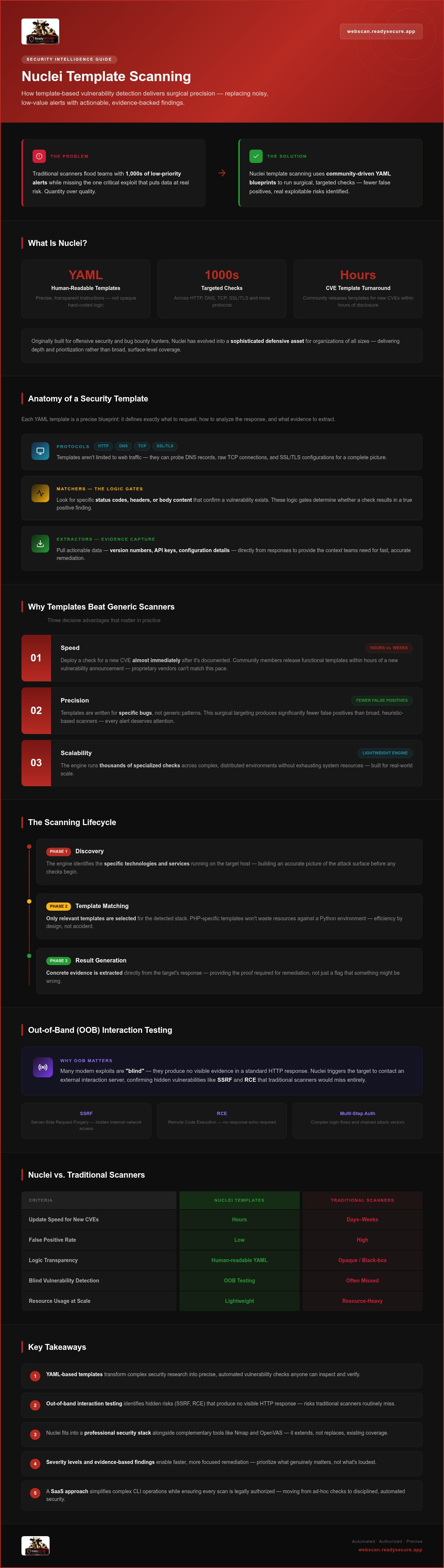
- Understand how YAML-based templates transform complex security research into precise, automated vulnerability checks.
- Learn how the execution engine uses out-of-band interaction testing to identify hidden risks that traditional scanners often overlook.
- Discover how nuclei template scanning fits into a professional security stack alongside complementary tools like Nmap and OpenVAS.
- Gain the skills to interpret severity levels and use evidence-based findings for faster, more effective remediation.
- Explore how a SaaS approach simplifies complex CLI operations while maintaining strict legal authorization for every scan.
What is Nuclei Template Scanning?
Nuclei is a template-based vulnerability scanner that has redefined how security teams identify exploitable risks. Unlike traditional scanners that use opaque, hard-coded logic, nuclei template scanning relies on human-readable YAML files to define security checks. These templates act as precise instructions for the scanner, telling it exactly what to look for and how to interpret the results. This approach provides a level of flexibility and transparency that is often missing in legacy security software.
Originally built for offensive security professionals and bug hunters, Nuclei has evolved into a sophisticated defensive asset for organizations of all sizes. Its strength lies in its ability to scan for thousands of specific vulnerabilities across various protocols, including HTTP, DNS, and TCP. By shifting from broad, generic checks to targeted templates, security teams can identify critical flaws without the "noise" typically associated with traditional vulnerability management tools. It's a tool designed for depth and prioritization rather than just broad surface-level coverage.
The Anatomy of a Security Template
A security template is essentially a blueprint for a vulnerability check. Within the YAML file, the scanner finds instructions on how to construct a request and what specific patterns in the response indicate a successful exploit. This structure ensures that every scan is predictable and repeatable. The following components are central to how these templates function:
- Protocols: Templates aren't limited to web traffic; they can probe DNS records, raw TCP connections, or even SSL/TLS configurations.
- Matchers: These are the logic gates of the template. They look for specific status codes, headers, or body content that confirm a vulnerability exists.
- Extractors: These allow the scanner to pull useful information, such as software version numbers or API keys, directly from the response to provide better context for remediation.
Why Templates Matter for Modern Security
Why are teams moving toward this model? The answer lies in the speed of the global security community. When a new Critical Vulnerability and Exposure (CVE) is announced, community members often release a functional Nuclei template within hours. This rapid turnaround provides a level of protection that proprietary vendors simply can't match with their slower development cycles. The benefits of this model are clear:
- Speed: You can deploy a check for a new threat almost immediately after it's documented.
- Precision: Because templates are written for specific bugs, they produce significantly fewer false positives than generic scanners.
- Scalability: The engine is lightweight, allowing it to run thousands of specialized checks across complex, distributed environments without exhausting system resources.
How Does Template-Based Vulnerability Detection Work?
How does the engine translate a static YAML file into a live security check? The execution engine acts as a functional bridge between the template's logic and the target network. It parses the YAML instructions, sends the formatted requests, and analyzes the responses in real time. This process is highly optimized to handle thousands of requests without overwhelming the target system. In 2026, maintaining template compatibility through strict versioning is vital. It ensures that your security checks don't fail when the core engine receives updates or new features.
Many modern exploits are "blind," meaning they don't return immediate evidence in a standard HTTP response. Nuclei addresses this through out-of-band (OOB) interaction testing. By triggering the target to contact an external interaction server, the scanner can confirm vulnerabilities like SSRF or RCE that would otherwise remain hidden. Additionally, the engine supports complex workflows and authentication. This allows the scanner to handle multi-step login processes or chain multiple templates together to verify sophisticated attack vectors.
The Scanning Lifecycle
A professional scan follows a logical progression to ensure efficiency and depth. It begins with the discovery phase, where the engine identifies the specific technologies and services running on the host. Once the stack is known, the template matching phase selects only the relevant security checks. This prevents the scanner from wasting resources by running PHP-specific templates against a Python environment. Finally, result generation extracts concrete evidence directly from the target's response, providing the proof needed for remediation.
Community vs. Custom Templates
The strength of nuclei template scanning comes from the ProjectDiscovery community. This global network of researchers provides real-time threat intelligence by contributing templates for the latest CVEs almost as soon as they're discovered. While community templates cover most public risks, organizations often develop custom templates to test internal business logic or proprietary APIs. However, you must be cautious with unverified third-party templates. Malicious or poorly written code can lead to inaccurate results or unintended system instability. Professional teams often use authorized scanning platforms to ensure they are using verified, high-quality template libraries that have been vetted for safety and performance.
Nuclei vs. Traditional Scanners: Which is Better for Your Stack?
Is one tool enough to secure a modern web architecture? Probably not. While traditional Dynamic Application Security Testing (DAST) tools like OWASP ZAP are excellent for crawling applications and identifying generic vulnerabilities, they often lack the specificity needed for the latest threats. Nuclei template scanning fills this gap by focusing on targeted detection. Instead of broad signature-based detection that might flag any "suspicious" header, template-based logic looks for precise indicators of a known exploit. This makes it an essential part of a professional free website security scan. It complements network scanners like OpenVAS and Nmap by moving beyond port discovery into deep vulnerability validation. While Nmap identifies which ports are open and OpenVAS checks for known network-level service vulnerabilities, Nuclei probes the application layer for specific, complex exploit chains.
Strengths and Limitations
Where does each tool excel? Nuclei is the industry leader for identifying misconfigurations, specific CVEs, and tech-stack bugs. It doesn't waste time spidering an entire site if it's looking for a specific WordPress plugin flaw. Conversely, traditional scanners are better at discovering "hidden" application logic through aggressive crawling and automated form testing. The most effective defense comes from the synergy of both. Integrating these tools into a continuous security scanning strategy ensures that you catch both systemic architectural flaws and the latest zero-day exploits. It's a disciplined approach that balances broad coverage with surgical depth.
Performance and Noise
How do these tools impact your server? Heavy-weight scanners can inadvertently cause performance degradation by flooding a target with generic payloads for every possible field. Nuclei is significantly lighter. It only sends the requests defined in the selected templates, which reduces server load and bandwidth consumption. This efficiency leads to a much higher signal-to-noise ratio. You spend less time investigating false positives and more time fixing real bugs. In an enterprise environment, managing the volume of data is critical. Traditional scanners often group results by generic categories, but template-based findings are inherently more granular. This allows security teams to filter results by specific tech stacks or exploit types, ensuring that critical findings don't get lost in a sea of "info" level alerts.
Best Practices for Interpreting and Acting on Nuclei Findings
How do you turn a list of results into a secure environment? It starts with understanding the severity levels generated during nuclei template scanning. Critical and High findings usually represent direct paths to compromise, such as Remote Code Execution (RCE) or SQL injection. Medium and Low findings often highlight security debt or misconfigurations that, while not immediately exploitable, provide a foothold for attackers. Info-level alerts are purely for reconnaissance, identifying technologies or headers that aren't inherently bugs but aid in profiling. This classification allows you to filter out noise and focus on the vulnerabilities that present the highest risk to your operations.
Every result from nuclei template scanning includes concrete evidence. This might be a specific string found in a response or a successful interaction with an out-of-band (OOB) server. You should always use this evidence to confirm the bug manually before assigning it for repair. Most templates include a Proof of Concept (PoC) that demonstrates exactly how the vulnerability was triggered. This transparency removes the guesswork for developers and ensures that remediation efforts are focused on verified risks rather than hypothetical threats.
Don't treat all findings equally. Prioritize based on the exploitability of the bug and the value of the affected asset. A Critical bug on a public-facing web server demands immediate attention. Conversely, the same bug on an isolated internal staging environment might be scheduled for a later sprint. To streamline this process, start a professional vulnerability scan to get prioritized reports that separate background noise from critical risks.
Common Nuclei Findings and Their Meaning
Nuclei often uncovers risks that broad scanners miss. Exposed sensitive files, such as .env or .git directories, are common findings that can lead to credential theft. Software version misconfigurations often reveal known CVEs that are easily exploitable. Additionally, the engine is highly effective at identifying DNS-level risks, such as subdomain takeovers, where a CNAME points to a decommissioned service. Understanding these categories helps you categorize the root cause of your security gaps.
Remediation Workflow
A disciplined remediation workflow is essential for long-term security. First, assign ownership of every finding to the development team responsible for the specific asset. This ensures clear accountability. Second, use your scan history to track the "time to fix" for different vulnerability classes. This data helps identify bottlenecks in your security process. Finally, always perform regression testing. Re-running the specific template after a patch is applied is the only way to verify that the risk has been successfully eliminated.
How ReadySECURE Automates Authorized Nuclei Scanning
How does a team move from manual, sporadic checks to a disciplined security posture? While the technical power of nuclei template scanning is clear, the operational overhead of managing command-line environments and manual template updates can be prohibitive. ReadySECURE eliminates this complexity by providing a professional SaaS interface for Nuclei. This approach allows security stakeholders to leverage deep vulnerability detection without the need for specialized infrastructure management. It turns a complex offensive tool into a reliable defensive asset.
A critical, often overlooked component of professional scanning is the Authorization Record. Scanning a network without documented permission can lead to legal complications or be mistaken for malicious activity. ReadySECURE addresses this by providing signed authorization records for every scan. This ensures that your security testing is not only thorough but also fully compliant with digital boundaries and ethical standards. It's a layer of professional transparency that protects both the security researcher and the organization.
Nuclei doesn't operate in isolation within the ReadySECURE stack. It works alongside five other industry-standard tools, including Nmap for port discovery, OpenVAS for network vulnerabilities, and ZAP for active application testing. By combining these results, the platform provides a holistic view of your security posture. This integration allows the system to cross-reference findings, ensuring that a vulnerability discovered by one scanner is validated and prioritized against the broader context of your environment.
The ReadySECURE Advantage
Consistency is the foundation of digital safety. ReadySECURE offers automated scheduling to ensure that your internet-facing hosts are monitored continuously rather than just during annual audits. The platform generates consolidated reports that merge findings from all six scanners into a single, unified view. Instead of sifting through disparate logs, you receive prioritized remediation steps for every discovered issue. This clarity allows your team to focus on resolution rather than data interpretation. It's about moving from raw data to a secure resolution efficiently.
Getting Started with Your First Scan
The process is designed to be straightforward and transparent. You begin by submitting your domain and providing the necessary authorization through the platform. Once the scan is complete, you'll receive your first prioritized security report, which highlights exploitable risks and provides actionable evidence for your development team. You can start your ReadySECURE Free Scan today to see Nuclei in action and begin securing your infrastructure with surgical precision.
Securing Your Infrastructure with Precision
Nuclei template scanning provides a surgical alternative to the generic noise of traditional vulnerability scanners. By leveraging community-powered intelligence, you can identify exploitable risks with a level of accuracy that was previously reserved for manual penetration testing. You now understand how template-based logic identifies hidden vulnerabilities and why a multi-scanner approach is essential for a comprehensive defense. A disciplined security posture requires more than just raw data; it requires authorization, prioritization, and actionable evidence.
ReadySECURE simplifies this process by integrating six industry-standard scanners into a single professional interface. We provide signed authorization records for every scan to ensure your testing remains legally compliant and ethically sound. You'll receive consolidated reports with prioritized remediation guidance, allowing your team to focus on the flaws that actually matter. It's time to move beyond manual one-off checks and establish a consistent, automated monitoring routine. Start your ReadySECURE Free Scan today to gain clear visibility into your internet-facing hosts. Protecting your digital boundaries is a continuous journey, and we're here to provide the technical rigor you need to stay secure.
Frequently Asked Questions
What is a Nuclei template?
A Nuclei template is a human-readable YAML file that defines a specific security check. It contains the logic for sending requests and identifying vulnerabilities through matchers and extractors. These templates act as a blueprint, telling the engine exactly what to look for, such as a specific misconfiguration or a known CVE. This approach allows for highly targeted detection without the need for complex, hard-coded scanning signatures.
Is Nuclei template scanning safe for production environments?
Yes, nuclei template scanning is generally safe for production because it's designed to be lightweight and non-intrusive. Unlike broad fuzzers that send thousands of random payloads, Nuclei sends targeted requests defined by the template logic. This precision reduces the risk of service disruptions. When you use a professional platform, scans are further optimized to ensure stability while maintaining the integrity of your live internet-facing hosts.
How often are Nuclei templates updated?
Templates are updated almost daily by a global community of security researchers and engineers. When a new critical vulnerability is announced, a functional template often appears in the public repository within hours. This rapid turnaround ensures that your security posture stays current with the latest threat intelligence. Regular, scheduled scanning is the most effective way to take advantage of these frequent community-driven updates for your infrastructure.
Can Nuclei detect zero-day vulnerabilities?
Nuclei primarily detects known vulnerabilities that have been defined in a template. It doesn't "predict" unknown flaws, but it's often the first tool to have a working check after a zero-day becomes public. If your internal team discovers a unique vulnerability, you can write a custom template to detect it across your environment. This flexibility allows you to turn proprietary security research into automated detection faster than traditional tools.
What is the difference between Nuclei and a traditional port scanner?
A port scanner like Nmap identifies open ports and services, while Nuclei probes those services for specific application-layer vulnerabilities. Port scanning is a reconnaissance step that maps your attack surface. Nuclei template scanning goes deeper by validating whether those discovered services are actually exploitable. Using both tools together provides a complete picture of your network's exposure and the specific risks that require immediate remediation.
How do I prove I have authorization for a Nuclei scan?
You can prove authorization by maintaining a signed record that documents your permission to scan specific assets. Professional services like ReadySECURE provide a signed authorization record for every scan performed through the platform. This document serves as legal proof that the testing was requested by the asset owner. Having this record is vital for distinguishing legitimate security audits from unauthorized or malicious activity on your network.
Do I need to be a developer to use Nuclei results?
You don't need to be a developer to understand the findings, but technical knowledge is helpful for the remediation phase. The scan results include prioritized severity levels and concrete evidence, such as the specific response that triggered the alert. This documentation is designed to be shared directly with your development or IT teams. Our reports provide actionable guidance that explains the risk and the steps needed to fix it.
What protocols can Nuclei scan besides HTTP?
Nuclei is highly versatile and supports several protocols beyond standard web traffic. It can scan DNS records for misconfigurations, test SSL/TLS settings, and probe raw TCP or UDP connections. This multi-protocol support allows it to identify risks like subdomain takeovers or insecure mail server configurations. By covering more than just the HTTP layer, it provides a more comprehensive view of the security posture for all your internet-facing hosts.


