

A board report should turn cyber risk into a clear business decision, not a catalogue of technical findings. To understand how to present security posture to the board, show the most significant risks, their potential business impact, the actions underway, and what has changed since the previous report. Make clear where leadership needs to decide or provide support.
It’s understandable to want enough detail to demonstrate that security is being managed while keeping the discussion accessible to directors who aren’t security specialists. The goal isn’t to hide complexity. It’s to explain what matters, why it matters, and whether mitigation is reducing exposure.
This article explains what a board-level security report should contain and how to describe likelihood, impact, scoring, and mitigation in plain language. It also covers how to show security trends, visibility gaps, and changes to the attack surface, so directors can see where risk is moving and where attention is needed.
Key Takeaways
- Frame cyber risk in terms of business exposure, using likelihood and potential impact to explain why an issue deserves attention.
- Show how risks are distributed across the organization and connect each priority to mitigation progress, ownership, and the next decision needed.
- Explain what a risk score measures and how severity, exploitability, and business context shape prioritization.
- Track posture over time with measures such as remediation times, incident detection speed, and compliance scores.
- Refresh visibility after major IT changes or a security incident so new assets and exposures are reflected in board discussions.
Communicating cyber risk to executives and boards
Directors should ask which business assets face the greatest cyber risk, how management ranks that exposure, and whether mitigation is working. These questions connect cybersecurity decisions to organizational priorities, operational resilience, and oversight.
Board Oversight Requirements
Board oversight means directors receive information about cybersecurity-related risks and understand how management monitors them. For public companies, the U.S. Securities and Exchange Commission requires disclosure of the board of directors' oversight of cybersecurity-related risks under Regulation S-K Item 106. This makes clear reporting important: directors need an accurate account of oversight, not just technical updates.
ISO 27001 is a framework for information security management, according to the International Organization for Standardization. A framework can help organize policies, responsibilities, and risk controls, while board reporting explains how those arrangements support the organization’s priorities. Directors should be able to distinguish management’s day-to-day security responsibilities from the board’s oversight role.
Cyber Risk Assessment and Prioritization
A cyber risk assessment identifies important assets, vulnerabilities, likely exploitation, and potential business impact. Prioritization then weighs the likelihood that a threat will exploit a weakness against the damage that could follow. This gives executives a basis for directing attention and resources to risks with greater potential consequences.
For example, an exposed system supporting a critical business process may need attention before a lower-impact issue. Explain the asset involved, the weakness, the possible effect, and the planned response. Show how third-party risk management fits, especially when suppliers or service providers connect to important systems.
Monetary Cyber Risk Quantification
Monetary quantification translates a cyber scenario into potential financial consequences, helping leaders compare risk with other business concerns. For an organization’s own scenarios, management can describe potential costs of response, service disruption, recovery, and lost business without presenting an estimate as a certain outcome.
Show the assumptions behind each estimate. Explain which systems or assets could be affected, how long disruption might last, and which business activities depend on them. If management uses a range or scenario, clarify what drives the difference. This makes the figure useful for discussion instead of a precise-looking number without context.
Questions for Management
Questions for management help directors test whether cybersecurity oversight connects to practical readiness and resilience. Ask which critical assets are most exposed, what evidence supports the current risk rating, and which mitigation actions remain open. Then ask who owns each action and how progress will be reported.
Directors can also ask how management would detect and contain an incident, maintain essential operations, and restore affected systems. Ask what lessons followed the last exercise or incident and whether identified gaps received attention. These questions focus discussion on capabilities and decisions, not just technical detail. They also help leaders identify where continuous monitoring or revised priorities are needed.
Executive reporting on risk distribution and mitigation
Effective reporting shows where cyber risk sits, what management is doing, and what has changed. It gives directors a clear view of exposure and of the decisions that could improve mitigation.
Board Report Contents
A board report is a concise account of material threats, mitigation progress, and decisions requiring leadership attention. Its value lies in making the distribution of risk and management’s ability to respond clear.
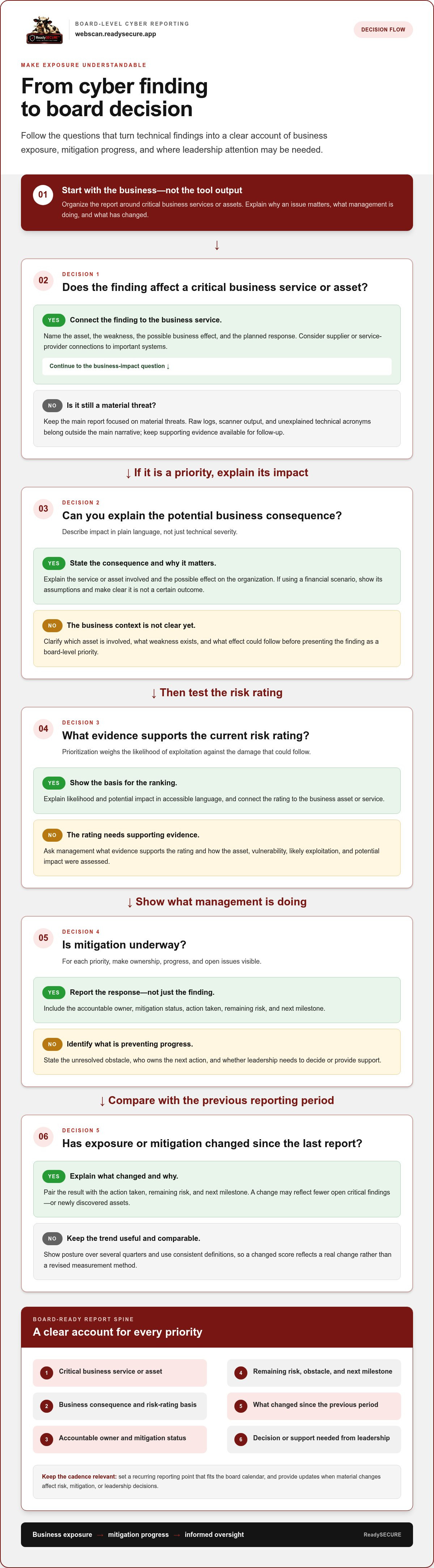
Organize the report around critical business services or assets, not tool outputs. For each priority, explain the business consequence, accountable owner, mitigation status, and any unresolved obstacle. A finding about an exposed system matters because of the service it supports and the response underway. Leave out raw log entries, scanner output, and unexplained technical acronyms; keep supporting evidence available for follow-up discussion.
Posture Changes and Reporting Outcomes
Posture-change reporting compares current exposure and mitigation results with the previous reporting period. This helps directors see whether risk management is reducing exposure or leaving important gaps unresolved.
Show a security posture trend over several quarters and explain the main changes behind it. For example, distinguish a reduction in open critical findings from a change caused by newly discovered assets. Pair each result with the action taken, the remaining risk, and the next milestone. Use consistent definitions across reports so a changed score reflects a real change, not a revised measurement method.
Use clear, accessible language when reporting progress to stakeholders and boards. A chart can show direction, but a short explanation should say why the measure changed and what management will do next.
Presentation Frequency
Presentation frequency sets the rhythm for giving directors a useful view of security posture. Reporting needs to keep pace with risk and fit the board’s oversight calendar.
How often should CISOs present security posture to the board? Set a recurring reporting point that fits the board calendar, then provide updates when material changes affect risk, mitigation, or leadership decisions. The right cadence depends on how quickly exposure changes and whether directors need to act. A regular schedule supports comparison, while event-driven updates ensure urgent developments don’t wait for the next scheduled report.
Use each presentation to report changes since the last review, outstanding actions, and decisions needed. If there has been no material change, say so plainly and show the measures supporting that assessment.
Incidents and Near Misses
Incident reporting explains what happened, its business impact, management’s response, and what remains unresolved. Near-miss reporting applies the same discipline to events that revealed a weakness without causing the same observed harm.
How should security incidents and near misses be presented to the board? State the known facts, affected services or assets, response actions, current operational impact, and lessons identified. Separate confirmed impact from ongoing investigation, and explain what changed in controls or priorities afterward. Don’t bury the central issue in a technical timeline. Keep detailed evidence for questions, while the main report supports oversight and decisions.
For a clearer view of internet-facing exposure that can inform reporting, review exposed assets and connect findings to business impact and mitigation ownership.
Rating, weighted-findings, and quantified-risk scoring approaches
Risk scores help directors compare findings, but a number matters only when its meaning is clear. Explain the inputs, business context, and limitations behind each rating so stakeholders can use it to guide monitoring and remediation.
Make Scores Explainable
A security rating summarizes selected evidence; a weighted-findings model ranks issues using factors such as severity, exposure, and business importance. Neither score should stand alone. State what the scale measures, which assets or networks it covers, and what a change means for the organization.
For example, a critical vulnerability on a system supporting an essential service may deserve priority over a similar finding on a less consequential asset. Explain the reasoning, not just the label. If the score combines multiple factors, show which carry the most weight and whether the underlying evidence is current.
The Exploit Prediction Scoring System estimates the probability that attackers will exploit a published CVE entry within the next 30 days. It can add exploit likelihood to prioritization, but it does not describe the impact on a particular organization. Pair that signal with asset importance, exposure, and mitigation status.
Track Vulnerabilities and Breach Risk
Vulnerability tracking connects each finding to an affected asset, remediation owner, status, and evidence of closure. This helps management distinguish newly identified issues from recurring or unresolved ones. A board report can summarize the highest-priority themes while retaining technical records for operational teams.
Present breach risk as a scenario, not as a claim that a score predicts an incident. Describe the weakness, how it could be exploited, which service or data could be affected, and what controls reduce exposure. When the evidence changes, explain whether the rating moved because of remediation, new vulnerabilities, or improved visibility.
Assess Third-Party and Supply-Chain Risk
Third-party risk scoring applies similar reasoning to suppliers and other connected parties. Identify which relationships support critical business services, what access those parties have, and which known concerns require management attention. A supplier rating can guide review, but it shouldn’t replace an assessment of the organization’s specific dependencies.
For example, a provider with access to sensitive systems may warrant closer monitoring than a supplier with no system connection. Report the business dependency, the evidence behind the rating, and the mitigation owner. This gives directors a clearer view of supply-chain exposure without treating every external score as equally relevant.
Use Scores to Direct Action
Make every rating actionable by linking it to a decision, owner, or follow-up measure. Management might prioritize an exposed vulnerability, review a supplier connection, or improve monitoring of a network segment. Explain why that action comes first and what evidence will demonstrate progress.
Consistent definitions make scores more useful over time. If a rating method changes, explain the change before comparing results; otherwise, directors may mistake a measurement shift for a change in risk. Keep the board view focused on meaningful movement, while technical teams retain the detailed findings needed to investigate each issue.
Security visibility and attack surface changes
Board visibility depends on knowing which assets connect to the organization’s systems and how exposure changes. An attack-surface view links those changes to business services, access controls, and assessment findings, giving directors context for decisions.
Build a Useful View of Exposure
An asset inventory gives security teams a working view of systems, services, and internet-facing entry points. Include each asset’s business purpose, accountable owner, and connections to important services. For example, a newly deployed customer portal may introduce a public-facing system that needs review. Without ownership and context, an asset list shows what exists but not which exposure matters most.
Compare assessment results with the inventory and explain visibility gaps. An unknown system, an unreviewed cloud service, or an unclear supplier connection can limit confidence in the reported posture. Distinguish confirmed exposure from areas where asset information is incomplete. Directors can then see whether management’s view covers critical systems or needs further discovery.
Explain Attack Surface Changes
Report changes in terms of what was added, removed, or made more accessible. A software deployment may create a new endpoint; a network change may expose a previously internal service. Explain the business purpose, affected assets, security controls, and assessment outcome. This makes a technical change understandable without requiring directors to interpret configuration details.
Repeat a security posture assessment after significant changes to an organization’s IT environment, such as software deployments or network changes, and after a security breach. Compare findings with prior results, then identify new exposures and mitigation actions. A before-and-after view helps the board distinguish a real change in risk from a change in reporting or inventory coverage.
Connect Access Controls to Risk Reduction
Access controls can reduce the attack surface by limiting which users and systems can reach sensitive assets. Report each control’s purpose, the systems it protects, and how management reviews its effectiveness. For example, restricting administrative access to approved accounts can reduce unnecessary entry points. Explain any remaining access paths and who is responsible for addressing them.
Show whether controls match actual system use. A dormant account or outdated connection may create exposure even when the main platform has protective settings. Pair access reviews with asset visibility so teams can identify accounts, services, and connections that no longer support business needs. The board report should describe the remaining risk and the operational reason for keeping each exception.
Turn Visibility into Board Decisions
A useful board view connects attack-surface changes to decisions, not just technical counts. Show which new exposure affects a critical service, whether existing controls reduce its impact, and what management plans to do next. If a platform change expands access, explain the operational benefit alongside the security implications. This gives directors context to assess trade-offs and resource priorities.
Use a consistent assessment scope when comparing periods. If coverage expands to include additional systems, explain the change before presenting a higher finding count. Otherwise, directors may mistake better visibility for worsening security. Clear reporting distinguishes new discoveries, changed exposure, and remediation outcomes, helping the board understand what the evidence actually shows.
Communicating security posture to executives and boards
Effective executive communication turns security evidence into choices about risk, readiness, and operational priorities. A useful report connects its evidence to decisions: what management should protect, where it should respond, and what support directors can provide.
Start with a clear statement of the organization’s current position, then explain the evidence behind it. Identify the reporting period, systems covered, and important changes in scope. For example, say whether a rising finding count reflects new vulnerabilities or broader assessment coverage. That distinction helps directors interpret results without mistaking improved visibility for a security decline.
Use measures that show whether security capabilities are improving. Vulnerability remediation times indicate how quickly teams address identified weaknesses. Incident detection speed shows how promptly the organization identifies suspicious activity. Compliance scores can show progress against selected requirements. Explain each measure’s definition, trend, and operational relevance. A metric without context can mislead, even when its underlying data is accurate.
Translate these measures into a decision path. If remediation is slowing on systems supporting critical operations, explain the cause, business consequence, and management’s proposed response. State whether the issue needs funding, a change in priority, or executive action. This connects cybersecurity reporting to risk management instead of treating a dashboard as the result.
Readiness also depends on how well teams can respond when an attack succeeds. Report whether incident procedures have been exercised, which operational dependencies could delay recovery, and what actions address those gaps. For example, if a recovery exercise revealed unclear ownership, identify the accountable role and corrective action. Describe observed capability, not an unsupported claim of complete preparedness.
Use evidence sources that directors can understand and management can explain. These may include vulnerability records, incident logs, remediation tracking, assessment results, and compliance measures. State when the evidence was gathered and what it covers. If two sources disagree, explain the difference rather than blending them into a single confident score. Transparent limitations make the resulting recommendation more useful.
A board-ready summary should separate three things: current exposure, progress since the last report, and the decision needed now. For each priority, name the business service affected, the control or action in place, and the remaining gap. This lets executives assess whether the response matches the risk and whether resources should shift.
Security leaders can use clear posture visibility to identify acceptable risk, direct remediation resources, and support board discussions with evidence. Make the closing recommendation specific: approve a priority, assign an owner, or accept a defined exposure. To ground that discussion in current external exposure, assess internet-facing security risks.
ReadySECURE: ReadySECURE Free Scan
ReadySECURE Free Scan helps owners assess the security of websites, APIs, and internet-facing hosts they control. After you submit a domain and written authorization, scheduled scanning identifies vulnerabilities and provides a prioritized report with severity and remediation guidance. This can help translate external exposure into clearer evidence for security reporting.
For ongoing monitoring, ReadySECURE Paid Plans add scheduled scans, a risk register, status tracking, and aging of findings. Reports, spreadsheet exports, and API or webhook delivery help teams track and communicate results over time. The free scan covers one target only and does not include scheduling or history. It has to be something you are authorized to have tested.
Visit webscan.readysecure.app to explore ReadySECURE Free Scan.
Make the Next Board Discussion More Decisive
A practical approach to how to present security posture to the board starts before the next meeting. Agree with directors on which developments need prompt attention, what decisions belong at board level, and how management will report follow-through. That shared understanding can focus later discussions and help prevent important risks from getting lost among routine updates.
Use the next reporting cycle to set clear expectations for accountability. Identify who will raise material changes, who owns the response, and how directors will know whether agreed actions are progressing. Ground the process in evidence management can explain, rather than adding measures simply to make the report look comprehensive.
If external security evidence would support that discussion, discuss board reporting with ReadySECURE. A clear reporting practice is built over time, and each thoughtful review can help leadership make more informed security decisions.
Frequently Asked Questions
What should a board-level security report contain?
A board-level report should give directors enough context to oversee decisions without requiring them to interpret technical records. Include the reporting period, scope, major changes, material risks, management’s response, and unresolved decisions. Add a concise note on evidence quality, such as whether key systems were included in the assessment. This helps directors see what the report covers and where its conclusions have limits.
What cybersecurity metrics should be reported to the board?
Choose measures that connect security work to business priorities, such as vulnerability remediation times, incident detection speed, and compliance scores. Explain how each metric is defined and what management is doing when results move in the wrong direction. For example, pair a remediation measure with the affected business service and accountable owner. Avoid displaying a metric without its scope, interpretation, or related action.
How should a board-level cybersecurity dashboard be structured?
Arrange a dashboard so directors can move from overall status to areas needing attention. Start with the reporting period and scope, then show risk areas, relevant trends, significant incidents, and decisions requiring oversight. Use consistent labels and units across reporting periods. For example, a dashboard can separate open issues from mitigated ones, while a short note explains a change in coverage or measurement.
How do you translate cybersecurity risk into business impact for directors?
Connect the technical condition to a business service, the disruption it could cause, and the people or operations affected. To understand how to present security posture to the board, frame an exposed system as a potential interruption to a customer-facing service, rather than relying on a vulnerability label alone. Explain the likely operational consequence, existing safeguards, and management’s proposed response in plain language.
What should a board cybersecurity presentation include?
A presentation should establish the decision or oversight issue early, then provide only the evidence needed to support it. Include a clear statement of current exposure, relevant changes, management actions, and any unresolved trade-off. Keep technical detail available for questions rather than putting raw findings on every slide. For example, explain why a control needs more attention and what business activity it protects.
Which cybersecurity frameworks help measure and communicate security posture?
ISO 27001 is a framework for information security management, according to the International Organization for Standardization. Frameworks can provide a structured way to discuss cybersecurity capabilities. These frameworks can help organize discussion around governance and security capabilities, but a board report should still explain how selected practices apply to the organization. Directors need the practical meaning of a framework, not only its name.
What cybersecurity risks and trends should boards prioritize in 2026?
Boards should prioritize risks according to the organization’s critical services, exposed assets, and potential business impact, rather than follow a generic trend list. Review changes in vulnerabilities, third-party connections, access, and incident readiness. A new supplier connection, for example, may deserve attention if it affects an important service. Management should explain why a risk matters now and what evidence supports its priority.
How can CISOs show security program progress, budget needs, and return on investment?
CISOs can show progress by linking program activities to observable outcomes, such as resolved findings, improved detection, or reduced operational exposure. For a budget request, identify the gap, the action the investment would support, and its expected operational benefit. Compare results with the organization’s previous baseline, and state assumptions clearly. This supports a practical investment discussion without presenting uncertain savings as guaranteed returns.


