

Cybersecurity findings matter to a deal when they are tied to the target’s systems and business exposure. A vulnerability assessment report for investors identifies known vulnerabilities, misconfigurations, insecure protocols or services, and outdated or unpatched software. It organizes findings by severity, affected assets, assessment scope, and remediation guidance, helping investors evaluate exposure and decide what needs attention.
A report can clarify the difference between a technical issue and a material deal risk. That distinction matters when assessing a target’s security posture, setting protections in transaction documents, or planning work after closing.
This article explains what a vulnerability assessment report covers, how to interpret its findings in a deal context, and how to turn them into a practical remediation roadmap. It also explains how reporting can support both leadership making investment decisions and technical teams responsible for addressing vulnerabilities.
Key Takeaways
- Separate what a scanner can identify from what the assessment’s scope leaves outside view, especially when comparing external exposure with internal systems.
- Translate technical findings into deal questions about business impact, ownership, and the protections or post-close work they may require.
- Prioritize remediation by exploitability, exposure, and business criticality rather than relying on severity scores alone.
- Use a report that gives executives a clear risk picture and gives technical teams enough detail to act and track progress.
- For an initial authorized scan of systems you control, ReadySECURE Free Scan can be a practical starting point.
What Is a Vulnerability Assessment Report?
A vulnerability assessment report records weaknesses found across defined systems and explains their potential business impact. For investors, it connects scanning evidence to assets, exposure, severity, and remediation priorities. Context matters: a finding on a public payment API may have different implications from the same weakness on an isolated test server.
How does a vulnerability assessment differ from a penetration test or security audit? An assessment reviews evidence and scan results to identify known weaknesses. A penetration test attempts controlled exploitation of selected attack paths. A security audit evaluates controls against defined requirements or criteria, rather than focusing only on exploitable technical findings.
Scope determines what the report can show. External attack-surface scanning examines internet-facing hosts, ports, websites, and APIs. Internal vulnerability scanning looks for issues inside an environment, such as outdated software or insecure services. Tools such as Nmap, OpenVAS, ZAP, TestSSL, and Nuclei support different scanning tasks, but their results still need asset and business context.
A useful report identifies the affected asset, finding, severity, evidence, and recommended action. It may include CVSS scores, methodology, scope, risk categories, and reproducible steps. Findings can also map to the OWASP Top 10, including cross-site scripting or misconfigurations. For APIs, examples include authentication bypass, insecure direct object references, and injection flaws.
Interpreting findings takes more than sorting them by severity. A critical rating on an exposed system deserves attention, but investors also need to understand exploitability, affected users, and business consequences. A report should explain possible effects on confidentiality, integrity, and availability. Automated scanning can produce false positives, so validation and technical context help distinguish actionable weaknesses from noise.
Penetration test reporting adds evidence from controlled attempts to exploit selected paths. Its executive summary can describe the scope and methodology defined in the project’s Statement of Work, while technical details document findings. Proof-of-concept demonstrations for critical and high-severity issues can help readers understand the attack. Discussion between technical and business stakeholders can then clarify impact and ownership.
Cybersecurity findings sit within wider financial conditions, but they are not a measure of market risk by themselves. The Federal Reserve kept its federal funds target rate at 5.25%-5.50% following its November 1, 2023 meeting. Investors should assess that capital-markets context separately from a target’s technical exposure, then consider how financing conditions affect deal assumptions.
International spillovers require a separate lens. The Financial Stability Board’s global financial stability surveillance framework uses three conceptual pillars: key principles, common terminology, and a common taxonomy of vulnerabilities. That framework concerns financial-system vulnerabilities, not a company’s scan results. Keeping the distinction clear helps investors avoid treating one target’s cybersecurity report as evidence about broader systemic risk.
Translating findings into deal risk and transaction protections
Deal teams translate technical findings into exposure, ownership, and actions tied to transaction milestones. A useful review connects each material issue to its business consequences and the protection or remediation decisions it may require.
Findings, Risk Ratings, and Deal Protections
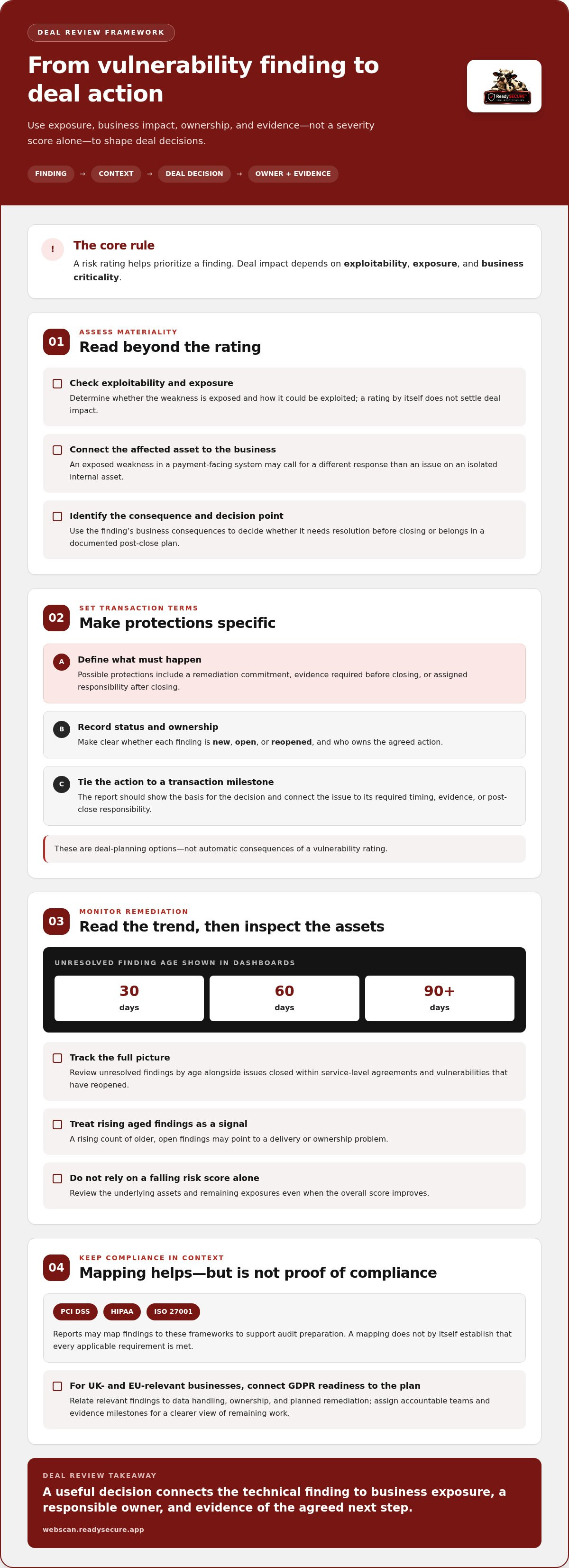
A risk rating helps prioritize findings, but deal impact depends on exploitability, exposure, and business criticality. An exposed weakness in a payment-facing system may require a different response from an issue on an isolated internal asset. Investors can use that distinction to identify which issues need resolution before closing and which can go into a documented post-close plan.
Transaction protections can reflect a finding’s status and owner. For example, parties might set a remediation commitment, define the evidence required before closing, or assign post-close responsibility. These are deal-planning options, not automatic consequences of a rating. The report should make the basis for each decision clear, including whether a finding is new, open, or reopened.
Dashboards add a trend view: they can show unresolved findings at 30, 60, or 90+ days, alongside issues closed within service-level agreements and reopened vulnerabilities. A rising count of older, open findings may signal a delivery or ownership problem. A falling risk score is useful context, but it should not replace review of the underlying assets and remaining exposures.
Compliance and Proactive Risk Management
Compliance mapping shows how findings relate to a named framework, while proactive management shows how the organization responds over time. Reports may map vulnerabilities to PCI DSS, HIPAA, or ISO 27001 to support audit preparation. Such mapping provides context for investor review; it does not by itself establish that an organization meets every applicable requirement.
For UK- and EU-relevant businesses, GDPR readiness can affect risk transfer and post-close workstreams. Investors can connect relevant findings to data handling, ownership, and planned remediation, then assign accountable teams and evidence milestones. This gives a clearer view of remaining work than treating a framework label as a complete assessment.
Cyber risk intelligence adds context about exposed assets and changing threats. A dashboard can pair an asset’s external exposure with its vulnerability status, then track whether remediation changes that exposure. Investors should look for operational measures such as mean time to remediate, SLA closure, reopened issues, and risk-score movement, rather than relying on a single snapshot.
Investor Due Diligence and Report Sharing Risks
What cybersecurity risks do investors evaluate during due diligence? They assess exposed systems, vulnerable software, misconfigurations, unresolved findings, and weaknesses affecting sensitive data or essential services. They also consider whether owners have assigned remediation and whether previous issues have recurred.
What are common limitations and risks of sharing a vulnerability assessment report with investors? A report can expose asset names, technical weaknesses, and attack details, while its scope may omit systems or controls. A scan can also contain false positives or become outdated as assets change. These limitations matter when teams use the document for deal decisions or share it beyond its intended audience.
Use an executive summary for decision-makers and restrict technical details to people responsible for evaluating or fixing the findings. Keep scope, assessment date, and unresolved issues visible, so a summary doesn’t imply broader coverage than the testing supports. For authorized review of systems you control, ZAP Active/Passive Scanning can help examine web application exposure.
Turning findings into a remediation roadmap
A remediation roadmap connects each vulnerability to an owner, a treatment, and evidence of closure. Assessment duration depends on scope, asset count, access, and system complexity. Organizations should conduct assessments at least quarterly, while high-risk industries may benefit from monthly checks.
Remediation Instructions and Verification
Remediation instructions turn a finding into a specific change a technical team can implement. A useful report identifies the affected component, gives relevant CVE references, and explains the corrective action for that environment. “Sanitize input” alone is too broad; instructions should identify the vulnerable input path and the appropriate control.
Verification should test whether a change addressed the original weakness without disrupting dependent services. Teams can patch staging, quality-assurance, and internal environments alongside production, then record deployment evidence. For a material issue, investors can request dated proof of the fix and an independent retest of the same attack path.
That evidence links the finding to a completed action. It also helps distinguish a closed vulnerability from one that remains exposed or has returned after a later change.
Remediation Costs, Valuation, and Timing
Remediation effort informs valuation by showing the work, dependencies, and business disruption required to reduce exposure. A software patch may be straightforward, while a weakness tied to legacy infrastructure could require redesign, testing, and coordination across teams. Relevant factors include the affected asset, technical complexity, operational impact, and available remediation capacity.
Investors can use those factors to frame diligence questions and transaction planning, without treating a severity rating as a cost estimate. A security due diligence assessment can also translate findings into a first 100-day remediation plan. That plan helps assign owners, sequence dependencies, and separate urgent exposure from work that can follow operational milestones.
Prioritize work according to exploitability and business criticality, not just the order findings appear in a report. An issue in a payment-facing API may take priority over a lower-impact weakness on an isolated system, even if both require engineering time.
Validation, Retesting, and Remediation Timelines
Validation checks whether a fix works in the affected environment; retesting checks whether the original attack path still succeeds. Organizations can record when a finding was opened and closed, then track mean time to remediate, SLA closure, reopened issues, and risk-score reductions.
A post-deployment verification within 14 days was recommended for the example involving an unpatched high-severity vulnerability in a payment-facing API. That example illustrates a verification milestone, not a universal timeline. The appropriate schedule depends on exposure, business impact, and deployment conditions.
Keep dated evidence with the retest result and the asset tested. If a finding reopens, record the cause and new owner rather than treating the previous closure as proof of lasting remediation. This makes progress visible to deal teams and technical leads.
Report structure and audience-specific reporting
A useful report gives decision-makers a clear account of security posture and gives technical teams a basis for action. Its structure should connect scope and methodology to findings, business relevance, and remediation status, rather than presenting scan output without context.
Start with an executive summary identifying the assessed systems, scope, and principal risk themes. State what the review covered and what it did not. For example, a report focused on internet-facing hosts should not imply that internal infrastructure received the same testing. This distinction helps investors judge how much of the target’s environment the evidence represents.
Next, document the frameworks and methods used. OWASP or NIST frameworks can describe assessment methodology, while asset-level findings show where weaknesses were observed. Include severity ratings, risk categories, and the evidence supporting each conclusion. A rating is more useful when readers can see the affected asset, its exposure, and the business context.
Organize technical findings consistently. Each entry can identify the vulnerability, affected component, reproducible evidence, and recommended remediation. Where relevant, include CVE references or map web application issues to the OWASP Top 10. For example, a cross-site scripting finding should identify the affected application area and describe the evidence, rather than appearing only as a label in a summary table.
Audience-specific reporting matters because leadership and engineering teams need different levels of detail. Share vulnerability assessment reports with leadership for decision-making and technical teams for remediation. The leadership view can emphasize exposure, business impact, open issues, and ownership. Technical readers need deeper evidence, reproduction details, affected assets, and actionable guidance.
Penetration testing reports need a similar distinction. An executive summary should use less technical language so business and management stakeholders can understand the assessment’s scope and main implications. Technical findings should preserve the methodology and evidence security teams need. Clear separation helps executives make decisions without stripping engineers of essential detail.
Use status fields to make progress readable across report versions. Distinguish new, open, and reopened vulnerabilities, and identify fixes that have been retested. A reopened issue can signal recurrence; a new finding may reflect expanded scope or a changed environment. Naming the status and affected asset prevents a dashboard from presenting unlike findings as one undifferentiated total.
Finally, state the report’s limitations alongside its conclusions. A scan can identify weaknesses within its defined scope, but it cannot represent systems that were not assessed. Investors can compare the stated scope with the target’s known assets and use any gap to frame further diligence. A precise report supports decisions without implying that one assessment proves an entire organization is secure.
Purpose and scope of a vulnerability assessment report
A vulnerability assessment report gives investors a bounded view of technical weaknesses, not a universal verdict on security. Its purpose is to show which assets were examined, what evidence the assessment produced, and how findings may affect operations. A vulnerability assessment report for investors is useful only when its scope matches the deal question, such as exposure in a customer-facing application or a business-critical network.
Scope defines the evidence. A pre-LOI review can examine a target’s public attack surface, available security evidence, prior reports, cloud posture indicators, and obvious data-risk signals. Once access is authorized, the review may include internal vulnerability scanning and evidence about application or cloud controls. Each boundary matters: a public-host scan cannot establish the condition of systems that were not examined.
Investors should compare the stated scope with the target’s operating model. If a company relies on an API to process customer transactions, an assessment limited to its marketing website leaves a material question unanswered. If a deal includes multiple subsidiaries, regions, or acquired platforms, the report should identify which environments were included. This comparison reveals where further diligence may be needed.
The report should make evidence useful without overstating what scanning proves. A detected weakness can indicate a possible route to attack, but automated results may need validation and business context. A clean result means no covered issue was found within the assessment’s defined scope and methods. It does not prove that a breach cannot occur or that every control works as intended.
Keep company-level exposure separate from financial-system vulnerabilities. The Financial Stability Board published a framework for identifying and assessing global financial-system vulnerabilities in September 2021. Its framework uses three conceptual pillars: key principles, common terminology, and a common taxonomy of vulnerabilities. That systemic lens helps describe cross-market risks, but it is not a substitute for examining a target’s operational technology and evidence.
For investors, the practical takeaway is to read the scope before the conclusions. Identify the assessed assets, testing methods, exclusions, and assessment period, then compare them with the systems central to revenue and service delivery. A report covering a subsidiary’s external hosts, for example, should not be treated as evidence about a parent company’s internal infrastructure. The boundary determines what the findings can support.
For an authorized review of websites, APIs, or internet-facing hosts you control, start an authorized vulnerability scan to gather scoped findings for assessment.
ReadySECURE: ReadySECURE Free Scan
ReadySECURE Free Scan gives investors and target teams a starting point for reviewing authorized, internet-facing systems they control. The service requires written authorization before scanning. Each target’s authorization record includes the approving person, the exact text they agreed to, and the date and time of approval. ReadySECURE then provides a prioritized report of discovered issues, their severity, and remediation guidance. The free scan covers one target and can help teams identify exposure for follow-up during due diligence.
For more focused review, TestSSL Inspection and ZAP Active/Passive Scanning address specific assessment needs; ReadySECURE Paid Plans provide another option for ongoing scanning. Scanning supports vulnerability assessment, but it does not replace penetration testing or remediation work. Visit ReadySECURE’s scanning platform to get started.
Make Security Evidence Part of the Investment Decision
A vulnerability assessment report for investors is most useful when it informs a decision, not just a diligence file. Bring security, deal, and operating stakeholders together to agree on which unresolved risks affect investment assumptions, who owns the response, and what evidence will support the next decision.
That discussion can continue after closing. Changes to infrastructure, integrations, and business operations can alter exposure, so include security review in ongoing ownership planning. Clear accountability helps teams connect technical work with business priorities without mistaking a scan result for a complete picture of risk.
If you’re assessing systems you’re authorized to review, ReadySECURE can help you consider a scanning option that fits the scope. Discuss investor security needs with ReadySECURE and take a considered next step.
Frequently Asked Questions
What evidence shows a material vulnerability has been fixed and retested?
A vulnerability assessment report for investors should be supported by dated evidence of the change and an independent retest of the same attack path. For example, pair a deployment record with results identifying the affected endpoint, test conditions, and outcome. If the original finding involved an API authentication weakness, evidence should show that the same path was tested again after remediation. Record remaining exposure separately, rather than treating one completed change as proof that related risks are resolved.
What is a vulnerability assessment report for investors?
It is a scoped record of technical weaknesses and their relevance to a potential investment. The report connects findings to affected assets, business operations, and remediation decisions. It is not, by itself, proof that a company is secure or that a breach has occurred. Investors should interpret its conclusions alongside the assessment’s scope, methods, and limits, and consider whether those boundaries cover systems central to the target’s business.
What information should an investor-focused vulnerability assessment report include?
Include the assessed assets, scope, methodology, assessment period, and exclusions. For each finding, show the affected asset, evidence, severity, business context, and recommended response. A status such as open, mitigated, or reopened helps distinguish current exposure from past work. Separate the executive view from technical detail: decision-makers need material risks and ownership, while technical teams need enough evidence to investigate findings and plan corrective work.
What standards and regulations apply to vulnerability assessment reports in the United States?
No single framework fits every U.S. organization or report. Relevant references depend on the company’s industry, data, and business requirements. Reports may map findings to frameworks such as NIST or OWASP, or support review against PCI DSS, HIPAA, or ISO 27001. Treat these mappings as context for diligence, not automatic proof of compliance. Investors should distinguish framework references in a report from a formal compliance determination.
How much does a vulnerability assessment for a company typically cost?
Cost depends on the assessment’s scope, asset types and count, testing methods, and reporting needs. Reviewing one public website differs from assessing APIs, cloud environments, and internal infrastructure. Effort also changes with access requirements and the evidence needed for a transaction. For a specific assessment, price depends on the case and is provided after a quote request. The scope and reporting needs shape the work involved.
What steps are involved in preparing an investor-focused vulnerability assessment?
First, define the investment question and identify relevant assets. Then set an authorized scope, gather existing security evidence, and conduct the agreed assessment. Analysts validate findings, connect them to business context, and document severity, evidence, and recommended actions. Finally, prepare a leadership summary and technical detail, noting exclusions and unresolved issues. This sequence helps readers understand what the report supports and where its conclusions stop.
How should vulnerability findings be ranked by severity and financial impact?
Rank findings using exploitability, exposure, and business criticality, rather than severity scores alone. A vulnerability assessment report for investors should make the reasoning behind each priority clear. For example, a moderately rated flaw on a revenue-critical customer system may warrant faster action than a higher-rated issue on an isolated asset. Consider potential effects on sensitive information, service availability, and operational continuity, then document how those factors shape the order.


