

Even an extensive API test can miss the risk that matters most. A cloud API security assessment should begin by identifying exposed APIs and the data and services they connect. Then test authentication, authorization, encryption, input validation, error handling, and rate limiting. Prioritize findings by how easily they could be exploited and the potential harm.
Security testing should uncover weaknesses, but a single scan cannot cover every risk or keep pace with changing cloud applications. An effective assessment connects tests to how APIs are actually used and carries security checks from design and development through testing, deployment, and monitoring.
This article explains how to assess API security, identify likely attack paths, and choose tests suited to your exposure. It also covers cloud misconfigurations and third-party connections, interpreting assessment results, and building repeatable checks into the software lifecycle.
Key Takeaways
- Map APIs, connected services, and sensitive data to understand where third-party and shared-environment risks could spread.
- Match vulnerability tests to exposure, from configuration and component checks to active and passive API scanning.
- Test input validation and authorization alongside encryption, error handling, and rate limits to uncover weaknesses that basic checks can miss.
- Rank attack paths by exploitability and potential impact, then focus remediation on the risks that could affect critical data or services.
- Build repeatable security checks into design, development, testing, deployment, and monitoring; use ReadySECURE Free Scan to assess an authorized asset.
What are the common cloud application security vulnerabilities?
Cloud application weaknesses often emerge where identities, configurations, APIs, and connected services meet. A focused assessment examines these relationships and prioritizes exposure according to the data and access involved.
Multi-Tenant and Supply-Chain Risks
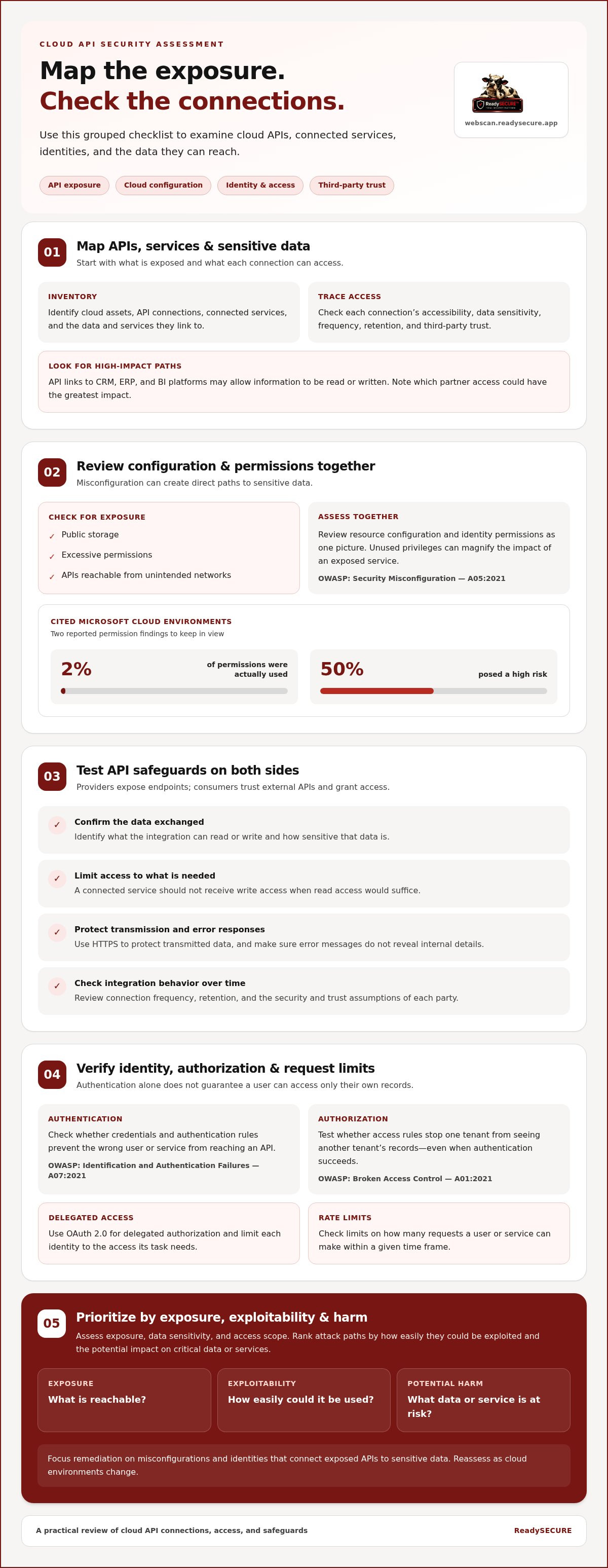
Multi-tenant risk arises when customers share cloud infrastructure, while supply-chain risk can come from third-party services, software, or integrations. A flaw in tenant isolation could expose another customer’s data; a compromised SaaS integration could misuse its granted access. API connections may let CRM, ERP, and BI platforms read or write information. Assess each connection’s accessibility, data sensitivity, frequency, retention, and third-party trust to identify which partner access could have the greatest impact.
Cloud Misconfiguration and Identity Risks
Cloud misconfiguration can occur when a service or resource is configured in a way that grants more access than intended. Public storage, excessive permissions, or an API reachable from an unintended network can create direct paths to sensitive data. In cited Microsoft cloud environments, only 2% of permissions were actually used, while 50% posed a high risk. Review configuration and permissions together: unused privileges can magnify the impact of an exposed service. OWASP identifies Security Misconfiguration as A05:2021.
API Provider and Consumer Risks
API provider risk comes from exposing endpoints with weak safeguards; consumer risk arises when an application trusts an external API or grants it excessive access. For example, a connected service may retain customer data longer than intended or request write access when read access would suffice. Assess both sides: identify the data exchanged, the integration frequency, and each party’s security and trust assumptions. Use HTTPS to protect transmitted data, and ensure error messages don’t reveal internal details.
Identity and Access Management Risks
Identity and access management risks arise when credentials, roles, or authorization rules let the wrong user or service reach an API. Broken access control can expose another tenant’s records even when authentication succeeds. OWASP classifies Broken Access Control as A01:2021 and Identification and Authentication Failures as A07:2021. Use OAuth 2.0 for delegated authorization, and limit each identity to the access its task needs. Rate limits can also restrict how many requests a user or service makes within a given time frame.
To evaluate risk, inventory cloud assets and API connections, then assess exposure, data sensitivity, and access scope. Check whether authentication and authorization restrict legitimate users and services, whether inputs are validated, and whether monitoring can surface unusual activity. OWASP’s API Security Top 10 and Cloud-Native Application Security Top 10 provide references for organizing these checks. Prioritize misconfigurations and identities that connect exposed APIs to sensitive data, then rapidly remediate weaknesses and reassess changing cloud environments.
Vulnerability assessments and penetration testing
Choose tests based on the weaknesses you need to find and the environment you can safely test. Combining code, dependency, API, and cloud configuration checks gives a clearer picture than relying on a single method.
Security Testing Methods
Security testing methods examine source code, running applications, dependencies, and attack behavior. SAST analyzes code without executing it; DAST tests a running service, while IAST observes application behavior during execution. SCA identifies vulnerable or outdated components. Fuzz testing supplies unexpected inputs to expose handling flaws, and penetration testing simulates attack paths. Each method finds different vulnerabilities, so combining them helps teams spot issues earlier and validate them in context.
Cloud Environment Testing
Cloud environment testing checks exposed services, API endpoints, and configuration alongside application behavior. Inventory accounts, services, identities, roles, policies, storage, databases, network egress, containers, and secrets managers. Then check whether access and exposure match each resource’s purpose. Cloud security assessment tools commonly use read-only API integrations, sometimes with lightweight agents, to connect to AWS organizations, Azure subscriptions, and Google Cloud projects or folders.
Which tools can test cloud APIs for vulnerabilities and misconfigurations? Postman, SoapUI, and OWASP ZAP can help test API security; cloud assessment tools can examine configuration and access across cloud resources. Choose tools according to scope: API behavior tests do not replace checks of cloud identities, policies, or network exposure.
Cloud Platform Assessment Differences
Assessments vary because platforms organize cloud accounts, services, and identities differently. AWS assessments may span an organization, Azure reviews may cover subscriptions, and Google Cloud checks may include projects or folders. In each environment, map APIs to their services and identities, then examine permissions, network exposure, and relevant configuration. Platform-aware scoping helps prevent gaps when workloads span cloud environments.
How do assessments differ across AWS, Azure, and Google Cloud? The core checks are similar, but resource relationships and scope differ across AWS organizations, Azure subscriptions, and Google Cloud projects or folders. Adapt inventories and access reviews to each platform’s structure.
Compliance Requirements for Assessments
Compliance requirements depend on the data handled, industry, contracts, and applicable rules. GDPR, HIPAA, and PCI DSS may be relevant to cloud application security assessments, but they do not apply in the same way to every organization. Map API data flows, access controls, and evidence to the requirements relevant to your operations. This makes compliance testing specific rather than a generic checklist.
What regulations apply in the United States? HIPAA and PCI DSS may be relevant depending on the data and industry, while GDPR may matter when services handle data connected to its jurisdictions. Assess scope against the information processed and the obligations that apply to your organization.
Before production, run SAST and SCA against code and dependencies, then use DAST or ZAP against a test deployment. Add fuzz testing for exposed inputs and validate important findings before release. Postman or SoapUI can help exercise API behavior. Keep penetration testing distinct: it examines realistic attack paths and complements, rather than replaces, routine testing.
For authorized internet-facing assets, automated vulnerability scanning can add a repeatable check to the assessment process.
How can I assess my API Security?
Assess each API’s inputs, responses, identities, and cloud configuration. A cloud API security assessment is more useful when tests reflect real request paths and the data each endpoint handles.
Input Validation and Injection Attacks
Input validation checks that API requests contain permitted values, formats, and lengths before processing. It matters because an endpoint that accepts untrusted input could expose databases or application functions to injection attacks. For example, test whether a search parameter containing unexpected database syntax is rejected rather than interpreted as a command.
Validate and sanitize input at the server, even when a client already checks it. Test query strings, JSON fields, headers, and uploaded files with missing values, unexpected types, and boundary conditions. Then verify output encoding: an API response containing user-supplied text should not become executable content when displayed by a consuming application. OWASP identifies injection as a relevant application-layer risk in its Top 10.
Check access rules alongside input handling. Even a valid request can exploit broken authorization if changing a record identifier returns another user’s data. Compare responses from authorized and unauthorized identities, and ensure errors do not reveal internal paths, query details, or secrets. These checks help reduce the attack surface and support compliance evidence for controls over sensitive information.
Automated Cloud Security Validation
Automated cloud security validation repeatedly checks APIs and cloud configurations against defined controls. It can improve visibility into exposed services, risky permissions, and configuration changes across accounts, services, identities, roles, storage, databases, and containers. Cloud security assessment tools commonly use read-only API integrations, sometimes alongside lightweight agents, to connect to AWS organizations, Azure subscriptions, and Google Cloud projects or folders.
Use automation for repeatable checks, not as a replacement for human review. Dashboards, risk heatmaps, policy drift alerts, compliance reports, and remediation steps ready for tickets can help route findings to owners. Validate high-impact results against the affected endpoint and its data access. Rerun checks after configuration changes to confirm whether exposure remains.
Input tests should cover ordinary and hostile requests. Fuzz testing can send unexpected values to parameters, while dynamic testing checks how a running API behaves. For each finding, record the endpoint, request conditions, observed response, and affected resource. This evidence helps distinguish a reproducible exploit from a harmless scanner alert and gives developers a precise target for fixes.
AI-assisted code deserves the same scrutiny as other source changes. According to Sonar, 61% of software engineers agreed that AI tools often produce code that appears functional but is unreliable. Review generated code for unsafe input handling, missing authorization checks, and exposed secrets, then run tests against the API behavior it creates. A passing build alone doesn’t establish that its security controls work.
Threat modeling and attack vector prioritization
Threat modeling connects API entry points to cloud identities, services, and data stores. Cover attacks that could expose sensitive data, disrupt availability, or move through connected workloads.
What security risks and attack vectors should a cloud API assessment cover? Examine broken access control, stolen credentials, exposed secrets, misconfigurations, vulnerable components, and server-side request forgery. Prioritize each path by exploitability and potential blast radius.
Threat-Informed Cloud Assessments
A threat-informed assessment tests cloud architecture against realistic attacker goals and the paths available to reach them. A low-severity weakness can become critical when it connects an exposed API to a privileged identity or sensitive data store. Use OWASP SAMM to guide threat modeling and secure design, then map identities, networks, and data stores to likely attack paths.
Start with a concrete scenario, such as an attacker using a compromised service identity to access another workload. Trace the identity’s permissions, reachable APIs, and data access. Cloud attackers use cloud-specific tools and APIs to carry out targeted, scalable attacks, so include control-plane access in the model. Record assumptions and update the model when architecture or access changes.
Cloud-Specific Threats and Attacks
Cloud-specific threats can exploit shared infrastructure, exposed management interfaces, excessive permissions, or rapidly changing configurations. A denial-of-service attack can overwhelm an API with requests and disrupt access for legitimate users. Rate limiting can restrict requests from a user or service within a time frame, while monitoring helps identify abnormal request patterns. Assess these controls for each exposed endpoint.
Also consider server-side request forgery, credential theft, and abuse of trusted integrations. OWASP identifies Server-Side Request Forgery as A10:2021, a useful reference when APIs fetch remote resources. Test whether an endpoint can be manipulated to reach unintended internal services. Emerging threats also warrant reviewing new API routes, permission changes, and unexpected outbound connections as cloud workloads evolve.
Prioritize findings by scoring exploitability alongside blast radius. An internet-accessible API with access to a sensitive database deserves attention before an isolated test endpoint with limited permissions. Map attack paths across identities, networks, and data stores, then rank routes that combine easy access with high impact. This helps teams focus remediation on exploitable chains, not just individual alerts.
Detection and response complete the assessment. Use API invocation monitoring and distributed tracing to follow a request through its service chain, then compare behavior with established patterns. An unusual request sequence or response time, for example, can trigger an investigation. Define who reviews alerts, how teams preserve relevant logs, and how to contain an exposed identity or endpoint. Reassess after configuration changes to keep controls aligned with the cloud environment.
Cloud application security assessment across the software lifecycle
Security checks work best when they follow cloud applications from design through monitoring. This connects API risks to the infrastructure, network, identities, and data each application uses.
How often should organizations assess cloud API security? Assess regularly, ideally within continuous integration and deployment, and whenever changes affect exposure or access. The right cadence depends on the pace of change, risk, compliance requirements, and how the business uses cloud infrastructure.
At the design stage, map critical data and business processes to proposed APIs. Document each API’s URL, arguments, authentication method, and connected services. Use threat modeling to examine trust boundaries, data flows, and likely attack paths before implementation. OWASP ASVS can help frame secure design and coding expectations.
During development, review code and dependencies as application features change. OWASP Top 10 provides a reference for application-layer risks such as broken access control, injection, and cryptographic failures. Security architecture guidance should be available to developers as they define API permissions, handle secrets, and configure integrations. This makes security decisions part of implementation, not a final release task.
In testing, combine code review with dynamic checks against a running application. Test API authentication, authorization, input handling, encryption, and response content. Include cloud configuration and network exposure in the analysis, since a secure endpoint can still be reachable through an overly broad rule. Map findings to relevant requirements such as CIS Benchmarks, NIST 800-53/CSF, ISO 27001, PCI DSS, HIPAA, or SOC 2.
At implementation, verify that deployment settings match the tested design. Compare allowed network paths, service identities, and access policies with their intended use. Automate evidence capture and route fixes to accountable owners through ticketing. After changes, rerun validation to confirm whether the specific issue is fixed and whether deployment introduced new exposure.
During monitoring, track API inventory and configuration changes as cloud assets evolve. An added endpoint, changed permission, or new third-party connection can alter the attack surface. Keep assessment scope tied to critical data and business processes, then adjust checks as applications and infrastructure change. OpenVAS Network Scanning can add a view of exposed network hosts; assess an authorized internet-facing asset as part of that review.
The practical takeaway is to make assessment a recurring lifecycle control, not a release gate used once. A cloud API security assessment should produce findings that teams can assign, resolve, and validate across development, deployment, and operations.
ReadySECURE: ReadySECURE Free Scan
ReadySECURE Free Scan provides a practical starting point for assessing one authorized website, API, or internet-facing host you control. Add your target and sign a written authorization statement that records the approving person, the exact text they agreed to, and the date and time of approval. The scan provides a prioritized report with issue severity and remediation guidance.
Use the results to identify exposure that needs further review, then select checks suited to your findings. ReadySECURE includes TestSSL for TLS/SSL inspection, ZAP Passive for non-intrusive analysis, and ZAP Active for authorized active testing of web applications and APIs. ReadySECURE Paid Plans add scheduling, history, and continuous scanning.
Scanning is intended for assets you own or are authorized to assess. To begin, visit ReadySECURE and start an authorized scan.
Make your next security check actionable
A cloud API security assessment is valuable when findings lead to clear decisions: what exposure to investigate, who owns the fix, and how to validate the change. Keep testing limited to assets you control and are authorized to have tested, and revisit the assessment as your applications and cloud environment evolve.
ReadySECURE Free Scan offers a starting point for checking an authorized website, API, or internet-facing host. ReadySECURE Paid Plans provide another scanning option, while TestSSL Inspection focuses on SSL configuration. Choose the check that fits the asset and the question you need answered.
For an authorized scan or help deciding on a suitable next step, contact ReadySECURE about API security. A focused assessment can help turn your next security decision into a practical action.
Frequently Asked Questions
How can Organizations help Safeguard against these Risks?
Organizations can reduce cloud API risk by assigning a clear owner to each endpoint and integration. Separate development and production credentials, remove unused service accounts, and restrict secrets to the workloads that need them. For example, a reporting integration should not retain write access if it only reads records. Review access after team or vendor changes, and monitor outbound connections for unexpected destinations.
How do I test API security?
Start with an authorized test environment and a documented list of endpoints, roles, and expected responses. Exercise the same route with different user roles and record whether each role sees only permitted data. For example, test whether changing an object identifier reveals another account’s record. Include valid and malformed requests, then compare results with the API’s intended behavior and access rules.
What are the different methods of API security testing?
Methods include static analysis, dynamic analysis, interactive analysis, software composition analysis, fuzz testing, and penetration testing. Static analysis examines source code; dynamic analysis tests a running API. Interactive analysis observes code during execution, while composition analysis checks third-party components. Fuzzing probes unexpected inputs. Penetration testing examines realistic attack paths. Choose methods according to development stage and risk, rather than expecting one test to find every weakness.
What is a cloud API security assessment?
A cloud API security assessment is a structured review of API exposure, access, and configuration in cloud-hosted applications. It considers how endpoints connect users, services, and data, including dependencies beyond the application itself. Define scope by listing the APIs, owners, environments, and data flows involved. This gives teams a useful boundary for testing and helps distinguish an overlooked endpoint from one intentionally restricted to internal use.
What standards and frameworks guide cloud API security assessments, such as OWASP API Security Top 10 and NIST?
The OWASP API Security Top 10 helps organize API-specific risks, while NIST 800-53/CSF can support broader cloud security control mapping. OWASP ASVS offers a reference for secure design and coding verification. These frameworks serve different purposes: use API guidance to structure endpoint testing, then map relevant controls to organizational requirements. Select the references that fit the application, data, and business processes being assessed.
What steps are involved in conducting a cloud API security assessment?
A practical assessment follows a defined sequence: set scope and authorization, inventory APIs and data flows, identify relevant threats, select tests, review findings, assign remediation, and validate changes. For example, add a new webhook to the inventory before testing its authentication and data handling. Record the environment and test conditions so teams can reproduce results and compare later assessments after application or infrastructure changes.
What should a cloud API security assessment report include, and how should findings be prioritized?
A useful report identifies the affected endpoint, evidence, conditions for reproducing the issue, potential impact, and a practical remediation direction. Prioritize findings by exploitability and potential blast radius, not severity labels alone. An exposed route to sensitive customer records should rank above a low-impact issue isolated to a test environment. Assign an owner and status to each finding so remediation and retesting remain traceable.


