

A scanner count isn’t a business case for vulnerability management. Clear ownership of business risk is. IBM’s 2026 Cost of a Data Breach Report puts the mean time to identify and contain a breach at 247 days, underscoring why security findings need to lead to timely, accountable action.
Stakeholders may see vulnerability scanning as a technical cost when reports list findings without showing which business services are affected or who should act. The case becomes clearer when you connect vulnerabilities to operational impact, set practical priorities, and track whether exposure is being reduced.
This guide shows how to build an evidence-led investment case that links security work to business priorities and measurable outcomes. You’ll learn how to map findings to services and owners, prioritize remediation based on risk rather than scanner counts alone, choose a proportionate approach, and report progress in terms decision-makers can use. An authorized scan can provide useful evidence, but sustained improvement depends on repeatable assessment and accountable remediation.
Key Takeaways
- Build a business case for vulnerability management around business services, risk ownership, and operational outcomes, not scanner counts alone.
- Map assets and findings to data sensitivity, exposure, and accountable teams to focus remediation capacity on the issues that matter most.
- Compare ad hoc checks, recurring scans, and broader assessments by their repeatability, visibility, reporting, and limitations.
- Make your proposal decision-ready with a defined scope, baseline, priorities, owners, capacity, and a plan to review outcomes.
- Use an authorized scan as a scoped evidence-gathering step. Prioritized findings and remediation guidance can inform a baseline, while accountable teams remain responsible for remediation.
Why Build a Business Case for Vulnerability Management?
A vulnerability report can identify technical weaknesses, but it doesn’t explain what they mean for the organization or what should happen next. A business case for vulnerability management connects investment and staff effort to organizational risk and expected operational outcomes. It gives decision-makers a basis for choosing a proportionate approach, assigning responsibility, and assessing whether the work is making a difference.
Vulnerability management is the ongoing process of identifying, assessing, prioritizing, and addressing vulnerabilities; a one-time scan is only a snapshot. A scan can reveal exposure within its scope. Prioritization determines which findings deserve attention first. Risk reduction depends on accountable teams taking action and checking whether that action has addressed the exposure.
This distinction matters because a longer findings list does not necessarily mean better protection. The vulnerability management process extends beyond identification to classification, prioritization, and remediation or mitigation. A business case should explain not just what a scan can reveal, but how findings will inform decisions and operational work.
Which business problems can vulnerability management address?
Start with the services the organization needs to deliver. An internet-facing system might support customer access, internal workflows, or a connection to sensitive data. Assess a vulnerability in context: what depends on the system, what information it handles, and which team can investigate or address the finding?
Unmanaged findings can also compete with planned delivery work. Without a clear owner or agreed priority, technical teams may defer fixes while security teams continue to report the same unresolved issues. A useful proposal connects each relevant finding to a service and an accountable team, then makes the work and trade-offs visible.
Who needs to understand the proposal?
Different stakeholders make different decisions, so translate the same evidence into terms each can use. Security and IT leaders define scan scope, interpret findings, and coordinate remediation. Executives weigh organizational risk and continuity priorities. Finance considers resource allocation, while service owners explain dependencies and operational constraints.
Keep the discussion specific. Instead of presenting an unexplained count of vulnerabilities, show which service is affected, what the finding could mean for its operation or data, and who is responsible for deciding what happens next. The proposal should make three things clear:
- Operational continuity: Which services or dependencies need attention?
- Accountable ownership: Which team will assess and address each priority?
- Resource allocation: What capacity is needed, and what work may need to be sequenced?
This framing helps stakeholders consider vulnerability management as coordinated risk work, rather than a recurring technical exercise without a clear business purpose.
How Does Vulnerability Management Create Business Value?
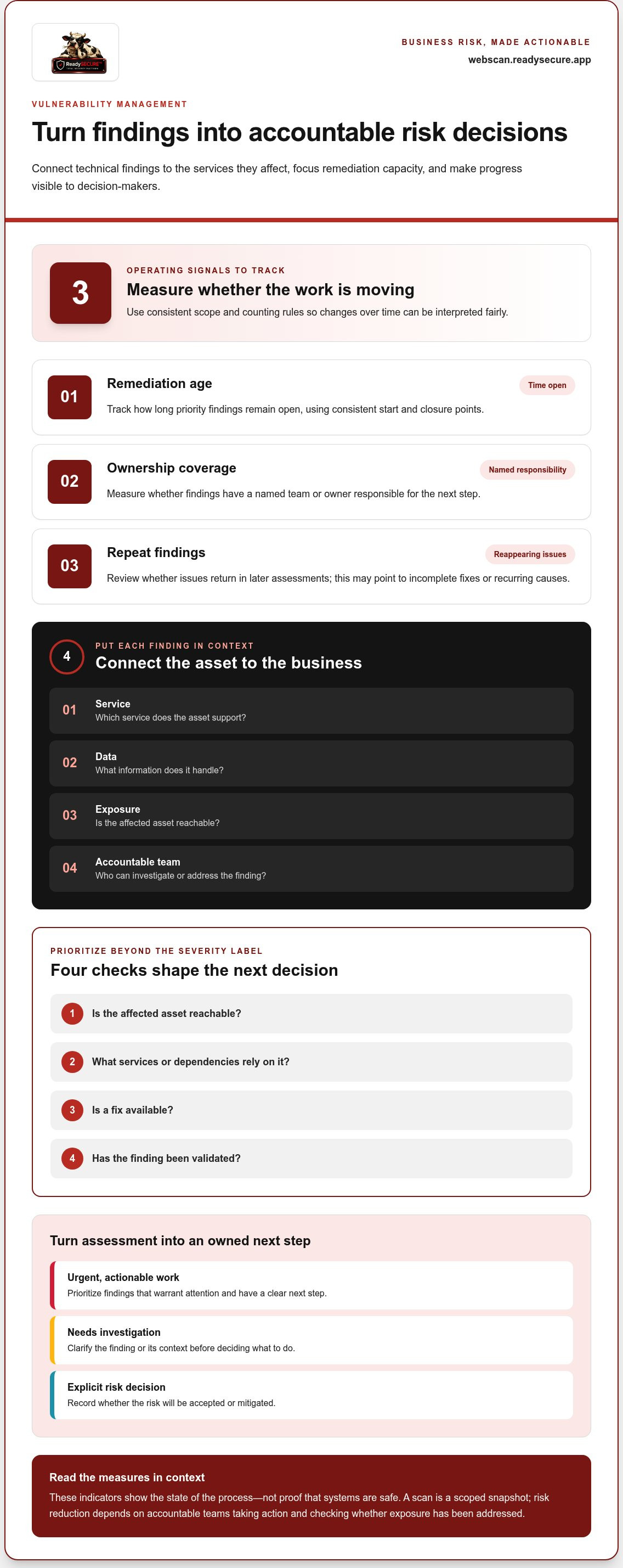
Business value comes from turning technical findings into decisions about services, resources, and responsibility. Connect each in-scope asset to the service it supports, the data it handles, its exposure, and the team accountable for it. A vulnerability on a public-facing system that supports a critical workflow may warrant different attention from a similar finding on an isolated test asset.
Vulnerability management supports informed risk decisions; it does not eliminate risk. Its value is in helping teams use limited remediation capacity deliberately, make unresolved exposure visible, and check whether agreed work is progressing.
Prioritization should consider more than a severity label. Ask whether the affected asset is reachable, what depends on it, whether a fix is available, and whether the finding has been validated. Then distinguish urgent, actionable work from findings that need investigation or an explicit decision to accept or mitigate the risk.
- Remediation age: Track how long priority findings remain open, using consistent start and closure points.
- Ownership coverage: Measure whether findings have a named team or owner responsible for the next step.
- Repeat findings: Review whether issues reappear in later assessments, which may point to incomplete fixes or recurring causes.
These indicators show the state of the process, not proof that systems are safe. Define the scope and counting rules behind each measure so changes over time can be interpreted fairly.
How can teams express risk without overstating it?
Separate what the assessment observed from what the organization infers. A scanner may report a technical condition and severity; business impact depends on the affected service, its dependencies, and the data involved. Likelihood also requires assumptions about exposure and other relevant context. State what is known, what is estimated, and what remains unknown.
Use a specific, plausible scenario rather than a generic breach prediction. For example, describe how an issue on a customer-facing application could affect access to that service, while making clear that the finding alone doesn’t establish an incident or its probability. Don’t present industry breach costs or incident rates as forecasts for your organization.
How should teams address the limits of scanning?
Automated scans can identify potential issues within defined targets, access, timing, and detection methods. They can’t establish that every relevant asset or weakness was covered, and they don’t assign business ownership or complete remediation. Review findings for relevance, route them to accountable teams, and record decisions and follow-up. The guide to automated vulnerability scanning compares scanning scope and approaches.
For an initial evidence baseline, an authorized scan of a target you control can provide a scoped view of discovered issues. Review scan findings as one input to prioritization, alongside service context and owner review, rather than as a complete risk assessment.
How Do Vulnerability Management Approaches Compare?
The right approach depends on the decision the organization needs to make. An ad hoc check can answer a specific question; recurring automated scans can make changes and unresolved findings easier to track; broader security assessment activity can examine risks beyond the scan’s defined targets and methods. None replaces deciding who reviews findings and how the organization will act on them.
Compare approaches against the operating needs behind your business case for vulnerability management:
| Approach | Repeatability | Visibility over time | Ownership | Reporting | Limitations |
|---|---|---|---|---|---|
| Ad hoc checks | Depends on whether scope and method are repeated | Limited to recorded snapshots | Often tied to the team requesting the check | May answer a narrow question | Can leave gaps between checks and make comparisons difficult |
| Recurring automated scans | Can repeat against defined targets and methods | Can show changes and repeat findings across scan history | Requires teams to review results and assign follow-up | Can support trend and remediation tracking | Coverage remains limited to configured scope and scan methods |
| Broader security assessment activity | Depends on the assessment scope and whether it is repeated | May offer a wider but still time-bound view | Requires coordination among relevant technical and service owners | Can address questions beyond automated scan results | Scope, method, and timing determine what it can establish |
Automated vulnerability scanning is not equivalent to penetration testing or complete security assurance. A scan reports potential issues it can detect within the authorized scope and selected methods. It doesn’t establish that every weakness has been found, show how every attack path could be used, or confirm that remediation is effective unless teams validate and follow up. Broader assessments have their own defined scope and limitations.
There’s no universal scan cadence for every organization. Consider how exposed the assets are, how often they change, the risk associated with the services they support, and whether teams have capacity to review and address new findings. More frequent scanning is useful only if results can be triaged and assigned. A continuous security scanning strategy can help frame how repeatable checks fit into a wider process, without implying uninterrupted coverage.
When is recurring scanning more useful than a one-time check?
Recurring scans make comparisons possible: teams can see which findings remain, which have cleared, and what new issues appear within the repeated scope. A one-time result provides a point-in-time baseline, but can’t show those changes on its own. Scheduled scans and historical reports support progress tracking, provided owners investigate and act on the results.
How should smaller organizations assess the right scope?
Begin with internet-facing assets the organization owns and the services that matter most to its operations. Then assess whether the team can review and remediate what that scope may uncover. A smaller, manageable scope is more useful than broad coverage that produces findings without owners or follow-through. The vulnerability scanning guide for startups discusses considerations for smaller teams.
For a scoped starting point, an authorized vulnerability scan can provide evidence about a target you control. Use its findings to inform decisions, not as proof of complete security.
How to Build a Decision-Ready Vulnerability Management Business Case
A decision-ready proposal gives stakeholders enough evidence to choose a scope, resource the work, and review results. Keep the case specific to the organization: distinguish observed facts from assumptions, proposed measures, and decisions that require approval. That discipline makes the business case for vulnerability management easier to assess and update as priorities change.
A decision-ready proposal documents the assets in scope, relevant findings, the current process, available capacity, reporting gaps, and the decisions stakeholders need to make.
- Define the scope. Identify the business services, assets, and teams included, along with the boundaries of any assessment. State exclusions and why they are outside the initial proposal. Scope should be clear enough that decision-makers understand what the investment will and won’t address.
- Establish a baseline. Record what the organization currently knows: in-scope assets, existing findings, how issues are tracked, and how teams assign and close remediation work. Note data gaps. An authorized scan can contribute a scoped snapshot for assets the organization controls, but it does not represent complete coverage.
- Prioritize findings. Explain how the team will consider technical severity alongside exposure, service importance, available evidence, and whether the issue is actionable. Separate validated findings from items that require investigation. Document assumptions rather than presenting them as established facts.
- Assign owners. Connect priority work to a responsible team and a defined next step, such as validation, remediation planning, or a documented risk decision. Include dependencies or capacity constraints that could affect progress.
- Review outcomes. Set a review period and use consistent measures to assess whether the process is working. Report changes, unresolved issues, and decisions needed, not just activity totals.
Which measures belong in the business case?
Choose measures that can be collected consistently and help stakeholders make decisions. Track the share of known in-scope assets assessed, the proportion of findings with assigned owners, and remediation status by priority. Where reliable historical data exists, review remediation time and recurring findings. Document the baseline and review period first, then agree on realistic targets. Don’t borrow benchmarks without showing that they fit your scope and counting method.
How can teams estimate investment value responsibly?
Compare the proposed effort with the current process. Estimate staff time spent gathering evidence, coordinating owners, reviewing findings, and preparing reports using your own records or clearly labeled estimates. Identify process friction and reporting requirements the proposal is intended to address. If reliable figures aren’t available, state that gap instead of implying precise savings.
Use organization-approved scenarios to explain why a service or asset matters. Label assumptions about impact and likelihood, and avoid turning generic incident costs into a forecast for your organization. Close by stating how results will guide prioritization, resource allocation, and future program decisions.
To build an initial evidence baseline, run an authorized scan of a target you control, then use its findings as one input to the proposal, not a substitute for accountable review and remediation.
How ReadySECURE Can Support the Evidence-Gathering Step
A business case for vulnerability management needs credible evidence about the environment it proposes to address. An authorized scan can provide a scoped snapshot of discovered issues on a website, API, or internet-facing host you control. Use that snapshot to inform an initial baseline, then connect findings to business services, accountable teams, and remediation decisions. A scan is one evidence-gathering step, not a complete vulnerability management program or a guarantee of security.
What evidence can an authorized scan contribute?
ReadySECURE reports prioritize discovered findings by severity and include remediation guidance. The scanning approach uses six industry-standard scanners, including Nmap, OpenVAS, ZAP, TestSSL, and Nuclei. Each result includes a signed authorization record. Together, these details help security and IT teams document what was assessed, review potential issues, and prepare findings for discussion with service owners.
Scope matters. Scanning requires written authorization and applies only to targets you control. Before starting, identify the specific target and confirm that authorization covers it. A report describes findings within the defined scope and methods; it doesn’t show that every asset or vulnerability across an organization has been assessed. Keep that boundary clear when using scan results in a proposal.
What should happen after the first scan?
Use the report as the start of a review, not the end of the work. For each relevant finding, identify the affected asset and business service, assign an accountable owner, and consider the finding alongside operational context and remediation capacity. Owners can validate relevance, plan remediation, and record status or decisions. This follow-through turns technical results into information stakeholders can use to assess priorities and resource needs.
The ReadySECURE Free Scan covers one scan of one authorized target. It can provide an initial snapshot for that target, but it won’t create an organization-wide baseline by itself. If recurring visibility is part of the approved approach, ReadySECURE Paid Plans add scheduling, history, and trend analysis. These capabilities help teams compare results over time and report changes, while owners remain responsible for reviewing findings and carrying out remediation.
Keep the proposal precise about what the evidence supports. Record the target and assessment scope, summarize prioritized findings, and note what needs validation or follow-up. Then explain how the organization will assign owners and review progress. This gives decision-makers a practical basis for considering next steps without overstating what a scan can establish.
Once you’ve defined the target, confirmed written authorization, and identified who will review and own remediation, start an authorized ReadySECURE Free Scan for one target.
Turn the Proposal Into the First Measurable Step
A business case for vulnerability management should lead to a decision the organization can revisit, not a document that goes stale after approval. Choose a first scope that’s practical to assess, name who will review the results, and agree when stakeholders will consider progress and adjust priorities. As systems, services, and team capacity change, those checkpoints help keep the investment aligned with operational needs.
The next step doesn’t need to solve every security gap at once. Start with evidence that can support a clear decision, then use what the team learns to refine scope, ownership, and reporting. A measured first step helps move from proposal to accountable action without promising more than the process can deliver.
For an authorized starting point, start a ReadySECURE Free Scan for a target you control. Build from there with clear ownership and a review plan. Evidence-led decisions can help your vulnerability management effort progress at a pace your organization can sustain.
Frequently Asked Questions
Is vulnerability scanning enough to manage business risk?
No. A scan can surface potential weaknesses, but it can’t decide whether a finding affects a critical workflow or whether a proposed fix could disrupt operations. For example, a team may need to coordinate a software update with a service owner and test it before release—often turning to automated packaging and patch deployment platforms like apptimized.com to roll out updates safely. Risk management also requires decisions about treatment, responsibility, and any remaining exposure after action is taken.
How do you calculate the return on investment for vulnerability management?
There isn’t a reliable universal formula. Compare the effort and resources required with changes the organization can observe, such as reduced time spent routing findings, clearer ownership, or improved remediation tracking. Use internal staff-time records and approved risk scenarios, and label estimates. The business case for vulnerability management should explain how these measures inform decisions, not claim that a program guarantees savings or prevents incidents.
Who should own a vulnerability management program?
A security or IT leader can coordinate the process, but ownership of fixes usually needs to sit with the teams responsible for the affected systems. A service owner can clarify operational constraints, while executives sponsor priorities and resource decisions. Make escalation clear: if a team can’t address a finding within the agreed plan, someone with authority should decide whether to adjust resources, timing, or the risk response.
How often should a business review vulnerability management results?
Set a review schedule that fits the organization’s exposure, system changes, and ability to respond. Also review results when a significant system change, new finding, or stalled remediation calls for a decision before the next scheduled meeting. Keep a record of the review date, attendees, unresolved items, and decisions. That record helps distinguish active oversight from a report that was generated but never discussed.
Can a small business build a vulnerability management business case without a security team?
Yes. A small business can begin with a defined set of important, authorized assets and assign a responsible person to coordinate review, even if that person has another role. Involve the people who manage the systems and understand service dependencies. Keep the initial proposal proportionate: identify what can be assessed, who will act on findings, and where outside technical expertise or additional capacity may be needed.
What evidence should a vulnerability management proposal include?
Include evidence that lets reviewers trace a claim back to its source. For example, attach or reference the asset inventory date, assessment scope, finding status, owner, and any validation notes. Show how the current process handles a finding from discovery to closure, and identify where records are missing or inconsistent. Separate confirmed information from estimates, then state what decision or resource approval the evidence is meant to support.
Does a vulnerability scan prove that a business is secure?
No. A scan reflects the targets, access, timing, and detection methods used; it can’t certify the entire business as secure. An unreported issue may sit outside scope or be missed by the method, and a clean result doesn’t establish that a fix will remain effective after systems change. Treat scan output as one source of evidence, alongside asset records, configuration review, and follow-up on changes. To create a scoped starting point, start a ReadySECURE Free Scan for a target you control.


