

What if the average cost of data breach for small business 2026 isn’t a useful forecast for your own company? A benchmark can show the scale of potential exposure, but it can’t predict your recovery bill.
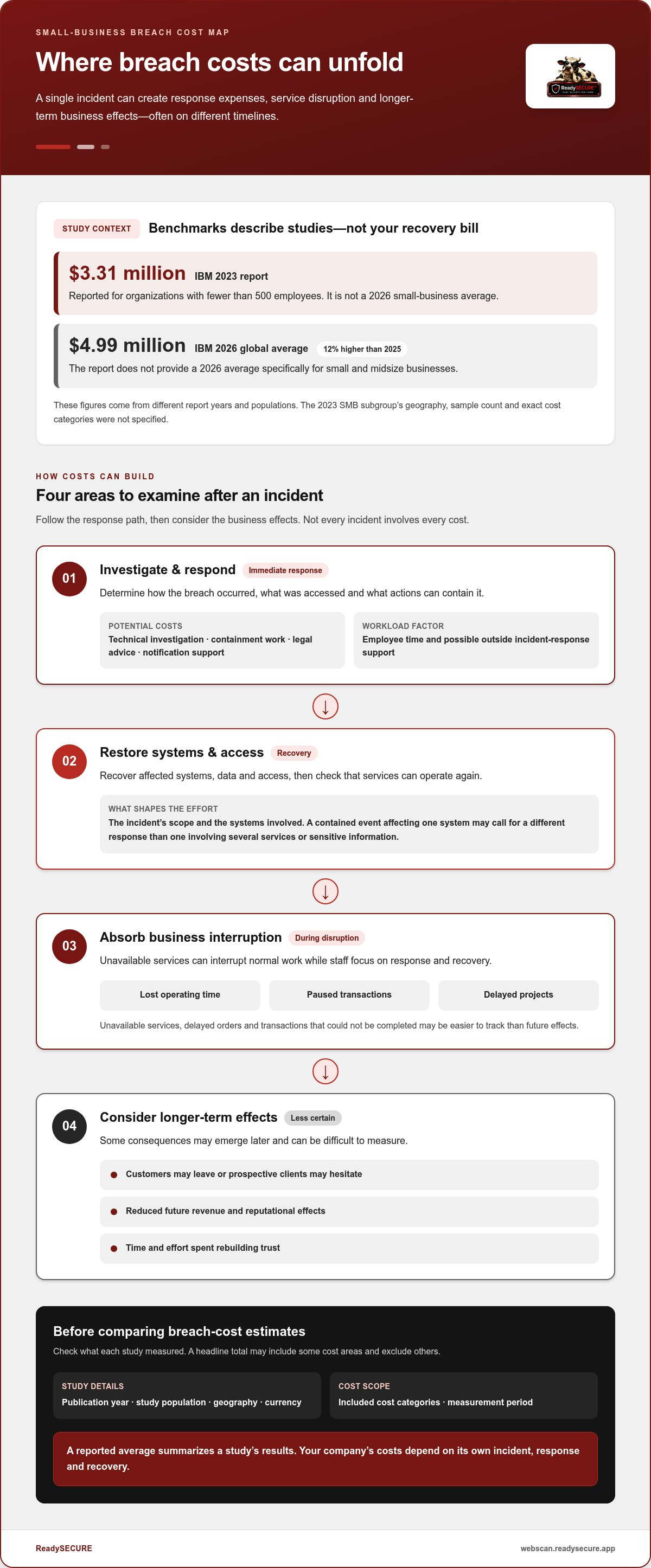
It’s reasonable to want one clear number for planning. The closest available small-business benchmark is $3.31 million, reported in IBM’s 2023 Cost of a Data Breach Report for organizations with fewer than 500 employees. Later reports didn’t break out costs by organization size, so that figure isn’t a 2026 small-business average. It reflects a particular study population and method, not every business’s likely losses.
This article explains what breach-cost estimates can include, from investigation and legal expenses to disruption, lost revenue, and customer trust. You’ll also learn why costs vary with the incident and recovery process, how to interpret headline figures without treating them as a prediction, and which practical security steps can help a small business improve visibility. Authorized vulnerability scanning can help prioritize fixes, but it can’t guarantee protection against a breach.
Key Takeaways
- Interpret the average cost of data breach for small business 2026 as a study benchmark, not a prediction of your company’s bill.
- Separate response and restoration expenses from interruption and longer-term business impacts to see where losses may arise.
- Compare breach-cost estimates by study year, population, geography, and included costs before drawing conclusions.
- Use a practical readiness sequence: identify critical assets, reduce exposure, assign response roles, and review preparedness.
- An authorized vulnerability scan can reveal some externally visible issues and help prioritize follow-up, but it can’t identify every breach pathway or guarantee prevention.
What does the average cost of a data breach for a small business mean in 2026?
An average summarizes the costs observed or estimated across a study population. It isn’t a forecast of what an individual business will pay after a breach. IBM’s reported 2026 figures show a global average of $4.99 million, up 12% from 2025. They don’t provide a 2026 average specifically for small and midsize businesses (SMBs).
The most recent SMB-size figure is $3.31 million in IBM’s 2023 Cost of a Data Breach Report, for organizations with fewer than 500 employees. That’s a 2023 report figure, not a 2026 estimate. The report does not specify the geographic makeup or sample count for that subgroup, or detail the exact cost categories used to calculate its result. Those limits matter when comparing it with other estimates.
A reported average describes a study’s results; your company’s breach costs depend on its own incident, response, and recovery.
Why global breach averages do not predict a small business’s loss
Organization size affects the scale and type of a breach response. A company holding more records may face a larger notification and support effort, while a smaller firm may have fewer systems but rely on a small number of critical services. Data type, applicable regulatory obligations, and available recovery resources also shape the response. A small business with limited internal capacity may need outside help, while a larger organization may have dedicated teams and established procedures.
Study results also depend on which organizations and incidents are included. A study drawing from multiple countries and industries blends different operating costs, business conditions, and incident types. Its average can shift with the sample and the way researchers define or estimate costs. A global trend offers context about the broader direction of breach costs, but it can’t establish what a particular SMB is likely to lose.
What a breach-cost estimate usually measures
Cost estimates can combine several kinds of expense. Direct response costs may include investigation, legal support, notifications, and restoring affected systems. Business interruption can capture lost sales or work delayed while systems are unavailable. Longer-term effects may include customers leaving, reduced revenue, or effort spent rebuilding trust. A study may count some of these categories and exclude others.
The measurement period matters too. Some estimates include costs incurred after the immediate response, while others focus on a narrower window. Before comparing figures, check the publication year, study population, geography, currency, and included costs. Don’t combine numbers simply because both are described as breach costs.
For a basic explanation of the event itself, see What is a data breach? The key point when interpreting any estimate is scope: understand what was measured before using the figure to guide a business decision.
Which direct and indirect costs shape a small-business data breach?
A breach can create expenses in stages, from investigating what happened to dealing with lost work or customers who don’t return. For the average cost of data breach for small business 2026, the useful question isn’t only “What’s the total?” It’s also “Which costs are counted, and which could affect this business?” IBM’s IBM Cost of a Data Breach Report outlines cost categories, but an individual incident won’t necessarily involve every one.
A practical cost map separates four areas:
- Investigation and response: determining how the breach occurred, what was accessed, and what actions can contain it. Employee time and outside incident-response support can add to the workload.
- Restoration: recovering systems, data, and access, then checking that affected services can operate again.
- Interruption: lost operating time, paused transactions, delayed projects, and staff diverted from normal work.
- Longer-term business impact: possible customer attrition, reduced future revenue, and reputational effects that can be difficult to measure.
One security incident can produce several kinds of costs at once, because response work, service disruption, and business effects unfold on different timelines.
Immediate response, investigation, and recovery expenses
The first costs depend on the incident’s scope and the systems involved. A business may need technical investigation, containment work, legal advice, and notification support. It may also need to restore affected devices, applications, or data. These aren’t standard bills for every incident: a contained event affecting one system may call for a different response than one involving several services or sensitive information.
Staff time matters too. Owners and employees may need to gather records, coordinate decisions, communicate with customers, or support recovery while routine work waits. Some businesses may bring in outside incident-response specialists; others may rely on internal capacity or different forms of support. The appropriate response depends on the situation.
Business interruption and longer-term financial effects
Interruption can be easier to estimate when a business can track unavailable services, delayed orders, or transactions that couldn’t be completed. Future effects are less certain. Some customers may leave, prospective clients may hesitate, or staff may spend time rebuilding trust. These impacts can influence revenue after systems are restored, but they’re not always straightforward to separate from normal business changes.
Other consequences also depend on circumstances. Regulatory or contractual obligations may lead to additional response work, but they don’t apply in the same way to every business or incident. Penalties, litigation, and changes to insurance terms are likewise possible, not automatic costs. Avoid adding them to a planning estimate as though every breach triggers them.
For a more useful internal estimate, list each category, identify what evidence would help measure it, and mark uncertain downstream effects separately from known response expenses. An authorized scan can also reveal some externally visible issues for follow-up. ReadySECURE scans require written authorization for a target you control, and the prioritized report details findings, their severity, and remediation guidance. Start a ReadySECURE scan for an authorized target.
How should you compare 2026 data-breach cost estimates?
Start by separating figures that describe different populations. IBM’s reported 2026 global average and older small-business benchmarks answer different questions. The 2026 figures don’t establish an SMB-specific average, so using a global number as one would give a misleading impression of precision.
| Source and publication year | Population | Geography | Included costs stated in the available information |
|---|---|---|---|
| IBM Cost of a Data Breach Report, 2026 | Organizations in the global study; no SMB-specific result | Global | The report gives a global average of $4.99 million and a 12% year-over-year increase. It doesn’t specify the cost categories or methodology. |
| IBM Cost of a Data Breach Report, 2023 | Organizations with fewer than 500 employees; reported average of $3.31 million | Not specified | The report doesn’t detail the sample count or cost definition. |
| PurpleSec estimate, 2025 | Small businesses; range of $120,000 to $1.24 million | Not specified | The estimate doesn’t state the sample, method, or included cost categories. Treat it as dated context, not a 2026 average. |
The table highlights an important limitation: a figure without clear population, geography, and cost scope is difficult to compare. Don’t fill those gaps with assumptions. These figures do not establish an average cost of data breach for small business 2026.
Which study details make an average meaningful?
Check what the study counted: confirmed data breaches, a broader set of security incidents, or company-reported losses. Then look for sample size, organization size, industry mix, geography, and the period in which incidents were measured. Finally, check whether the figure includes interruption and longer-term losses, insurance, legal expenses, or only response costs. If details are missing, note that rather than implying the estimate is directly comparable.
How to use a benchmark without mistaking it for a forecast
A benchmark can help identify cost categories worth considering, but it can’t promise a financial outcome for your company. Relate it to your own data sensitivity, dependence on key systems, and capacity to restore operations. Before comparing years, check the currency, any inflation adjustments, and whether definitions changed. A headline figure is useful context; your planning assumptions should reflect your own operations and recovery needs.
For example, a business that relies on one online ordering system might focus its planning on downtime and restoration, while a service business managing appointments and client profiles through platforms like Milano Software would prioritize booking availability and customer record privacy. That comparison is more actionable than choosing a budget based on an average drawn from a different population. Keep each number’s original scope beside it in planning notes, and label unknown details instead of treating them as settled facts.
How can a small business make breach costs more manageable?
You don’t need to match a large-company security budget to make useful progress. Start with the systems and information that matter most to your operations, then assign practical actions to the people responsible for them. The goal isn’t to promise that a breach won’t happen. It’s to make informed choices, reduce avoidable exposure, and prepare for decisions that may need to be made quickly.
Use this four-step sequence to focus effort:
- Identify critical assets. List sensitive information, essential systems, and key dependencies. Note what would interrupt sales, service, or daily operations if it became unavailable.
- Reduce exposure. Review who can access important accounts and systems. Remove permissions that are no longer needed, and prioritize known security issues according to their potential business impact.
- Prepare response roles. Document who makes initial decisions, who communicates internally, and who coordinates technical recovery. Keep the plan accessible if ordinary systems are unavailable.
- Review readiness. Check that assigned actions are progressing, backups can be restored, and responsibilities still make sense as systems, staff, and business priorities change.
Prioritize the data and services that matter most
Begin with an inventory, not a long list of security purchases. Identify the records that would create the greatest difficulty if exposed or unavailable, and the services your business depends on to serve customers. Include dependencies such as hosting or business applications where disruption could affect your own operations. Assign an owner to each improvement, set a review point, and revisit priorities when your systems or data use changes.
Keep the focus proportionate. A low-impact issue on a nonessential service may not deserve attention before a known weakness affecting a business-critical system. An authorized vulnerability scan can add visibility into some issues exposed on websites, APIs, and internet-facing hosts you control. It won’t cover every risk, but prioritized findings can help inform follow-up decisions. For additional risk-management context, see this guide to vulnerability scanning for startups.
Prepare for response before an incident
A short, usable response plan is better than a detailed document nobody can find. Record who has authority to make initial decisions, how staff should share updates, and who coordinates system recovery. Note where recovery procedures are stored and how to reach people if normal communication tools are affected. Keep backups separate from ordinary production access, and test restoration so you know whether the process works in practice.
These steps support clearer decisions and may help limit confusion during recovery, but they can’t guarantee a particular recovery time or cost. ReadySECURE scans require written authorization for a target you control, and the report prioritizes findings with severity and remediation guidance. Scan an authorized external target with ReadySECURE.
How can an authorized vulnerability scan support breach-cost readiness?
A breach-cost estimate can’t show which weaknesses exist in your own online systems. An authorized vulnerability scan adds a narrower, practical view: it checks selected websites, APIs, or internet-facing hosts for issues that may be visible from outside. That information can help you decide what to investigate and prioritize, but it isn’t a complete security assessment or a promise that a breach won’t happen.
What an external vulnerability scan can and cannot tell you
A scan can surface some externally visible issues on systems you control. Use the findings as a basis for triage: consider each issue’s severity, whether the affected asset supports an important business function, and what follow-up is appropriate. A prioritized report can turn a broad concern into a list of items to review and address.
There are limits. A scan doesn’t show every possible breach pathway, establish that an attacker has or hasn’t accessed information, or assess every internal process and system. It also doesn’t repair findings. Treat results as one source of visibility alongside your other security and recovery practices, not as proof that the business is protected.
A low-friction next step for checking an authorized target
ReadySECURE requires written authorization before scanning a target you control. Its free scan covers one target and provides a prioritized report with severity and remediation guidance. Use the report to inform follow-up decisions, then track any findings you choose to address through your normal risk-management process. The scan itself doesn’t carry out remediation.
Before starting, define the target and confirm you have authority to approve the scan. Keeping scope clear helps ensure the results relate to the system you intend to review. The ReadySECURE free website security scan guide explains the scan option in more detail.
For a small business weighing the average cost of data breach for small business 2026, an authorized scan is a focused way to improve visibility, not a way to calculate or eliminate potential losses. Pair its findings with decisions about critical assets, response roles, and recovery readiness.
If you’ve defined the scope and have written authorization, start a ReadySECURE free scan for one target and use the prioritized findings to guide your next steps.
Turn cost uncertainty into a practical next step
The average cost of data breach for small business 2026 is a benchmark to consider, not a reason to make security decisions by headline alone. A more useful next step is to connect your priorities to the systems your business depends on, then build a manageable process for reviewing and addressing risks over time. You don’t need to solve every security concern at once. Start with a clear view of one authorized target and decide what follow-up makes sense.
ReadySECURE requires written authorization for each target before scanning. Its report prioritizes findings and includes severity and remediation guidance, with a signed authorization record attached to each result. The scan can help you assess some externally visible issues, but it can’t identify every breach pathway or guarantee protection.
If you’re ready to review a target you control, start your authorized ReadySECURE Free Scan. Use the prioritized findings to guide your next steps.
Frequently Asked Questions
What is the average cost of a data breach for a small business in 2026?
There isn’t a verified 2026 figure specifically for small businesses in the figures cited here. IBM’s reported 2026 average covers a global study population, so it shouldn’t be treated as an SMB result. The average cost of data breach for small business 2026 depends on incident scope and which expenses a study counts. PurpleSec’s $120,000 to $1.24 million range is a 2025 estimate, not a 2026 result.
Why can one data-breach cost estimate differ so much from another?
Estimates can differ because studies use different samples, organization sizes, geographies, and study periods. They may also define an incident differently or count different cost categories. For example, one study may focus on confirmed breaches, while another may include broader security incidents or company-reported losses. Before comparing headline figures, check the methodology and scope. If those details don’t align, treat the estimates as separate reference points.
Does the average data-breach cost include lost revenue?
It depends on the study. Some estimates include lost revenue or other business-interruption effects, while others focus more narrowly on expenses tied to investigation and response. A business can compare records of cancelled orders or paused services against its usual sales, but future customer decisions are harder to measure. Check the study’s cost categories and measurement period before using an estimate to guide financial planning.
Can a small business recover from a data breach?
Recovery is possible, but its course depends on the incident’s scope, operational resilience, available response resources, and recovery planning. A business that knows which service to restore first, who can make decisions, and where key records are kept may be better prepared to coordinate work. Start by documenting those responsibilities and the first actions for affected systems. No plan can guarantee a particular outcome or recovery cost.
Does cyber insurance cover every cost of a data breach?
No. Coverage depends on the policy’s wording, exclusions, limits, and the circumstances of the incident. A policy may address some costs while leaving others outside its terms, so don’t assume every loss or expense will be covered. Insurance is also different from prevention and response readiness: it doesn’t itself reduce exposure or restore systems. Review your policy documents and understand the stated conditions before relying on coverage in a plan.
What happens if a small business cannot afford a full security team?
A small business can sequence practical work rather than trying to build a full security function at once. Identify essential accounts and systems, review who can access them, and make sure recovery steps are understood. Controlling access also includes physical premises where sensitive hardware and records reside; solutions like mygatepass.com help facilities manage and verify visitor entry. Then use available risk information to decide what deserves attention first. An external scan may add visibility into some exposed weaknesses, but it doesn’t replace access management, backups, response preparation, or broader security work.
Can a vulnerability scan prevent a data breach?
No scan can guarantee that a breach won’t happen. An authorized external scan may identify some weaknesses visible on a website, API, or internet-facing host, giving the business information to review and address. For example, a finding may point to an exposed issue that merits investigation, but a scan won’t reveal every way an attacker could gain access. Results need appropriate review and follow-up, alongside other security measures.


