

What if a vulnerability scan is thorough but still doesn’t support your audit? A scan can show what was tested and what issues were found, but it doesn’t certify compliance or prove that every related control is effective. The key is whether your vulnerability scanning for compliance requirements matches the applicable framework, covers the right assets, and leads to documented follow-up.
It’s reasonable to expect a scan report to serve as evidence. But without a clear scope, a repeatable process, and remediation records, the report may leave important questions unanswered. Translate framework language into practical decisions about authorized targets, scan timing, and the evidence your organization needs to retain.
This guide explains how scanning can support compliance, where its limits are, and what a defensible workflow looks like. You’ll learn how to align scans with specific control expectations, document findings and remediation, and prepare evidence for internal reviews and auditor discussions, without confusing a vulnerability scan with certification.
Key Takeaways
- Translate each applicable control into a defined asset scope, scan evidence, follow-up action, and evidence owner.
- Use vulnerability scanning for compliance requirements as supporting evidence, not as proof of certification or complete control effectiveness.
- Distinguish scan observations from confirmed exploitability, full asset coverage, and completed remediation.
- Set scan frequency according to applicable framework requirements and documented risk decisions, rather than a universal schedule.
- ReadySECURE provides authorized scan results with a signed authorization record, prioritized findings, severity information, and remediation guidance for targets you control.
What vulnerability scanning means for compliance requirements
Vulnerability scanning is a technical method for identifying potential security weaknesses within an authorized scope. Depending on the scan, it may examine internet-facing hosts, network services, or web applications for known issues and configuration concerns. Its results describe what the scanning process observed at a particular time, on the assets and with the settings included in that scan.
That makes scan output useful, but not conclusive. Compliance may involve multiple controls, evidence types, system boundaries, and assessment steps. A scan can contribute evidence about technical weaknesses, but it cannot establish by itself that an organization meets a framework, contract, or law. Scan findings are evidence inputs, not a compliance conclusion.
Compliance scan versus vulnerability scan: what is the difference?
A vulnerability scan asks, “What potential weaknesses can be identified in these systems?” A compliance assessment asks whether defined requirements are met and whether the evidence supports that conclusion. Depending on the assessment, evidence may include scan results alongside policies, asset records, remediation history, and other control documentation.
The activities can overlap. A scan may test a technical condition relevant to a control, while a compliance tool may check whether required evidence or settings are present. But they answer different questions: a finding indicates a potential issue to investigate, while a compliance determination requires interpreting the applicable requirement and the broader evidence. For more context on how identification connects with prioritization and remediation, see Vulnerability Management Explained.
Why there is no universal scanning rule
Expectations depend on the source of the obligation and the environment being assessed. A law may set broad security duties; a contract may specify testing conditions for a supplier; a framework may define controls and assessment methods; and an internal policy may set additional safeguards. These sources are related, but they aren’t interchangeable. Identify which requirement applies before deciding what to scan and how often.
Scope matters just as much as cadence. A system boundary might include public websites and APIs while excluding unrelated assets. The right boundary depends on the applicable requirement, the environment being assessed, and the assets that support the relevant service. A scan of one host cannot substantiate claims about systems it didn’t cover.
Some guidance applies only in a particular context, such as a procurement or contract. Don’t treat a context-specific requirement as a universal scanning rule. For vulnerability scanning for compliance requirements, start with the authoritative requirement, identify the system boundary and assessment method, then document why the selected scope and schedule address them. If requirements overlap, record how each maps to the assets and evidence instead of assuming one scan automatically satisfies them all.
What a vulnerability scan can, and cannot, demonstrate
An external vulnerability scan provides a view of selected systems from outside the organization. Depending on its scope and configuration, it can identify exposed services, detect characteristics of web applications, and flag potential weaknesses associated with software versions or security settings. These observations can help teams investigate risk and support a compliance review. They describe what the scan detected, not everything that may be present.
Results also depend on what the scanner can access. An unauthenticated scan examines targets without logging in, which can help show what an external party might encounter. An authenticated scan uses authorized credentials to inspect areas that aren’t visible from the outside, such as certain system settings. Neither approach automatically provides complete coverage: the tested targets, permissions, scan configuration, and system changes all affect what the results represent.
A clean scan is not proof of zero risk; it means the scan didn’t identify reportable issues within its scope at that point in time. A finding, in turn, is an indicator to investigate, not necessarily proof that an attacker can exploit the issue. A scanner may flag a potential weakness that needs validation, while a missed asset or inaccessible component may leave a gap in the results. Severity helps prioritize review, but it doesn’t establish business impact or control effectiveness on its own.
What scan evidence is useful to a compliance review?
A useful evidence package lets a reviewer understand what was tested and how the organization responded. Retain the target identification, scope, scan date, findings, severity information, and remediation guidance. Include an authorization record showing that testing was permitted and bounded to approved assets. Then map the scan to the relevant control only after checking the framework’s current language and assessment method.
- Scope and target: Identify the approved systems and any exclusions.
- Timing and method: Record when the scan ran and whether access was authenticated.
- Results and response: Preserve findings, severity, guidance, and related remediation records.
- Authorization: Keep documentation establishing permission and testing boundaries.
When a vulnerability scan is not enough
A scan report cannot replace policy review, control testing, or a required audit. Those activities may assess responsibilities, operating procedures, and evidence beyond technical weaknesses. Automated scanning and manual penetration testing also use different methods and produce different outputs: a scan checks for potential issues across its configured scope, while a penetration test involves human-led assessment. Neither should be presented as interchangeable evidence or as an automatic compliance determination.
For vulnerability scanning for compliance requirements, use the report as one input in a documented review, then connect findings to the applicable control and follow-up records. An authorized scan of a website, API, or internet-facing host you control can provide a clear snapshot. Authorized website vulnerability scanning can help generate evidence for that process.
Mapping Compliance to Scan Scope and Evidence
A defensible scan plan starts with a specific obligation, not a tool setting. Identify the authoritative requirement, the control owner responsible for interpreting it, and the system boundary it applies to. Then decide which assets fall inside that boundary and what evidence would help demonstrate the relevant control. This makes vulnerability scanning for compliance requirements a traceable process, rather than a report collected without context.
Use a compact mapping record to connect each requirement to its evidence and follow-up:
- Requirement: Record the framework citation, contract clause, or internal policy reference, including its version or date.
- In-scope asset: Name the relevant website, API, or internet-facing host and explain why it falls within the boundary.
- Scan evidence: Identify the result or report that addresses the technical aspect of the requirement.
- Follow-up: Link findings to remediation records, retesting, or a documented rationale for another response.
- Evidence owner: Assign responsibility for maintaining the artifact and reviewing its accuracy.
Frameworks such as SOC 2, PCI DSS, HIPAA, and GDPR can provide useful reference points, but they don’t create one shared scanning checklist. Their requirements, assessment methods, and applicability differ. Verify the current authoritative language for the framework and your organization’s circumstances. Have the responsible compliance owner review the citation and interpretation before treating a scan as evidence for a particular control.
Which assets should the compliance scan cover?
Build the asset list from the documented boundary, then record each asset’s owner, business purpose, and exposure. Include relevant websites, APIs, and internet-facing hosts that the organization controls and is authorized to test. Document exclusions and the reason for each, such as being outside the assessed service boundary, so a reviewer can understand what the results do and don’t cover. A material system change, such as adding a public-facing API, should trigger a scope review.
For web applications, the web application security assessment guide offers a useful way to match assessment scope to an application and its components. Apply the same discipline to compliance evidence: show how the asset relates to the system boundary, not just that its address appeared in a scan.
How do framework requirements translate into scan evidence?
Read each applicable control for the action and evidence it actually calls for. A scan report may support a technical weakness assessment, while a policy, access review, or remediation record may be needed to demonstrate other parts of the control process. Keep those artifacts distinct, then cross-reference them in the mapping record. Mark the framework citation, interpretation, asset coverage, and evidence owner for review. This gives internal reviewers a clear path from requirement to scan result without implying that the scan alone satisfies the control.
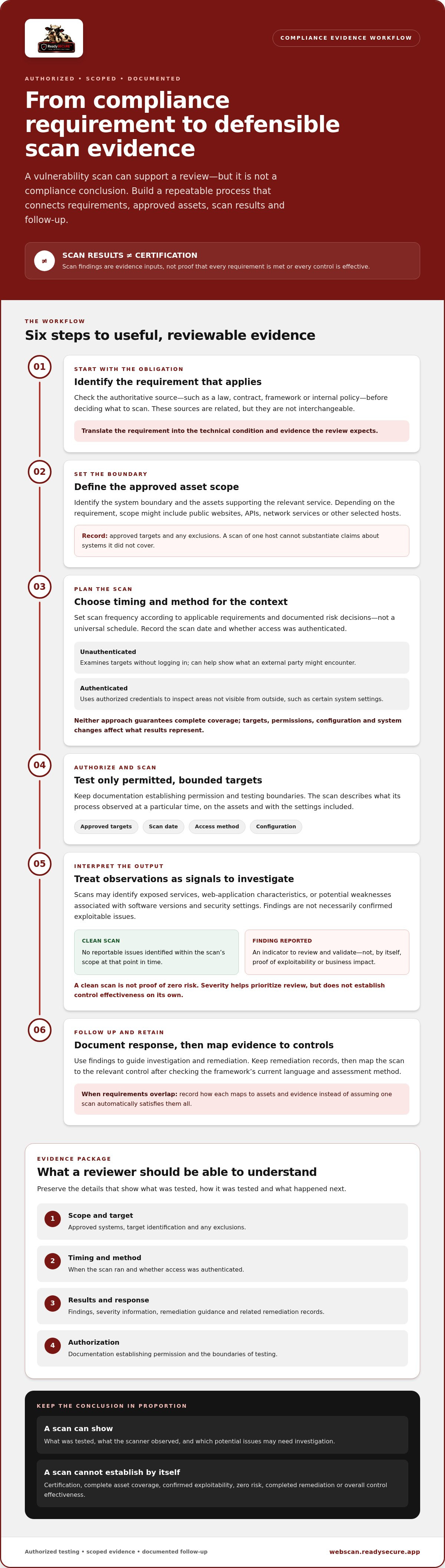
A repeatable workflow for authorized compliance vulnerability scans
A reliable process connects the requirement to the scan, then connects each finding to a documented decision. Keep the sequence consistent so the evidence can be reviewed later and repeated when the scope or applicable requirement changes. A continuous security scanning strategy also depends on clear ownership and evidence handling, not simply running scans more often.
- Identify the requirement. Record the applicable control, contract clause, or internal policy, along with its version and the control owner’s interpretation. Confirm any required scope, method, or timing from the authoritative source.
- Define and authorize the scope. List the websites, APIs, and internet-facing hosts to be tested. Confirm that the organization controls each target and has written authorization for the scan. Record exclusions and the reason for each.
- Run the scan. Preserve the date, targets, scan configuration, and resulting report. Use a consistent process where practical so results can be compared over time.
- Review and assign findings. Have an appropriate owner assess each finding’s severity and context. Record its disposition, priority, and the person responsible for follow-up.
- Remediate and retain evidence. Document the action taken, completion date, and validation evidence, such as a follow-up scan where appropriate. Keep the records together with the original scope and authorization.
There’s no universal scan frequency. Follow the applicable framework or contractual requirement, then document risk-based decisions about how to maintain coverage between required assessments. Revisit the schedule when the environment, system boundary, or relevant obligations change. A repeatable program makes that rationale visible instead of relying on an unexplained calendar interval.
How should teams document scope and authorization?
For each scan, record the target, responsible owner, written authorization, approved scope, exclusions, and scan date. Authorization should apply to the specific assets being tested; don’t include systems the organization doesn’t control or lacks permission to assess. Retain the authorization alongside the results so a reviewer can see both what was tested and the boundaries of that activity.
How should findings become remediation evidence?
Scanner severity is a useful starting point, not a final risk decision. Review the finding against the asset’s purpose and exposure, then record the owner, disposition, action, and dates. For organizations relying on managed IT support services to maintain systems and apply security patches, coordinate closely to ensure every technical fix is properly logged. If a finding is disputed or accepted, document the rationale and any required approval. After remediation, use a follow-up scan or other appropriate validation evidence to show the outcome; a closed ticket alone may not demonstrate that the issue was resolved.
For example, an authorized scan of a website, API, or internet-facing host you control can provide results to retain alongside the related authorization and follow-up records.
Use ReadySECURE scan evidence as one part of compliance readiness
A scan report is most useful when it fits into a wider evidence process. ReadySECURE scans websites, APIs, and internet-facing hosts that you control and are authorized to test. Written authorization is required before a target is scanned, helping establish the permitted scope of the activity.
Each result includes a signed authorization record and a prioritized report with findings, severity information, and remediation guidance. These details can help your team understand what the scan observed, identify issues for review, and connect technical findings to documented follow-up. They don’t establish that every asset or control has been assessed.
One free scan covers one target. ReadySECURE paid plans add scheduling, scan history, and trend analysis, which can support ongoing evidence collection and help teams compare results over time. For an overview of the scan, see the ReadySECURE free website security scan guide.
What does a ReadySECURE report contribute?
Treat the report as technical evidence to review against your organization’s applicable controls, not as a certification, audit opinion, or guarantee of compliance. Check the targets and scan date against your documented scope, then confirm that the report is relevant to the specific requirement you’re assessing.
Severity information and remediation guidance provide a starting point for investigation and prioritization. Your team still needs to assess findings in context, decide on next steps, and retain related records. That distinction is central to vulnerability scanning for compliance requirements: a report can support an evidence package, but the organization must interpret and act on it.
What should happen after the scan?
Compare the results with the approved scope and the evidence requested by the applicable framework or contract. Then bring each finding into your normal follow-up process. Preserve the report and authorization record together, and link relevant findings to the responsible owner and any remediation documentation.
- Review: Check that the scanned targets match the intended scope and note any gaps.
- Assign: Give findings to an owner for investigation and a documented disposition.
- Follow up: Record remediation decisions and retain subsequent validation evidence where relevant.
Only scan targets you control and have written authorization to test. Once that boundary is clear, ReadySECURE Free Scan provides a scan of one target to use as one input to your compliance evidence workflow.
Make your next scan part of a stronger evidence process
Choose one authorized target and define what you need the scan to help assess. Before running it, identify the applicable control and decide how the result will fit into your records. This keeps vulnerability scanning for compliance requirements tied to a clear purpose, rather than treating a report as an end in itself.
ReadySECURE provides a signed authorization record with each result, along with prioritized findings, severity information, and remediation guidance. Use these as inputs to your review, then document your organization’s decisions and follow-up. Paid plans add scheduling, history, and trend analysis to support ongoing evidence collection. No scan replaces your responsibility to assess the relevant controls.
Start with a website, API, or internet-facing host you control, and make sure written authorization is in place. Run an authorized ReadySECURE Free Scan to begin building evidence around a defined target.
Frequently Asked Questions
Does a vulnerability scan satisfy compliance requirements?
No. A scan may support evidence for a relevant technical control, but it doesn’t establish that an organization meets all applicable obligations. The answer depends on the framework, contract, system boundary, and assessment method. For example, a report about a public website won’t address an internal policy requirement by itself. Map each artifact to authoritative language with your compliance owner, including policies, control testing, remediation records, or independent review where required.
How often should vulnerability scans be performed for compliance?
There’s no universal cadence that applies to every organization or framework. For vulnerability scanning for compliance requirements, check the current authoritative control language and any relevant contract, then consider risk, system changes, and your documented security policy. A newly exposed API, for instance, may prompt a scope or schedule review. Record why your chosen frequency fits the environment, who approved it, and what events would trigger another review.
What evidence should we keep after a compliance vulnerability scan?
Keep enough detail for someone outside the scanning team to understand the test and its outcome. Retain the approved scope, target ownership, written authorization, scan date, report, findings, severity, remediation decisions, assigned owners, and follow-up evidence. For example, link a finding to its disposition and validation record rather than storing an isolated report. The exact evidence set depends on the control and assessment process, so map retained records to those expectations.
Can an external vulnerability scan prove that our systems are secure?
No. An external scan can identify potential weaknesses visible within its authorized scope, but it can’t prove that systems are free of vulnerabilities. Coverage, configuration, timing, and scan method all shape the result. A clean report is a point-in-time observation, not a guarantee; it may not reflect assets or conditions the scan didn’t reach. Consider scan results alongside other security controls, operational records, and relevant evidence about the systems assessed.
Is vulnerability scanning the same as penetration testing?
No. Automated vulnerability scanning checks a defined scope for potential weaknesses, while penetration testing uses a different assessment approach to evaluate security through controlled testing. Their goals and outputs aren’t interchangeable. A scan can help identify issues for investigation, but it doesn’t provide the same kind of assessment as a penetration test. Check the applicable requirement to determine what evidence or activity is expected; don’t assume one automatically substitutes for the other.
Does SOC 2 require vulnerability scanning?
Vulnerability scanning can support evidence for relevant security practices, but don’t assume one scan rule applies to every SOC 2 engagement. The useful scope and evidence depend on the organization’s controls, system boundary, and assessment approach. For example, a scan of a public service may support review of that service, but not unrelated systems or control activities. Consult current AICPA materials and your compliance owner for an interpretation suited to your assessment.
Can we scan a website or API without written authorization?
Only scan assets you control or have explicit permission to test. Written authorization and a defined scope help establish which targets are approved and prevent testing from extending to unrelated systems. ReadySECURE requires authorization for submitted targets, and each result includes a signed authorization record. If an outside party operates the website or API, don’t scan it unless you have permission covering that target and the planned testing.
Does a vulnerability scan replace a compliance audit?
No. A scan reports technical findings for a defined scope; an audit evaluates requirements and evidence through a broader assessment process. Scan results may contribute to the evidence set, but they don’t replace an audit, control review, or certification decision. Keep the report with related records and map it to the specific assessment requirement. This helps reviewers understand how the scan informs the evaluation without treating it as the evaluation itself.


